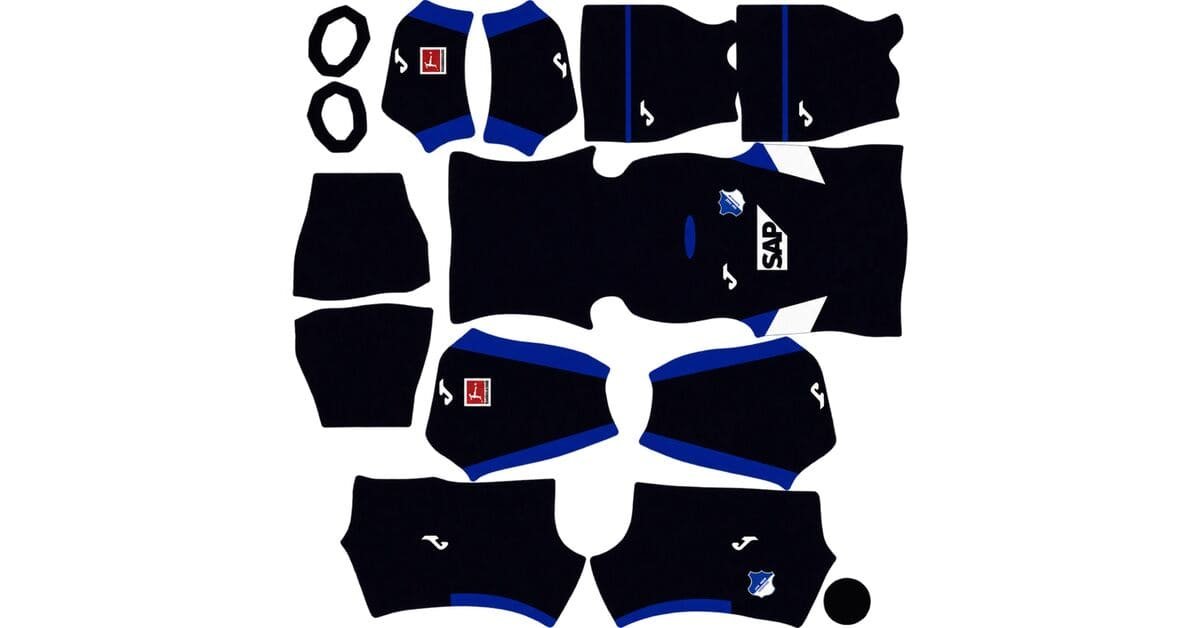
A Hoffenheim DLS kits URL is a direct link to a 512×512 PNG TSG shirt that you paste into Dream League Soccer. All four slots are covered below, and each file was loaded into the game before being added to this page.
TSG Hoffenheim Logo
Official Logo 512×512 (2026/27)

TSG Hoffenheim Home Kit
Home Kit 512×512 (2026/27)
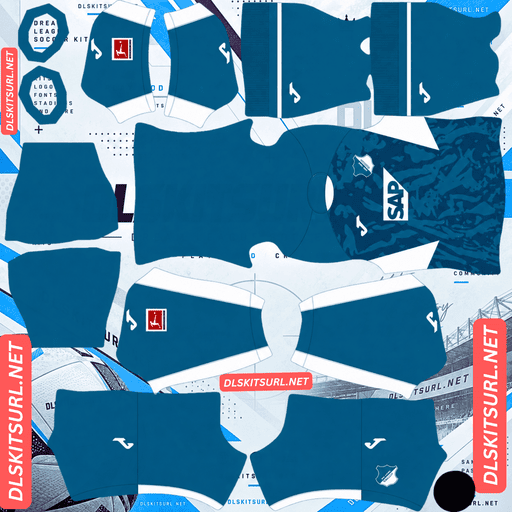
TSG Hoffenheim Away Kit
Away Kit 512×512 (2026/27)
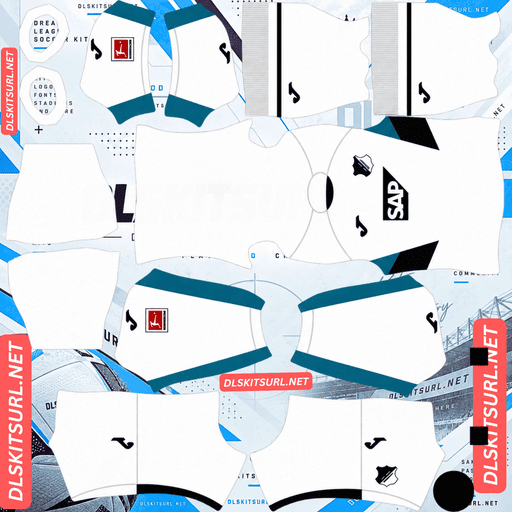
TSG Hoffenheim Third Kit
Third Kit 512×512 (2026/27)
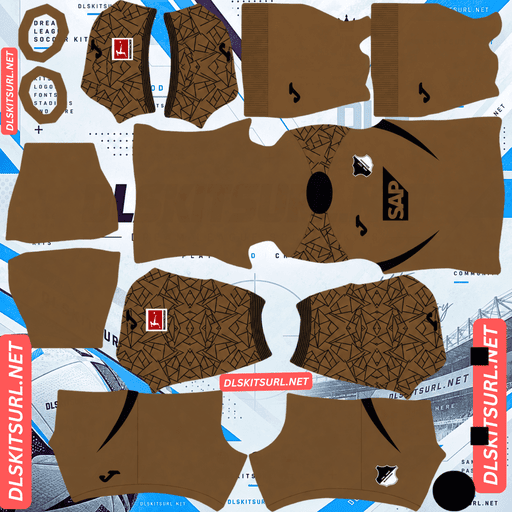
TSG Hoffenheim GK Home Kit
GK Home Kit 512×512 (2026/27)
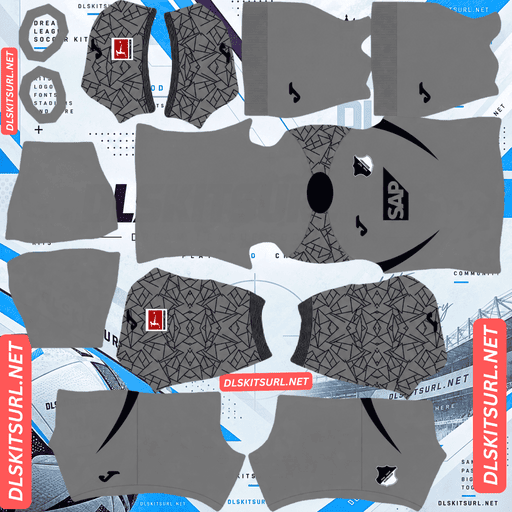
TSG Hoffenheim GK Away Kit
GK Away Kit 512×512 (2026/27)

TSG Hoffenheim GK Third Kit
GK Third Kit 512×512 (2026/27)
Macron has taken over from Joma for this season, and Hoffenheim’s third kit shows an important DLS distinction: a design can disappear without making the whole kit a bad choice.
The lilac third loses its design and still wins
Hoffenheim’s 26-27 third kit is built around two distinct shades of lilac, with white details and SAP as the shirt sponsor.
Two shades of one colour always merge
Tonal design means using different values of the same colour family. At 512×512, there is very little contrast for compression to preserve.
Expect the two lilac shades to merge into one.
That does not necessarily make the kit poor in DLS. What matters is the colour that remains after the detail disappears.
But the base colour saves the whole kit
Dream League Soccer displays players relatively small, so kit visibility depends heavily on how far the shirt colour sits from the pitch.
Purple and lilac are about as far from pitch green as you can get.
So Hoffenheim loses the tonal design but keeps an extremely visible base colour.
That is the opposite of what happens with Aldosivi’s third kit, which also uses two shades of one colour. The mechanism is identical: the two shades merge. The difference is what remains afterward. Aldosivi are left with green, which blends into the pitch and produces one of the weakest combinations for visibility. Hoffenheim are left with lilac, which separates cleanly from the grass.
That is worth remembering whenever you judge a tonal kit. Do not only ask what the file loses. Ask what is left behind.
Fiorentina, Austin FC, Orlando City, Dortmund, Marseille and Elche all benefit from the same general purple advantage, as does Alianza Lima with its Morada shirt.
Use white numbers on the lilac third.
The home’s stag antlers are embossed
Released on 3 July 2026, the Hoffenheim home shirt features a stag antler embossed pattern, drawing on the stag used in Hoffenheim’s heraldry. The shirt itself uses the club’s blue and white colours.
Why the pattern is impossible twice over
Embossing is a relief effect. It is visible because light catches the raised surface and creates shadows around the ridges.
A flat 512×512 image has no physical surface and therefore cannot reproduce that effect.
The antler artwork also creates a second problem. Antlers are branching, fine line work, and those small shapes are difficult to retain even when the design is printed rather than embossed.
Expect the home to become a clean blue shirt with its white details. A higher-quality URL cannot restore the missing embossing.
Torino’s embossed third, Monaco’s embossed monogram, Brazil’s bespoke knit, Marseille’s woven chassis, Roma’s melange effect and Venezia’s jacquard third all run into the same basic limitation: the physical fabric treatment does not exist in the imported image.
Check the file by its trim instead
Since the antler pattern is not a useful quality test, look at the white detailing around the collar, cuffs and seams.
Those areas have actual colour contrast and defined edges, so they are much more useful for judging whether the PNG is clean.
Check the dimensions as well. On a computer, right-click the image and open it in a new tab. Your browser will show the actual image size.
Blue still plays well
Blue separates cleanly from pitch green, so the home remains easy to follow even after the embossed design disappears.
The problem is that removing the antlers leaves relatively little internal contrast apart from the white elements.
Use white numbers on the home.
The away is a brushstroke you cannot really judge
Also released on 3 July 2026, the away kit uses an elegant off-white base with dark blue details and an abstract sublimated graphic across the body. The artwork has a deliberately irregular brushstroke appearance.
Brushstrokes survive, but they give you no quality test
A brushstroke has no fixed geometric shape. Its edges are supposed to be irregular and uneven.
That means there is no straight line to check for breaks, no repeated pattern to align and no hard edge where compression damage becomes obvious.
The graphic can survive while giving you almost no way to judge the quality of the file.
A weak file may look perfectly convincing because blur can resemble the intended brushstroke effect.
Eyüpspor’s brushstroke designs, Bayern’s navy third and San Jose’s tie-dye kits create the same problem.
Sublimation makes the test even harder
A sublimated graphic is printed into the fabric rather than sitting on top of it. That generally produces softer edges and more tonal variation than bold surface colour blocking.
Those soft transitions are harder for a small flat image to preserve — and harder for you to evaluate.
So do not use the brushstroke itself as your main test.
Judge the dark blue details instead
The dark blue against off-white provides genuine contrast.
That gives you defined elements to inspect, along with the Macron branding and the image dimensions.
If those details are sharp and correctly positioned, the file is much easier to trust.
Off-white needs the right number colour
Dream League Soccer takes the number colours from two small swatches on the kit template rather than reading them from your PNG. One swatch controls the shirt numbers and the other controls the shorts.
That matters on a light kit.
White numbers on an off-white shirt are extremely difficult to see. The shirt preview does not necessarily make that problem obvious because the number settings are separate from the image itself.
Use dark blue numbers on the away.
There is a fourth kit for Europe
Hoffenheim’s European kit, released in September 2026, combines visual ideas and colours from the home, away and third. It uses contrasting white details around the collar, sleeve cuffs and along the raglan sleeve seams.
The raglan detailing is the interesting part
A raglan seam runs diagonally from the collar toward the underarm. Crucially, that seam already exists as part of the kit’s construction.
White detailing placed along it therefore follows geometry that the DLS template already understands.
That makes the raglan lines more reliable than a diagonal graphic printed across the body.
Austria’s black sleeves, Lorient’s navy sleeves and Cagliari’s third kit work on the same principle. Details that follow the garment’s existing construction generally reproduce more reliably than graphics that have to cross several independently mapped sections.
The collar and cuffs will still lose some detail
The collar and cuffs are among the smallest mapped areas on the kit.
Even when the white is clearly visible in the original design, expect those details to become thinner in the 512×512 version.
A line may survive where a wider graphic would, but it will not necessarily retain its original thickness.
Four kits, three outfield slots
Hoffenheim have four designs in this cycle, but Dream League Soccer provides only three outfield kit slots.
That means one has to sit out.
The lilac third is the strongest candidate for regular use because its base colour remains highly visible even after the tonal design disappears.
Which Hoffenheim kit survives best?
The home loses its embossed stag pattern, but the blue base and white details still make it a good match kit.
The away keeps its brushstroke graphic visually, although that artwork cannot give you a reliable quality test. The dark blue details are the better indicators.
The third loses the separation between its two lilac shades, but the resulting single lilac base is exceptionally visible against the pitch and makes it the strongest performer of the range.
The European kit has the most interesting construction detail. Its white raglan lines should follow the existing sleeve geometry, while the smaller collar and cuff details are more likely to thin.
How to tell if a Hoffenheim file is current
Four checks make the current cycle relatively easy to identify.
First, look for Macron rather than Joma. Macron took over for 26-27, so a Joma logo points to 25-26 or an earlier season.
Second, check for SAP as the shirt sponsor, which has remained consistent for years.
Third, the current third kit should be lilac, making it one of the easiest designs in the range to recognise at a glance.
Fourth, remember that there are four outfield designs in circulation, including a separate European shirt. A file can therefore be genuine and current while still being a different Hoffenheim kit from the one you intended to use.
The Macron check is the most useful one. Joma supplied Hoffenheim for several seasons, so older Joma files remain common.
How to use a Hoffenheim DLS kits URL
Copy the link using the button on the kit card rather than copying the browser address bar. The browser address often points to the webpage containing the image instead of the actual PNG file.
In Dream League Soccer, go to My Club → Customise → Kit. Do not choose Logo, because badges are handled separately.
Select the slot you want to replace before pasting the URL. Press and hold inside the field, choose Paste, then press Confirm. On older versions of the game, the button may be labelled Download.
Dream League Soccer gives you three outfield slots, so decide which of Hoffenheim’s four current designs you want to leave out. You can always replace one later.
The first custom kit requires a one-time gem unlock. Once that has been paid, changing custom kits does not cost additional gems.
Test the link before importing it
Open the URL in your browser first.
A genuine direct image link should display the PNG by itself, and the address should end in .png.
If you see a webpage with buttons, menus or other content around the picture, you are looking at a viewer page rather than the direct image. Dream League Soccer cannot use that page as a kit URL.
For the home kit, do not judge the URL by looking for the antler pattern. The embossed pattern is not going to reproduce in DLS regardless of file quality.
The away is slightly different. Its brushstroke artwork is too irregular to provide a useful visual quality test. Instead, inspect the dark blue details and the actual image dimensions.
Why do Hoffenheim kit URLs stop working?
There are three common reasons a kit URL eventually stops working, and only one of them is immediately obvious.
Free image hosts can delete files. An unused upload may be removed after months or years while the old URL continues to look valid. Hoffenheim also sit in the lower half of Bundesliga coverage, so there are generally fewer files available than for clubs such as Bayern or Dortmund. The limited-use European kit is likely to be the hardest version to replace.
Hotlink protection can also be enabled. A host may allow the image to load when you visit its own website but reject a direct request from the game. That explains why a URL can work in your browser and still fail inside Dream League Soccer.
Finally, the preview and the actual link may be different files. Some pages display a thumbnail stored on their own server while the copyable URL points somewhere else. The page can continue working even after the direct image has disappeared.
For these Hoffenheim cards, the shirt you see and the URL you copy are the same file on the same server.
The Hoffenheim badge
Set the crest during the same customisation process, but choose Logo instead of Kit.
Hoffenheim’s badge is circular and carries the TSG 1899 lettering in blue and white.
That shape works particularly well in DLS because the game crops badges into a circle. A round crest does not lose important corners or edges during the crop.
The lettering is the more vulnerable part. Small letters soften quickly at the size the game displays a badge, so use a genuine 512×512 badge file rather than enlarging a smaller image. Leave enough clear space around the design so the circular crop does not cut into the lettering.
The blue-and-white colour combination also provides strong contrast, helping the crest remain readable at small size.
Keeping your Hoffenheim kits
Custom kits are stored on your device rather than attached to your account.
A normal game update will usually leave them in place, but reinstalling Dream League Soccer or changing phones can remove the saved kits and badge.
With Joma-era files still widely available and four Hoffenheim designs in the current cycle, keep track of exactly which version you imported.
The easiest approach is to paste all four URLs into a notes app before you start. That gives you a record to return to if you later replace one of the designs.
FAQ for Rank Math
What is a Hoffenheim DLS kits URL?
It is a direct link to a 512×512 PNG TSG shirt that you paste into Dream League Soccer’s kit screen. A working direct image URL normally ends in .png.
Will the two shades of lilac on the third kit show up?
No. The two shades belong to the same colour family, so compression is likely to merge them into one lilac tone. The good news is that lilac separates extremely well from pitch green, so the kit remains one of the most readable Hoffenheim options.
Will the stag antler pattern appear on the home kit?
No. The antlers are embossed, meaning their appearance depends on physical relief and shadows. A flat 512×512 image cannot reproduce that surface effect, and the fine branching artwork would also be difficult to retain at this size.
How should I check an away kit file?
Use the dark blue details, Macron branding and image dimensions as your main tests. The brushstroke itself is deliberately irregular, so blur or softness can look like part of the intended design.
How many Hoffenheim kits are there?
There are four current designs: home, away, third and a separate European kit. Dream League Soccer only provides three outfield slots, so one has to remain out of rotation.
Does the European kit’s raglan detailing survive?
Yes, the white raglan detailing has a good chance of surviving because it follows a construction seam already present in the kit template. It does not have to cross an independently mapped section of the shirt.
What number colour should I use?
Use white numbers on the blue home and lilac third, and dark blue numbers on the off-white away. White numbers on the off-white shirt have very little contrast and can become difficult to see.
Who makes Hoffenheim’s kits?
Macron makes the Hoffenheim kits from 26-27, replacing Joma. A Joma-branded file is therefore from 25-26 or an earlier season.