
An Odense Boldklub DLS kits URL is a direct link to a 512×512 PNG OB shirt you paste into Dream League Soccer. All four slots are below, with each file loaded into the game before it was added to this page.
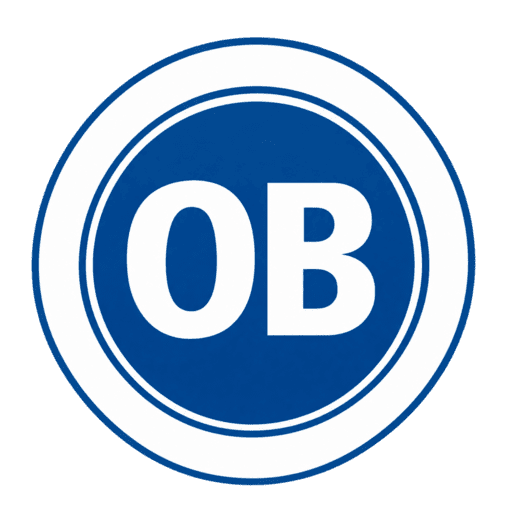
Odense Boldklub Logo
Official Logo 512×512 (2026/27)
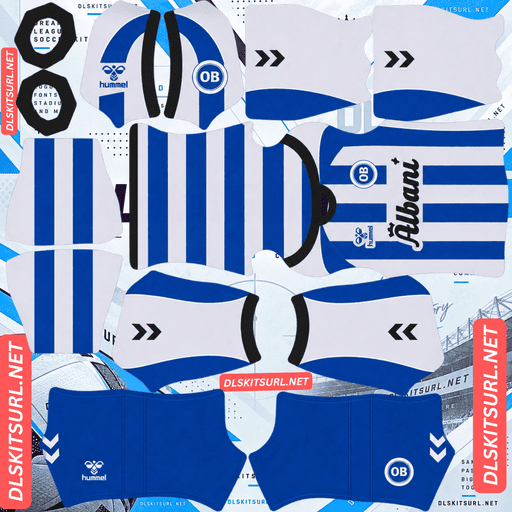
Odense Boldklub Home Kit
Home Kit 512×512 (2026/27)
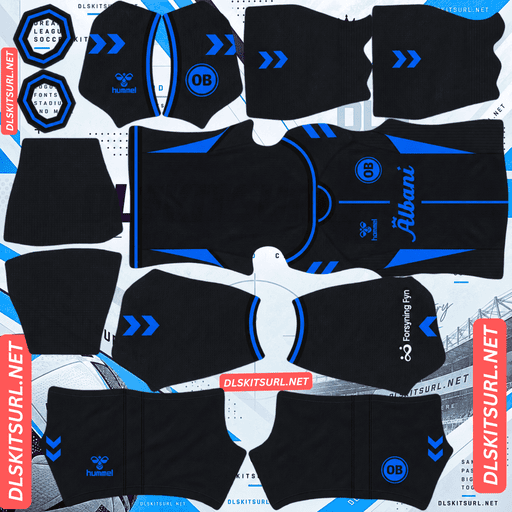
Odense Boldklub Away Kit
Away Kit 512×512 (2026/27)
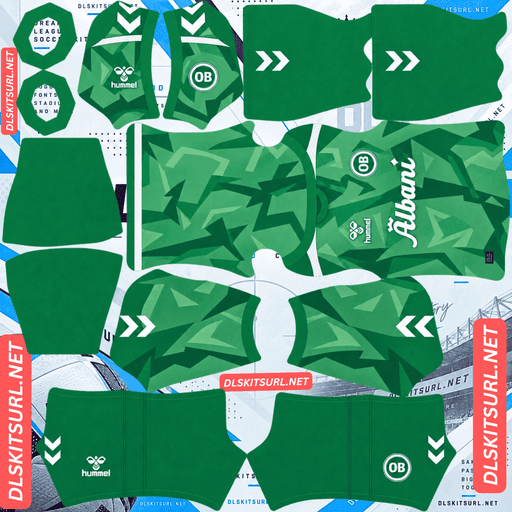
Odense Boldklub GK Home Kit
GK Home Kit 512×512 (2026/27)

Odense Boldklub GK Away Kit
GK Away Kit 512×512 (2026/27)
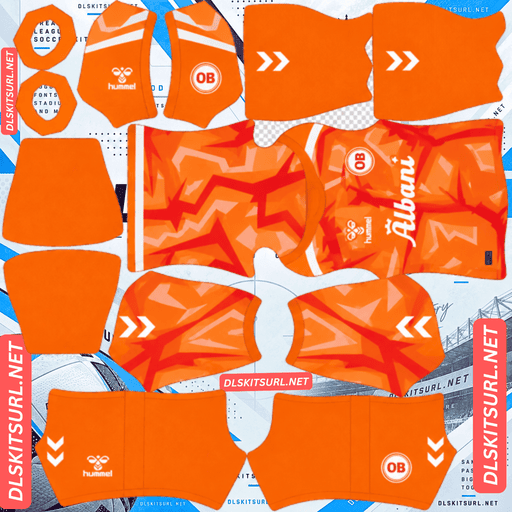
Odense Boldklub GK Third Kit
GK Third Kit 512×512 (2026/27)
The home kit is one of the most forgiving designs covered here. There is just one catch: that also makes it a poor test of image quality.
Blue and white stripes are the easy case
Released on 12 May 2026 as a deliberately traditional design, OB’s home shirt brings back the club’s iconic vertical blue and white stripes, running cleanly down the front. It comes with blue shorts and white socks, is made by Hummel, and carries Albani as sponsor.
Three things go right at once
Vertical stripes align in one place on the kit template, down the centre line of the body. That is about as forgiving as kit geometry gets.
Blue against white is maximum contrast. Nothing needs to be subtle, so the colour boundary remains obvious even after the image is reduced to 512×512.
Both colours also separate well from grass. White is as bright as the kit gets, while blue does not blend into the pitch.
The result is a home shirt that reproduces reliably and remains easy to read in matches. América de Cali’s away, Rosario Central’s home and Boca’s home fall into the same broad category.
Which also makes it a weak test
That simplicity creates the problem.
Wide, high-contrast stripes look good at almost any resolution.
So do not use the stripes to decide whether an OB file is genuinely good.
Check the Hummel chevrons instead. Hummel’s signature trim runs down the sleeves and sides as a row of small repeating shapes. They are defined, narrow and high-contrast, which means compression damage becomes visible much sooner there than on the broad stripes.
That makes the chevrons the more useful quality check on a Hummel kit.
Confirm the dimensions as well. On a computer, right-click the image and open it in a new tab to check the actual image size in your browser.
And set the garments separately
Dream League Soccer treats the shirt, shorts and socks as separate areas.
OB’s combination is straightforward: blue shorts and white socks. There is no complex boundary to align and no tonal colour to recover.
Still, set all three deliberately. Leaving one to the game’s default can produce a combination that does not match the intended kit.
Bahía, Young Boys, Rosario Central and Vaduz use the same multi-garment approach this season.
Number colour
Dream League Soccer gets number colours from two small swatches on the kit template, not from the shirt image itself. One controls shirt numbers and the other controls shorts numbers.
For the home, navy, black or red are the safest choices.
The stripes continue across the back, so blue numbers disappear into the blue sections and white numbers disappear into the white sections. A third colour avoids that problem.
White numbers on white are invisible, which is an easy mistake on pale kits. The shirt preview does not warn you because the number swatches are handled separately.
A checkerboard only works if you can see it
OB’s previous third provides a useful example of why pattern geometry and pattern visibility are two different problems.
The 25-26 third was pale pink with a tonal chequered pattern, and it used the original OB logo as a heritage reference.
Croatia wear a checkerboard too, and theirs survives
The difference is contrast.
Croatia uses red and white — maximum contrast.
OB used pink on pink — minimal contrast.
Same geometry. Completely different result.
A checkerboard has a genuine technical challenge because its grid must line up across two axes and continue correctly through the seams. But that only matters when the grid remains visible.
With OB’s tonal pink design, the pattern can disappear at 512×512. Once it is gone, there is no checkerboard left to misalign.
And the heritage logo goes too
Dream League Soccer places your imported badge over the chest area of the shirt.
That means the original OB logo on the 25-26 third is replaced by whichever crest you have selected.
You can use the original logo as your badge file if you want to recreate the shirt’s intended appearance. The catch is that the badge is global, so that choice applies to every kit you own rather than just the third.
Houston Dynamo’s Archive Kit and Rosario Central’s retro-crest third create the same dilemma.
But pale pink plays well
The pink base itself is not the problem.
Pink sits well away from pitch green, so the shirt remains easy to distinguish from the playing surface even though its tonal checkerboard disappears.
That gives you a readable kit with a much simpler visual than the original shirt. Hoffenheim’s lilac third and Houston’s away produce a similar result.
For numbers, navy or black are the safest choices. White on pale pink has too little separation.
The away
OB’s 26-27 away was released as part of the current range and is also made by Hummel.
For this file, compare the design directly with the card above rather than trusting a filename or a description from another site.
Check that:
Colour boundaries are sharp, not smeared
The Hummel chevrons remain distinct shapes
The crest and Albani sponsor are crisp
The image is actually 512×512
And note that OB vary their alternates widely
Recent OB alternatives have included orange with dark pinstripes, black and green stripes, and pale pink with checkers.
That makes the away particularly difficult to identify from a filename alone. If a file simply says “OB away 2026,” compare its actual design with the card before importing it.
Which Odense kit survives best?
The home is the clear winner.
The blue and white striped home reproduces with very little working against it, while also being the easiest kit in the range to read during a match.
The away depends on its exact construction, so the card comparison is more useful than a generic ranking.
The warm-up shirt is a usable third
There is another option worth keeping in mind because OB have only released two match kits so far this season.
The 26-27 warm-up shirt is a cream and blue design intended for pre-match use.
Dream League Soccer does not care what the garment was originally made for. If you have a working 512×512 PNG URL, you can use it in a kit slot.
And it should reproduce cleanly
Cream and blue provide a genuine value difference. Blue is considerably darker, so any defined shape formed by the two colours has a good chance of remaining visible.
Expect fewer files, though. Warm-up and pre-match shirts are photographed and uploaded much less often than official match kits.
For the number swatch, navy or black makes more sense than white, which has little separation from cream.
AGF Aarhus, Iraq and Arsenal also released pre-match shirts this season that can be used in the same way.
A note on OB’s recent file availability
The club’s recent league status matters when you are searching older files.
OB spent 24-25 in the Danish 1st Division after relegation from the Superliga.
Which thins out that season
Kit sites tend to follow top divisions much more closely than second tiers.
That means 24-25 OB files are noticeably scarcer than files from their Superliga seasons, including the black and green striped away from that campaign.
The current range is easier to find now that the club is back in the Superliga.
Vaduz faced the same issue in reverse after returning to the top level.
How to tell if an OB file is current
Four checks narrow it down quickly.
Hummel branding with Albani as sponsor. Hummel have supplied OB for many years, so this identifies the club but does not date the file by itself.
The current home should be clean vertical blue and white stripes, with blue shorts and white socks.
A pale pink chequered shirt belongs to 25-26, not the current range.
Compare the file with the cards above. OB’s striped home can look broadly similar from one season to another.
OB are therefore harder to date than clubs with a recent supplier change. The design itself is doing most of the work.
Sion, Thun, Nordsjælland and Puebla face a similar problem with long-running suppliers.
A note on the Danish season
The Danish Superliga runs across two calendar years, so the current range is labelled 26-27.
That means a file marked simply “2026” could refer to either the 25-26 or 26-27 season.
When in doubt, trust the design rather than the year in the filename.
How to use an Odense Boldklub DLS kits URL
Copy the URL using the button on the kit card, not from your browser address bar. The browser address usually points to the webpage rather than the image itself.
In Dream League Soccer, go to My Club → Customise → Kit. Do not open Logo; that is a separate system.
Select the slot first, then press and hold the URL field, tap Paste, and choose Confirm. Older versions may call the button Download.
With the home and away occupying two outfield slots, the third slot is available for something different. The warm-up shirt or the 25-26 pink third are the obvious candidates.
Set the shorts and socks separately as well, since DLS treats each garment independently.
The first custom kit requires a one-time gem unlock. After that, changing custom kits is free.
Test the link first
Open the URL in a browser before putting it into the game.
A valid direct image should fill the screen by itself, with the address ending in .png.
If you get a webpage containing headers, buttons or other surrounding content, you have a viewer page rather than a direct image file.
For OB’s home, do not use the broad stripes as your quality test. They are too forgiving.
Look at the Hummel chevrons. Those small repeated shapes are much more likely to expose compression, resizing or an undersized source.
Why do OB kit URLs stop working?
There are three common causes, and only one is immediately obvious.
Free image hosts can delete files. Old uploads may be removed after months or years while the original page still looks intact. OB have a long history and are well supported among Danish clubs, but Danish Superliga coverage is smaller than the major European leagues. That makes the 24-25 second-tier files and the warm-up shirt higher-risk candidates.
Hotlink protection can also be enabled. Your browser may display the image because it is requesting it from the host’s own page, while DLS makes a direct request that the server refuses.
That is why a URL can work when opened manually but fail when pasted into the game.
The preview and the copied URL can also point to different files. A page may still show a cached thumbnail even after the direct image has disappeared.
For these OB files, the displayed shirt and the copied link are the same file on the same server.
The Odense Boldklub badge
Set the crest during the same process, but choose Logo instead of Kit.
OB’s badge uses the club’s blue and white, with the club initials and the 1887 founding year.
The four-digit year is the weakest small detail. Numbers soften quickly at the size DLS displays a badge, so start with a genuine 512×512 badge file rather than an enlarged image.
Blue against white gives the crest excellent contrast.
Remember that DLS crops imported badges into a circle. Leave enough clear space around the artwork so the circular crop does not cut into the design.
The original OB logo used on the 25-26 third is also a legitimate badge option. Just remember that changing the badge changes it for every kit, not only that third.
St. Gallen, Union Saint-Gilloise, Lausanne-Sport and AGF Aarhus have similar founding-year details that become less readable at small badge size.
Keeping your OB kits
Custom kits are stored on your device rather than tied to your account.
A normal game update may leave them intact, but reinstalling the game or moving to another phone can remove the custom kits and badge.
OB are also easy to mix up between seasons because Hummel has supplied them for a long time.
Before importing, save all four URLs somewhere outside the game and record the season beside each one.
FAQ FOR RANK MATH
What is an Odense Boldklub DLS kits URL?
A direct link to a 512×512 PNG OB shirt that you paste into Dream League Soccer’s kit screen. A working direct image link ends in .png.
Does the home kit reproduce well?
Yes. The vertical stripes are highly forgiving because they align cleanly, blue and white have maximum contrast, and both colours separate well from pitch green.
Then how do I check whether an OB home file is good?
Check the Hummel chevrons. They are small, repeated and high-contrast, so they expose weak resolution or compression much faster than the broad blue and white stripes.
Why does Croatia’s checkerboard survive when OB’s does not?
Because of contrast. Croatia’s checkerboard uses red and white, while OB’s 25-26 third used tonal pink on pink. The checkerboard geometry can only be reproduced if the grid remains visible.
Will the original OB logo appear on the 25-26 third?
Not automatically. DLS places your imported badge over the chest. You can use the original OB logo as your badge file, but that badge then applies globally to your kits.
What number colour should I use on the home?
Navy, black or red. The blue and white stripes continue across the back, so blue and white numbers would disappear into parts of the shirt.
Can I use the warm-up shirt as a DLS kit?
Yes. DLS accepts any working 512×512 PNG URL regardless of whether the original garment was a match shirt or pre-match shirt. The main drawback is availability, since warm-up shirts are photographed and uploaded less often.
Why are 24-25 OB kits harder to find?
OB spent that season in the Danish 1st Division after relegation from the Superliga. Kit coverage is generally much thinner for second-tier seasons than for top-flight campaigns.