
An FC Copenhagen DLS kits URL is a direct link to a 512×512 PNG FCK shirt you paste into Dream League Soccer. All four slots are below, with each file loaded into the game before it was listed here.
FC Copenhagen Logo
Official Logo 512×512 (2026/27)
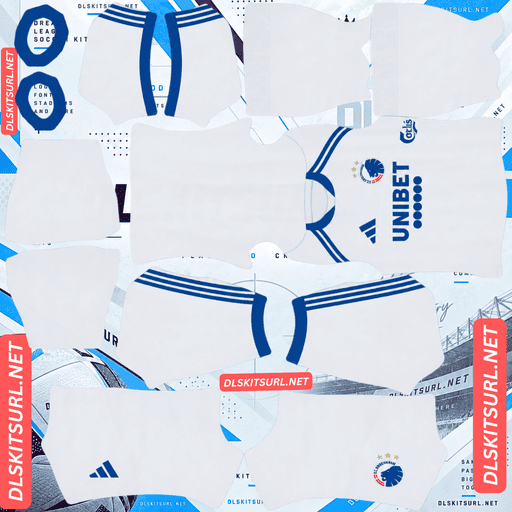
FC Copenhagen Home Kit
Home Kit 512×512 (2026/27)
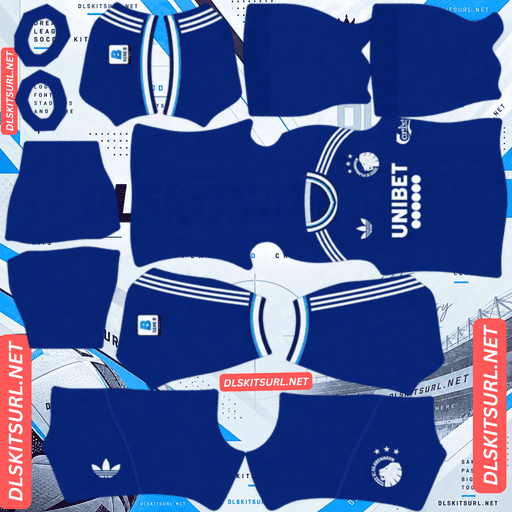
FC Copenhagen Away Kit
Away Kit 512×512 (2026/27)
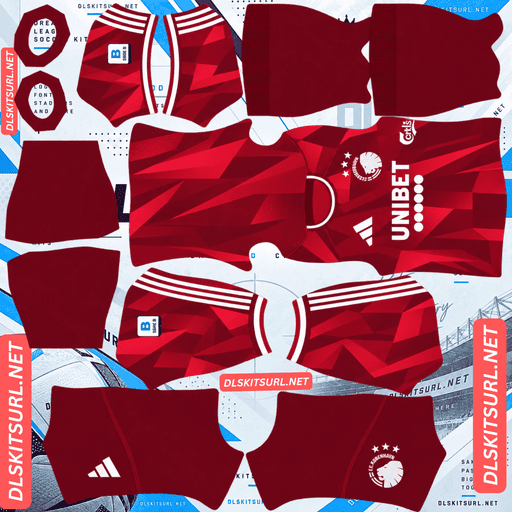
FC Copenhagen Third Kit
Third Kit 512×512 (2026/27)

FC Copenhagen GK Home Kit
GK Home Kit 512×512 (2026/27)

FC Copenhagen GK Away Kit
GK Away Kit 512×512 (2026/27)
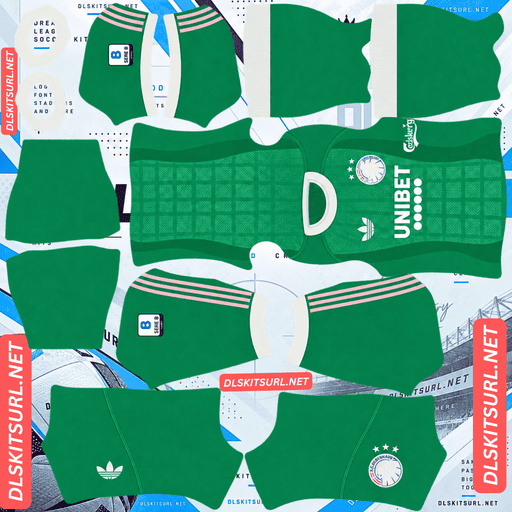
FC Copenhagen GK Third Kit
GK Third Kit 512×512 (2026/27)
The third kit breaks a rule that almost every other page on this site relies on, and understanding that difference changes how you should judge its files.
The third has no canonical version
Released in autumn 2026 and built around Copenhagen’s creative identity, the third is a red shirt with a bold geometric pattern — but each individual shirt carries unique details.
Which removes the usual way of checking a file
Normally, a kit has one correct appearance. You compare your file against a reference image, and differences usually indicate that something is wrong.
That does not work here.
Two FCK third-kit files can look different from one another and both be accurate, because the physical shirts themselves are different.
So change what you check
Stop comparing the pattern and check the fundamentals instead:
Confirm the dimensions. On a computer, right-click the image and open it in a new tab; the browser reports the actual size.
Check the Adidas Three Stripes. They are hard-edged and untextured, making compression damage easy to spot.
Check the crest and sponsor edges.
Check that the red base is clean and that the geometric shapes have defined boundaries.
Those elements remain consistent between the different versions. The pattern does not.
Two people can therefore have different-looking FCK third files and both be right.
The good news is the design reproduces well
A bold geometric pattern is exactly the kind of graphic that survives at 512×512: large shapes, strong edges and clear colour boundaries.
You should therefore expect whichever genuine version you find to retain its basic appearance.
Red is also an excellent DLS base colour. Players are rendered relatively small, and red separates strongly from the green pitch.
That makes the third a good match kit despite being impossible to verify through a single canonical reference.
Necaxa’s Mexico 1998 tribute, Universidad de Chile’s Chuncho graphic and Columbus’ angular blocking work on the same principle.
Use white or navy numbers on the third. If the geometric pattern covers much of the back, white is the safer option.
The home draws on the city’s coat of arms
Released on 8 July 2026, Copenhagen’s home is inspired by the city’s historic coat of arms and is made by Adidas.
Which is a density question
A coat of arms is intricate by nature. Copenhagen’s contains towers, waves and stars inside a shield, with fine heraldic linework throughout.
At 512×512, there simply is not enough resolution for every tiny element to remain distinct.
The result depends heavily on how the reference design was translated:
Abstracted into bold shapes — can survive well.
Reproduced as detailed heraldry — tends to become texture.
Rendered tonally within the base — can disappear completely.
Open the home at full size and inspect the body. If the major forms are already readable in the flat image, they have a chance of surviving in-game.
This follows the same pattern seen elsewhere: designs that simplify their source usually perform better than designs that try to reproduce every detail. Iraq’s Uruk mosaic, Alavés’ crowd photograph and Nacional’s departmental map all suffer because they contain too much information.
But white and blue is a strong base
White is the brightest base colour available, so it remains highly visible against the pitch.
Blue against white also gives you maximum contrast.
That means any blue elements in the coat-of-arms treatment are likely to remain among the sharpest features on the shirt.
Use those elements as your quality test.
And white needs the right number colour
Dream League Soccer takes number colours from the two small swatches on the kit template, not from the image. One controls shirt numbers and the other controls shorts numbers.
White numbers on a white shirt disappear.
Use blue or navy instead.
The preview will not warn you about this because it shows the shirt artwork rather than the final number rendering.
Watch for a sash on the away
Copenhagen’s 26-27 away was released on 28 July 2026.
Compare the file with the card above rather than relying on a written description, then apply the normal structural checks.
And check which version you have
The women’s 26-27 away is black with a blue sash.
Men’s and women’s kits are not necessarily identical at FCK, so a file labelled simply “Copenhagen 26-27 away” could refer to either.
Compare the design against the card before importing.
Monterrey, FC Juárez, Pachuca and Young Boys also have women’s variants this season, while Alianza FC is an example where one collection is shared across both teams.
If it is a sash, check the direction
A sash travels from one shoulder towards the opposite hip, making it asymmetric.
A mirrored file can therefore look perfectly convincing while being wrong.
Check which shoulder the sash begins on before importing.
Diagonal construction is also among the hardest geometry to reproduce because its position and angle must remain correct through the seams.
Import it and inspect the shirt from the side.
With one piece of good news
A blue sash on black gives you a genuine value difference, although it is nowhere near as strong as blue on white.
The sash also continues on both sides of the badge, so the imported crest only interrupts part of the graphic.
Lugano’s V and Vélez’s chevron create the same type of directional check. Minnesota’s black-on-navy sash demonstrates what happens when the contrast itself becomes too weak.
Which FC Copenhagen kit survives best?
The home has the strongest base because white and blue provide excellent contrast, although the amount of heraldic detail that survives depends on how heavily the original design was abstracted.
The away needs a direct comparison with the card, particularly if the file carries a sash. Check the direction before importing.
The third is technically strong because its geometric pattern uses large defined shapes, but there is no single canonical appearance against which to compare it.
Copenhagen changed their crest
This matters directly when choosing your badge.
FCK released an entirely new logo, replacing the previous version.
Which splits badge files in two
A Copenhagen crest file can therefore be either the old version or the new one, and both remain in circulation.
Check the artwork itself before downloading.
Use the current version unless you deliberately want a period crest with a heritage kit.
And remember that the badge is global in Dream League Soccer. Whichever version you import applies across all your kits.
Marseille, Atalanta, Sporting CP and Rosario Central have also changed crests recently. Houston Dynamo’s Archive Kit presents the clearest version of the same choice: the shirt can carry an older identity, but the imported badge affects everything.
The 150th anniversary kit is worth finding
There is a date that can be misleading when you first see it.
FC Copenhagen released a 150th anniversary kit in 2026, despite the modern club being formed in 1992.
The anniversary refers to the heritage of Kjøbenhavns Boldklub, founded in 1876 and one of the predecessor clubs behind FCK.
Which usually means a heritage design
A heritage anniversary shirt normally draws from older football designs.
Those historical shirts were generally built around flat colours and simple shapes rather than the textures, gradients and surface effects that are difficult to preserve in a 512×512 PNG.
So the main design should reproduce well.
The commemorative marking is a different matter. If it sits on the chest, the imported badge can cover it. On the upper back or neck it competes with the number area; at the hem it becomes tiny; and anything inside the collar is outside the mapped surface.
Those details are effectively unreachable in DLS.
But expect fewer files
A one-off anniversary shirt gets a burst of attention when released and then becomes much harder to find.
If you want the 150th anniversary kit, keep a working file when you find one.
Copenhagen produce a lot of kits
This is worth remembering before you search.
During 25-26 alone, the club released a home, away, third, fourth and 150th anniversary shirt. The club has also produced Champions League and pre-match designs in recent seasons.
Which makes slot labels unreliable
Once a club has five or more shirts in a season, “away” and “third” become less useful labels.
Different kit sites may classify the same shirt differently.
Compare the actual design with the cards above rather than trusting the filename or slot label.
Lausanne-Sport, Servette and Basel create similar problems this season.
How to tell if an FCK file is current
Four checks narrow it down:
Adidas branding — useful confirmation, but Adidas have supplied Copenhagen for many years.
The new crest — the strongest current marker because the club recently changed its logo.
The third should be red with a bold geometric pattern.
Compare the actual design with the cards above, especially for the white-and-blue home.
The crest is the most reliable dating clue, and you can check it both on the shirt and in your separate badge file.
A note on the Danish season
The Danish Superliga runs across two calendar years, so Copenhagen’s current shirts are labelled 26-27.
A file simply labelled “Copenhagen 2026” could therefore refer to either the 25-26 or 26-27 collection.
Check the design, not the year.
How to use an FC Copenhagen DLS kits URL
Copy the link from the button on the kit card, not from your browser address bar. The address bar normally gives you the webpage rather than the direct image.
In Dream League Soccer, open My Club → Customise → Kit. Do not select Logo; the badge uses a separate menu.
Choose your slot before pasting because the selected slot is the one that gets replaced. Press and hold the field, tap Paste, then Confirm. Older versions may label that button Download.
The three outfield kits occupy the three outfield slots, leaving the goalkeeper slot available.
That creates a choice for FCK because the club has more candidates than the game has outfield slots. The 150th anniversary shirt and pre-match options can compete with the standard home, away and third.
Choose your badge version before you start, since the crest change will be visible across every kit.
The first custom kit requires a one-time gem unlock. After that, changing kits is free.
Test the link first
Open the URL in your browser before putting it into the game.
The image should appear on its own, and the address should end in .png.
A webpage containing headers, buttons or other surrounding content is a viewer page rather than the direct file DLS needs.
For the third, do not compare its pattern against another uploaded file. Different patterns can be correct.
Instead, check the dimensions, Adidas Three Stripes, crest, sponsor edges and geometric boundaries.
For the away, check whether the file carries the correct sash and confirm its direction before importing.
Why do FCK kit URLs stop working?
Three problems account for most broken links.
Free image hosts delete files. Old or unused uploads can be cleared after months or years while the URL remains in an article. Copenhagen have strong coverage and regular European exposure, so standard kits are relatively easy to replace, but the 150th anniversary shirt and pre-match designs are more vulnerable because fewer copies are likely to exist.
Hotlink protection can be switched on. A browser may load the image because the request comes directly from the host, while DLS’s request is refused. That is why a URL can work when clicked and fail when pasted into the game.
The preview and direct file can be different files. A website can show a thumbnail from one server while its copy button points somewhere else. The page can remain intact even after the actual image URL stops working.
Here, the shirt shown and the copied URL are the same file on the same server.
The FC Copenhagen badge
Import the crest separately through My Club → Customise → Logo.
Copenhagen’s badge uses white and blue and carries lion and heraldic imagery associated with the club and city.
As explained above, choose the current crest deliberately because the club has recently changed its logo and both versions are still circulating.
DLS crops every badge into a circle, so leave clear space around the full artwork rather than trimming it tightly.
Blue against white is maximum contrast, making the basic badge colours well suited to DLS.
The finer heraldic details will soften when the badge is rendered at game size. That is a limitation of the display, not necessarily a bad source file.
Use a genuine 512×512 badge file rather than enlarging a smaller image.
Keeping your FCK kits
Custom kits are stored on your device rather than in your account. Updating the game normally keeps them, but reinstalling it or changing phones can remove the saved kits and badge.
Record which crest version you used, because both versions are in circulation and your choice applies globally.
Save all four kit URLs in a notes app before importing them, and record the season beside each one.
FAQ FOR RANK MATH
What is an FC Copenhagen DLS kits URL?
A direct link to a 512×512 PNG FCK shirt that you paste into Dream League Soccer’s kit screen. A working direct image link ends in .png.
Why can’t I check the third kit against one reference image?
Because every individual shirt carries unique details. There is no single canonical pattern, so two different-looking files can both represent genuine versions of the shirt.
How do I judge an FCK third-kit file?
Check the dimensions, Adidas Three Stripes, crest, sponsor edges, red base and the sharpness of the geometric shapes. Do not reject a file simply because its pattern differs from another version.
Does the third reproduce well at 512×512?
Yes. Large geometric shapes with strong edges are well suited to this resolution, and red is a highly visible base colour in DLS.
Will the coat of arms on the home survive?
Only partly, depending on how it was simplified. Bold abstract forms can survive, while detailed heraldry can turn into texture and tonal elements may disappear.
What number colour should I use on the white home?
Blue or navy. White numbers on a white shirt disappear.
Could the Copenhagen away file be the women’s shirt?
Yes. The women’s 26-27 away is black with a blue sash, so compare the actual design with the card instead of trusting a filename that only says “Copenhagen away.”
How do I check a sash?
Check which shoulder it starts from before importing. A sash is asymmetric, so a mirrored file can look correct while being wrong.
Which FCK crest should I use?
Use the current version unless you deliberately want a period crest. Copenhagen changed its logo recently, and the imported badge is global across your DLS kits.
Is the 150th anniversary kit from 2026 a mistake?
No. The anniversary refers to Kjøbenhavns Boldklub, founded in 1876, one of the predecessor clubs behind modern FC Copenhagen.
Is an FCK file labelled “2026” necessarily current?
No. The Danish season crosses two calendar years, so a “2026” filename can refer to either 25-26 or 26-27. Check the actual design and crest.