

A Silkeborg IF DLS kits URL is a direct link to a 512×512 PNG Silkeborg shirt you paste into Dream League Soccer. All four slots are below, with each file loaded into the game before it was added to this page.

Silkeborg IF Logo
Official Logo 512×512 (2026/27)
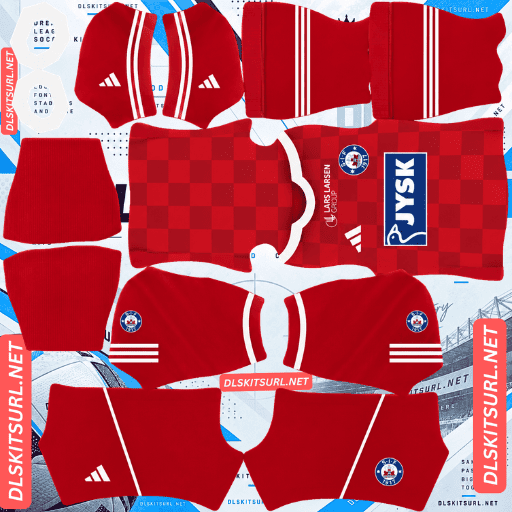
Silkeborg IF Home Kit
Home Kit 512×512 (2026/27)
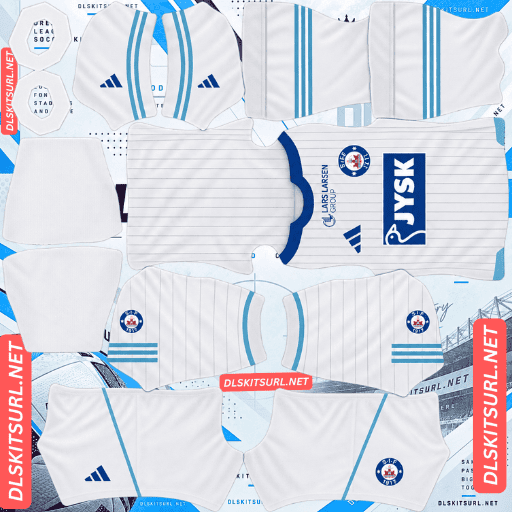
Silkeborg IF Away Kit
Away Kit 512×512 (2026/27)
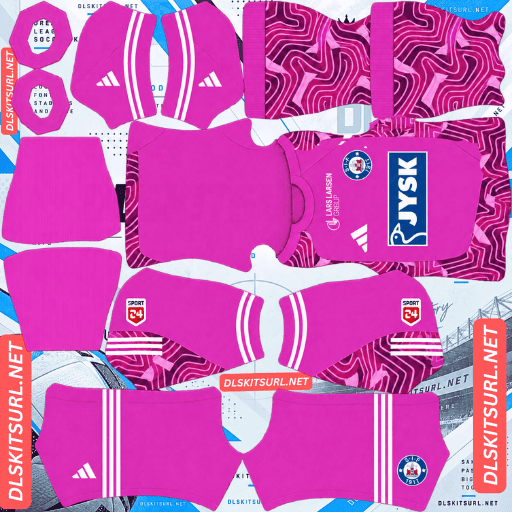
Silkeborg IF GK Home Kit
GK Home Kit 512×512 (2026/27)
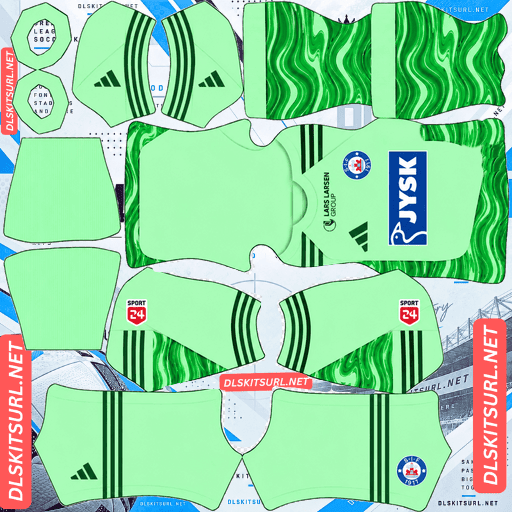
Silkeborg IF GK Away Kit
GK Away Kit 512×512 (2026/27)
Adidas built the 26-27 shirts around a named teamwear template, and that is more useful for judging a DLS file than most launch descriptions.
A named template is the best news a kit can carry
Silkeborg launched its 26-27 kits at an event at JYSK Park. The shirts are based on the Adidas Tiro 26 competition template, produced by Adidas with JYSK as the sponsor.
Which means you know exactly what you are getting
Tiro is Adidas’ standard competition teamwear range, used across clubs at different levels around the world.
That matters because teamwear is designed for mass production. You get flat colours, defined panels and straightforward construction.
There is no sublimated texture, tonal weave, embossed relief, metallic finish or complicated gradient for a 512×512 PNG to lose.
The simpler the manufacturing, the more faithfully the file reproduces.
And it helps you find one
The same Tiro 26 template appears across numerous clubs this season.
The basic shirt construction is therefore already familiar to file makers. They are changing the colours and club details rather than rebuilding an unusual bespoke pattern from scratch.
For a club of Silkeborg’s size, that can make a noticeable difference to the number of usable files available.
Alianza FC’s Adidas teamwear kits and Union Saint-Gilloise’s move to O’Neills show the same advantage. FC Zürich is the opposite example: its bespoke construction introduced features that are much harder for a flat DLS image to preserve.
Which inverts what you would assume
A bespoke shirt sounds more impressive.
For DLS, it can be worse.
AC Horsens’ home is described as bespoke this season, and that kind of construction is often where sublimated textures, tonal effects and other details begin to disappear at 512×512.
“Competition template” points in the other direction.
For a DLS file, practical manufacturing is often an advantage.
So what do you check?
Not much, and that is exactly the point.
First, confirm the dimensions. On a computer, right-click the image and open it in a new tab so the browser can report the actual size.
Then inspect the Adidas Three Stripes. They are hard-edged and free of texture, making compression or resizing damage easy to spot. On the Tiro construction, they run down the sleeves.
Finally, check the collar and cuff trim.
Those three checks are enough for a kit this straightforward.
The sponsor dominates, and the game fixes some of that
The launch coverage highlighted the large JYSK sponsor across the chest as one of the defining features of the shirt.
Which your badge partly covers
DLS draws your imported crest onto the chest, over whatever is already there.
On a shirt with an oversized sponsor, that means the badge lands directly over part of the JYSK logo.
It does not remove the sponsor completely because the logo extends beyond the badge area, but it does break it up.
That creates an unusual situation where the badge collision actually makes the original shirt look less sponsor-heavy.
And it matters for your quality test
Do not judge a Silkeborg file by the JYSK logo.
Part of it will be covered in-game anyway.
Use the Three Stripes, collar and cuff trim as your quality checks instead.
Red and white is doing the heavy lifting
Silkeborg’s traditional red-and-white palette is close to ideal for DLS.
Both halves work
Players are rendered small, so the distance between the shirt colour and the pitch matters.
Red sits well away from green and remains highly visible.
White is even simpler: it is the brightest major shirt colour and does not blend into the pitch.
Then there is the internal contrast. Red against white gives you a maximum light-versus-dark difference.
That makes a Tiro template in red and white about as safe a combination as you can ask for: simple construction, strong contrast and two highly visible base colours.
Number colour
DLS gets number colours from separate small swatches on the kit template rather than reading them from the shirt image.
One swatch controls shirt numbers and another controls shorts numbers.
Use white numbers on a red shirt, and red or navy numbers on a white one.
White numbers on white are the obvious failure. The shirt preview will not warn you because it does not show how the separate number setting will look during a match.
The home and away
Both 26-27 kits were released together at the JYSK Park launch.
Compare each file with the cards above rather than relying on descriptions from another site.
Because both are based on the Tiro 26 template, the main question is the exact colour arrangement rather than whether the design itself can survive 512×512.
The template should reproduce cleanly.
Which Silkeborg kit survives best?
The home is the safest quality result because the Tiro construction is simple and the red-and-white palette has maximum contrast.
The away uses the same template architecture, so it should also reproduce cleanly. Judge its exact colour blocking against the card rather than expecting the file to contain some special texture.
The 25-26 third is the one to find
This is worth remembering because Silkeborg have only released two match kits so far in the current season, while the previous collection contains a particularly useful DLS option.
The 25-26 third was pink, black and white with contrasting sleeves.
Which gets three things right
Pink is an excellent DLS base colour. It sits a long way from pitch green, giving the player a bright and distinct silhouette.
The contrasting sleeves are useful for another reason: their boundary follows the armhole seam already built into the shirt construction.
There is therefore no awkward custom seam that needs to be aligned across the body. The sleeve split occurs exactly where the template already changes from torso to arm.
Then there is the colour combination itself. Pink, black and white provide strong separation at every major boundary.
The result should arrive almost completely intact at 512×512 and remain easy to follow during a match.
This site has now covered eleven clubs using contrasting sleeves in a single season — Austria, Lorient, Cagliari, Alavés, Basel, Young Boys, Grasshoppers, Cremonese, Deportivo Pasto, Servette and Vaduz — without the construction itself failing.
Alianza Lima’s Morada, Sport Recife’s Pink October and Servette’s 23-24 third benefit from the same pink-versus-green visibility advantage.
With one caution
The problem is not the design.
It is the age.
A third from 25-26 naturally has fewer current files available than the shirts being released now.
If you want the pink third, find the file while it is still available.
Use black or navy numbers on it.
Silkeborg produce a lot of kits
This matters when you search because Silkeborg can create more filename confusion than the average club.
In 25-26 alone, the club released a home, away, third, fourth and pre-season home. They also had a Home V2 during 24-25.
Which makes slot labels unreliable
Once a club is releasing five shirts in a season, labels such as “third” and “fourth” become less useful.
Different kit sites may assign those names differently.
A pre-season home is another problem. It can be a completely different design from the official home while still appearing in searches simply as “Silkeborg home”.
So compare the actual shirt against the card instead of trusting the filename.
Lausanne-Sport, FC Copenhagen, Randers and Servette create similar search problems this season for different reasons.
How to tell if a Silkeborg file is current
Four checks will narrow it down:
Adidas with JYSK — useful confirmation, but Adidas have supplied Silkeborg for many years, so the supplier does not date the shirt by itself.
Tiro 26 construction — the current 26-27 signature, with the Three Stripes running down the sleeves.
Pink with contrasting sleeves — this identifies the 25-26 third rather than the current collection.
Compare against the kit cards — Silkeborg’s red-and-white designs can look similar enough across seasons to make filenames unreliable.
Silkeborg are harder to date than clubs with a recent supplier change. Here, the template is doing the dating work.
Sion, Thun, Odense, Nordsjælland and Brøndby have similar problems because their long-running suppliers do not provide a clean seasonal dividing line.
A note on the Danish season
The Danish Superliga runs across two calendar years, so Silkeborg’s current collection is labelled 26-27.
A file simply labelled “2026” could therefore belong to either the 25-26 or 26-27 cycle.
Check the design, not the year.
How to use a Silkeborg IF DLS kits URL
Copy the link using the button on the kit card, not the browser address bar. The browser address usually points to the page containing the image rather than the direct PNG.
In Dream League Soccer, open My Club → Customise → Kit. Do not select Logo; the badge is handled separately.
Choose the kit slot before pasting. Then press and hold the URL field, tap Paste, and select Confirm. Older versions may call the button Download.
With a home and away installed, the third slot remains available.
The 25-26 pink third is the obvious candidate if you want a different Silkeborg look because it combines strong visibility with a simple, well-defined construction.
The first custom kit requires a one-time gem unlock. After that, changing custom kits is free.
Test the link first
Open the URL in a browser before entering it into DLS.
The image should appear by itself, and the address should end in .png.
If you see a page with headers, buttons or other website elements around the shirt, that is a viewer page rather than the direct image file.
With a Tiro kit, the visual preview is less useful than usual because there is so little complicated detail to degrade.
Check the dimensions, inspect the Three Stripes and confirm the basic trim.
Why do Silkeborg kit URLs stop working?
Three things usually break kit links, and only one is obvious.
Free image hosts delete files. Older uploads can be removed after months or years while the page or reference remains visible. Silkeborg are a mid-sized Danish Superliga club, so older fourth kits, pre-season designs and other less-common shirts carry more risk than the main current kits.
The shared Tiro template helps on the creation side because the construction is straightforward, but it does not protect an old file from being deleted.
Hotlink protection can also cause problems. A host may allow the image to load when you open it directly but reject the request when DLS tries to fetch it. That is why a URL can work perfectly in a browser and fail inside the game.
The preview and the direct file can be different. A page may display a thumbnail stored on its own server while the copied URL points somewhere else. The page can continue showing the shirt even after the direct file has disappeared.
For these files, the shirt displayed on the card and the URL you copy are the same file on the same server.
The Silkeborg IF badge
Set the crest during the same session, but select Logo instead of Kit.
Silkeborg’s badge uses the club’s red-and-white colours together with its initials and heraldic elements.
DLS crops imported badges into a circle, so leave clear space around the artwork rather than using an image that is already tightly cropped.
Red against white gives the badge maximum contrast, which is ideal at the small size the game uses beside the score.
Fine lettering and small heraldic details will soften first. That is normal at this scale, so use a genuine 512×512 badge rather than enlarging a smaller source.
The badge is particularly important on the Tiro shirts because the template itself is intentionally simple. It also sits over part of the large JYSK sponsor, making its placement one of the most noticeable details on the finished shirt.
Keeping your Silkeborg kits
Custom kits are stored on your device rather than in your account. Updating the game normally keeps them, but reinstalling it or changing phones can remove the kits and badge.
Silkeborg’s large number of recent shirt variations makes it especially easy to confuse one file with another.
Save all four URLs in a notes app and record the season and design beside each one before importing them.
FAQ FOR RANK MATH
What is a Silkeborg IF DLS kits URL?
A direct link to a 512×512 PNG Silkeborg shirt that you paste into Dream League Soccer’s kit screen. A working direct image link ends in .png.
What is the Tiro 26 template?
It is Adidas’ standard competition teamwear template. It uses straightforward construction, flat colours and defined panels, making it much easier to reproduce faithfully in a 512×512 PNG than a bespoke shirt with woven, embossed or tonal effects.
Do the Silkeborg kits reproduce well?
Yes. The Tiro 26 construction gives a flat DLS image very little to lose. The shared template also makes the basic design easier for file makers to reproduce.
How should I check a Silkeborg file?
Confirm that it is genuinely 512×512, inspect the Adidas Three Stripes running down the sleeves, and check the collar and cuffs. Those hard-edged details reveal compression or resizing problems.
What happens to the large JYSK sponsor?
Your imported badge covers part of the sponsor because DLS draws the crest over the chest. The sponsor is not completely removed because it extends beyond the badge area.
Which Silkeborg kit plays best?
The 25-26 pink, black and white third is the strongest option if you can find it. Pink stays well away from pitch green, while the contrasting sleeves and high-contrast colour boundaries remain easy to read.
What number colour should I use?
Use white on a red shirt, and red or navy on a white shirt. For the pink third, black or navy gives strong visibility.
Why are Silkeborg files confusing to search for?
The club released five shirts in 25-26 — home, away, third, fourth and a pre-season home — and also used a Home V2 in 24-25. Because of that, filenames and slot labels are not always reliable. Compare the actual design with the kit card.