

An Adelaide United DLS kits URL is a direct link to a 512×512 PNG Reds shirt you paste into Dream League Soccer. All four slots are below, with each file loaded into the game before it was placed on this page.
Adelaide United Logo
Official Logo 512×512 (2026/27)
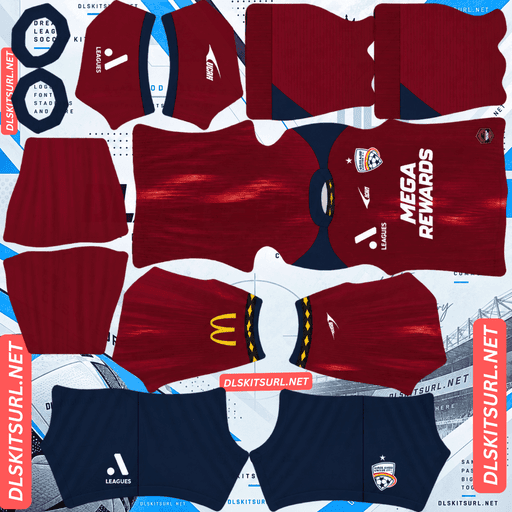
Adelaide United Home Kit
Home Kit 512×512 (2026/27)
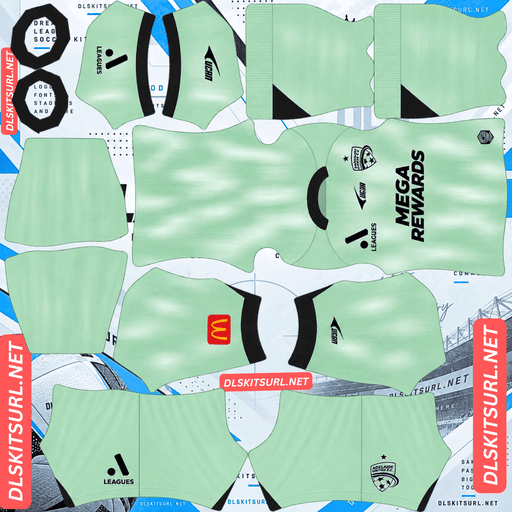
Adelaide United Away Kit
Away Kit 512×512 (2026/27)
The 26-27 home is inspired by a Victorian glasshouse, and whether that reference was drawn boldly or literally makes a huge difference to what survives in a 512×512 PNG.
A glasshouse is a grid of thin lines
Adelaide’s 26-27 home takes its inspiration from Palm House at the Adelaide Botanic Garden, the 19th-century glasshouse associated with the city. The kit is made by UCAN.
Which is a density question before anything else
Palm House gets much of its character from its ironwork: repeated glazing bars forming a regular geometric lattice around the glass panes.
That creates a difficult problem at 512×512.
A faithful interpretation means fine, repeating linework spread across a large part of the shirt. That is the same basic problem seen with topographic maps and other dense line-based references.
Open the home at full size and first work out how literally the pattern has been reproduced.
If the design has been reduced to bold arches, panels or a few strong lines, the reference should survive.
If it is a fine glazing lattice, the lines can collapse into texture and leave you with what looks like a mottled red shirt.
If the pattern is tonal red on red, it can disappear almost completely.
The rule is simple: if you can read the structure clearly on the flat image, it has a chance of carrying into DLS. If you have to work it out, it probably will not.
That distinction appears across several architecture- and map-inspired kits. Iraq’s Uruk mosaic, Alavés’s crowd photograph, Nacional’s departmental map and FC Zürich’s topographic away all lose their defining detail because the source is too dense. Atlético San Luis’s Caja del Agua, Mainz’s architecture third and Bologna’s Torre di Maratona work in similar territory.
Portland’s art deco arches are the easier version of the idea because large arches are defined shapes rather than a field of tiny lines.
And the contrast decides the rest
Contrast determines whether any of that linework survives.
A white or light-coloured lattice over red has enough contrast to remain partly visible, even if the finest lines thin out.
A red-on-red version can disappear regardless of how clearly the original artwork was drawn.
Check the actual file before judging its quality.
And confirm the dimensions as well. On a computer, open the image in a new tab and check the browser’s reported size. A visually sharp preview is not proof that the file is genuinely 512×512.
But red is an excellent base
The good news is that the base colour does most of the work for visibility.
DLS players are displayed relatively small, and red separates strongly from the green pitch. Even if the Palm House reference disappears, the shirt remains a saturated red kit that reads clearly at match distance.
You lose some of the concept but keep a strong playing colour.
Use white numbers on the home.
UCAN works in your favour
Adelaide have worn UCAN since 2020-21, replacing Macron.
Which is good news for reproduction
UCAN is a smaller manufacturer supplying a limited number of clubs. That generally means less reliance on the elaborate manufacturing effects that create problems in flat 512×512 artwork.
You are less likely to encounter the kind of sublimated weaves, 3D-knit effects, embossed relief or metallic finishes that disappear when reduced to a game texture.
So the underlying shirt construction should reproduce fairly faithfully.
It is the same general advantage seen with Union Saint-Gilloise and O’Neills, Alianza FC and Adidas teamwear, and Lyngby and Select: simpler manufacturing gives the DLS file fewer details that can collapse.
And bad news for finding one
The downside is availability.
UCAN generates far less kit coverage than Nike, Adidas or Puma, while the A-League receives less attention from kit-file sites than many major European competitions.
That combination means fewer Adelaide files circulate.
If you find a working file, save it.
But it dates a file cleanly
A Macron logo on an Adelaide shirt places it in 19-20 or earlier.
A UCAN logo puts it in the period from 20-21 onward, although the supplier alone will not identify the exact season because UCAN have remained with the club for several years.
Use the sponsor as a second marker. Flinders University and Mega Rewards have both appeared in recent periods.
The away
Adelaide’s 26-27 away was released through the club’s online store and is also made by UCAN.
Compare the file with the card above rather than relying on a written description. Then check the basic construction:
Colour boundaries should be sharp rather than smeared.
Collar and cuff trim should have clean edges.
UCAN branding, crest and sponsor should remain crisp.
The image should actually be 512×512.
And check it against the home
With a red home, the away needs to give you some visual separation.
If the away is light or brightly coloured, it earns its place in the rotation.
If it is another red or a dark design, look at the back catalogue instead.
Put both source images beside each other at thumbnail size before importing. If they read as essentially the same shirt, one of the slots is being wasted.
Lyngby Boldklub demonstrates the same problem from another angle this season, with a navy third sitting too close to a blue home.
The 25-26 pink away is worth finding
The 25-26 away was pink and black, and it is arguably the most useful Adelaide shirt for DLS if you can find a working file.
Which gets two things right
Pink sits well away from pitch green, giving it excellent match visibility.
Black against pink also creates strong internal contrast, so the main shapes and trim remain easy to read.
It is also a relatively straightforward design, meaning there is little fine texture for a 512×512 file to lose.
Use black or navy numbers.
Alianza Lima’s Morada, Sport Recife’s Pink October, Silkeborg’s 25-26 third and Inter Miami’s home benefit from the same basic colour advantage.
With one caution
The problem is availability.
A previous-season kit naturally generates fewer new uploads, and Adelaide already have the double disadvantage of a smaller supplier and a more modestly covered league.
If you want the pink away, save it when you find it.
Which Adelaide kit survives best?
The home has a strong red base, but the Palm House detail depends on how heavily it was abstracted. The current away should be judged directly from its source image. The 25-26 pink away is the safest older option because its colours and simple construction survive well at 512×512.
Adelaide run extra kits worth knowing about
Adelaide have more than the standard home and away, which matters when you are looking for a useful third slot.
Cup kits
Adelaide had separate Cup Home and Cup Away shirts in 25-26.
That means a file labelled something like “Adelaide 25-26 home” may refer to either the league shirt or the cup version.
Check the actual design.
More importantly, determine what the cup version changes. If the difference is limited to competition patches or badge treatment, DLS effectively removes the distinction: competition patches are not useful as a reason to occupy another slot, and the imported badge replaces the shirt crest.
If the cup kit changes the colour or layout, however, it becomes worth finding.
The same question appears with European variants from FC Thun, Basel, Lausanne-Sport and Union Saint-Gilloise.
And some unusual extras
Adelaide’s catalogue also includes a 25-26 rain kit as well as 26-27 training, travel jacket and travel shirt pieces.
DLS accepts any working 512×512 kit URL regardless of what the garment was originally intended for, so these can be legitimate third-slot choices.
Training and travel pieces are usually straightforward to reproduce because they rely on flat colours and defined panels.
The catch is availability. There will be far fewer files for these than for the regular match kits.
How to tell if an Adelaide file is current
Four checks make the identification much easier:
UCAN branding rather than Macron — Macron ended after 19-20.
The sponsor — a tighter season marker than the supplier alone.
The Palm House reference on the home — the most specific visual clue for 26-27.
The source card — compare the actual design rather than trusting a filename.
The Palm House treatment is the strongest current-season clue. Whether the fine detail survives DLS is a separate question.
A note on the A-League season
The A-League runs across two calendar years, with the Australian season generally running from October into the following May.
That is why Adelaide’s current range is labelled 26-27 rather than simply 2026.
A file labelled only “2026” could refer to either season.
Australian kits also tend to appear around September and October, later than most European club releases.
As always, check the design rather than trusting the year in the filename.
How to use an Adelaide United DLS kits URL
Copy the link using the button on the kit card, not the address from your browser. The browser address often points to the page displaying the image rather than the direct PNG.
In Dream League Soccer, open My Club → Customise → Kit. Do not use Logo; that is a separate import system.
Select the slot before pasting because the selected slot is the one that gets replaced. Press and hold the field, tap Paste, then Confirm. Older versions may call that button Download.
With the current home and away occupying two slots, the third remains open for something more useful. The 25-26 pink away is the obvious candidate if you can find it because it provides excellent visibility and a clear visual break from red.
The first custom kit requires a one-time gem unlock. After that, changing kits is free.
Test the link first
Open the URL in your browser before putting it into DLS.
The image should appear by itself, and the address should end in .png.
If you see a webpage with headers, buttons or other surrounding content, that is a viewer page rather than the direct image file.
For the home, establish what kind of Palm House treatment you are looking at before judging the file. A fine lattice collapsing into texture is a limitation of the design at this resolution, not automatically a bad source file.
Instead, judge the UCAN branding, crest, sponsor edges and dimensions.
Why do Adelaide kit URLs stop working?
Three problems account for most broken kit links.
Free image hosts delete files. Old uploads can be cleared after months or years even when the original page remains visible. Adelaide’s smaller supplier and the A-League’s more modest kit coverage mean there are already fewer replacement files around. Cup kits, rain kits and travel pieces are particularly vulnerable.
Hotlink protection can be switched on. A browser may display the image normally while the game is refused because its request does not originate from the host’s own website. That is why a URL can work when opened manually but fail when pasted into DLS.
The preview and the direct file can be different. A site may display a thumbnail from one location while its copy button provides a URL pointing somewhere else. The preview remains visible even after the actual image file disappears.
Here, the shirt displayed and the URL copied refer to the same file on the same server.
The Adelaide United badge
Set the crest during the same session by opening My Club → Customise → Logo rather than Kit.
Adelaide’s badge uses the club’s red identity and a shield-shaped design with the club name and stylised internal artwork.
Because DLS crops badges into a circle, the shield shape needs some breathing room. Avoid a source file that has been cropped tightly against the artwork, especially around the pointed lower section.
Red against white provides strong contrast at the size the badge is displayed.
The lettering is more vulnerable than the main shield shape, so use a genuine 512×512 badge file rather than enlarging a smaller source.
The badge becomes especially important if the Palm House pattern is too fine to survive. Once the lattice turns into background texture, the crest is one of the few sharply defined elements left on the shirt.
Keeping your Adelaide kits
Custom kits are stored on your device rather than in your account.
A normal game update may leave them intact, but reinstalling the game or moving to a new phone can remove the saved kits and badge.
Adelaide files can be harder to replace because of the smaller supplier and league coverage, so save any working URLs you find.
Paste all four links into a notes app before importing, and record which older kit you used if you decide to replace the current away or reserve a slot for the pink 25-26 shirt.
FAQ FOR RANK MATH
What is an Adelaide United DLS kits URL?
A direct link to a 512×512 PNG Reds shirt that you paste into Dream League Soccer’s kit screen. A working direct file ends in .png.
Will the Palm House design show up on the home kit?
It depends on how literally the reference was drawn. A fine glasshouse lattice is dense repeating linework and can collapse into texture at 512×512. Bold arches, panels and strong structural lines have a much better chance of surviving.
How do I tell which version I have?
Open the file at full size. If you can clearly read the Palm House structure from the flat image, it has a chance of carrying into DLS. If the pattern is already difficult to distinguish, expect it to become texture or disappear.
Does UCAN affect file quality?
Generally, it helps. UCAN is a smaller supplier and the kits are less dependent on the elaborate woven, embossed or three-dimensional effects that tend to disappear in a flat 512×512 image. The downside is that fewer Adelaide files circulate.
Which Adelaide kit plays best?
The 25-26 pink away is the strongest older option if you can find it. Pink separates well from the green pitch, while black provides strong internal contrast.
Should I look for the Cup kits?
Check what actually changes first. If the difference is only competition patches or badge treatment, DLS does not give you much reason to use a separate slot. If the cup version changes colour or layout, it is worth finding.
What number colour should I use?
Use white on the red home. Black or navy works well on the pink 25-26 away.
Is a file labelled “Adelaide 2026” current?
Not necessarily. The A-League spans two calendar years, so a file labelled only 2026 could belong to either the 25-26 or 26-27 cycle. Check the design, especially the Palm House reference, rather than relying on the year.