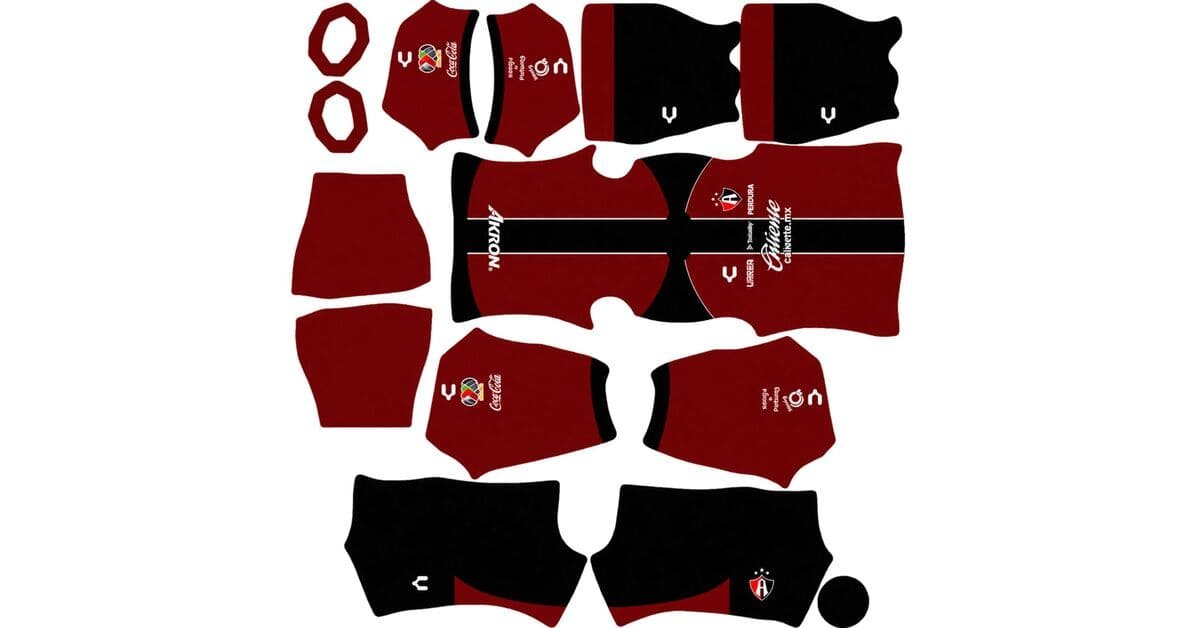
An Atlas DLS kits URL is a direct link to a 512×512 PNG Atlas shirt you paste into Dream League Soccer. All four slots are below, with each file loaded into the game before it went on this page.

Atlas Logo
Official Logo 512×512 (2026/27)

Atlas Home Kit
Home Kit 512×512 (2026/27)

Atlas Away Kit
Away Kit 512×512 (2026/27)

Atlas Third Kit
Third Kit 512×512 (2026/27)
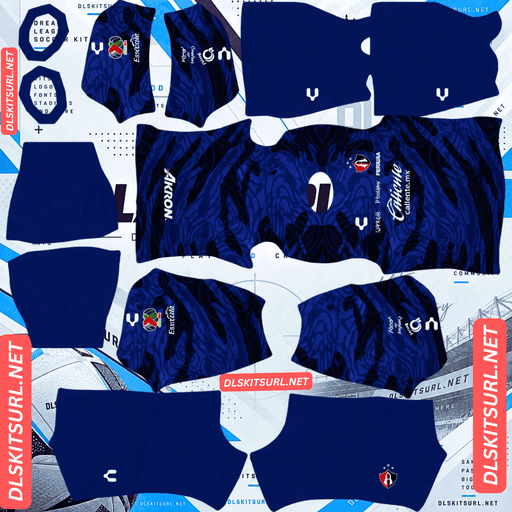
Atlas GK Home Kit
GK Home Kit 512×512 (2026/27)
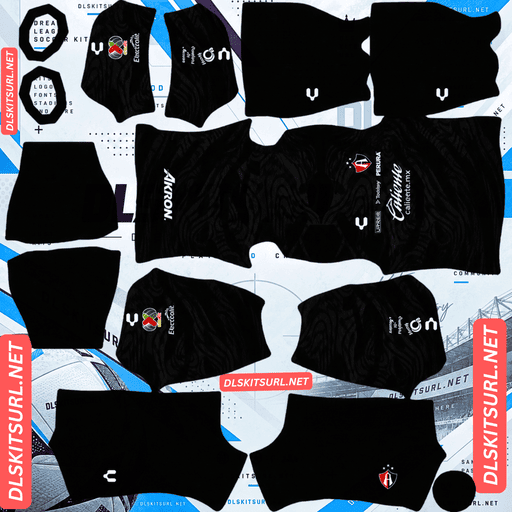
Atlas GK Away Kit
GK Away Kit 512×512 (2026/27)
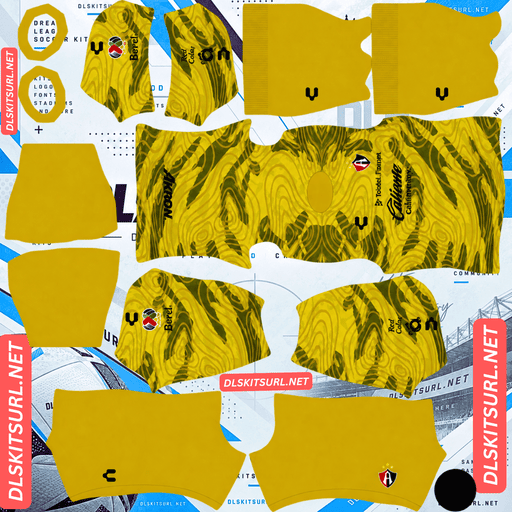
Atlas GK Third Kit
GK Third Kit 512×512 (2026/27)
The home kit has the simplest shape on this site, but it still has one check you need to make before importing it.
The half-and-half home needs checking first
Released in July 2026 to mark the club’s 110th anniversary, the home keeps Atlas’s traditional red-and-black half-and-half design. It adds a subtle commemorative print woven into the fabric and a classic vintage-inspired collar to honour the milestone.
The geometry is the easiest there is
A half-and-half split runs directly down the centre line of the body. That gives you one alignment point, making it about as forgiving as a kit template can be.
For comparison:
Half-and-half split: 1 alignment point — easiest
Vertical stripe: 2 edges, 1 place
Horizontal band: 6 alignment points
Diagonal split: position and angle have to be maintained at every seam
So the split itself is not the difficult part.
But the file can be mirrored
The problem is that red is on one side and black is on the other, making the shirt asymmetric.
The kit template maps left and right separately, so asymmetry works in principle. But a poorly made file can flip those sides while still looking completely convincing.
Check which side is red and which side is black before importing. Once the kit is on the model, there is no reliable way to tell whether the original file had the sides reversed.
This is the sixth kit covered here where left and right differ, after Vélez Sarsfield’s cuffs, Universidad de Chile’s halves, Venezia’s gradient away, Monaco’s diagonal and Cagliari’s split.
Asymmetric designs are the only ones where a file can be wrong in a way that still looks right.
And your badge sits on the boundary
Dream League Soccer draws your imported crest on the chest, which on a half-and-half shirt is exactly where the two colours meet.
The badge therefore straddles the divide.
A full-colour crest with a defined outline handles this better than one without a clear edge. It reads as a deliberate element placed over the two colours instead of getting partially lost into either half.
Cerro Porteño’s home and Cagliari’s create the same situation.
The commemorative print will not appear
The anniversary print is woven into the fabric, meaning its effect depends on the arrangement of the threads.
A flat 512×512 image has no threads and no physical surface.
It is also described as subtle, so even a more detailed image would not give the effect much room to survive.
Expect clean red and black halves. No amount of file quality will restore the woven texture.
Marseille’s woven chassis, Croatia’s woven away, FC Juárez’s woven cross pattern and Monaco’s embossed monogram all disappear for the same reason.
So the collar is your test
A vintage-style collar is a structural shape with a defined outline. Unlike the commemorative surface effect, that structure has something the game can actually reproduce.
The collar and Charly branding are therefore your main quality checks on this shirt.
Confirm the dimensions too. On a computer, right-click the image and open it in a new tab; your browser will report the actual size.
Red against black is the home’s real weakness
Dream League Soccer renders players small, so visibility depends on how far the shirt colours sit from the grass.
Both Atlas colours separate from pitch green. Red sits close to green’s opposite, while black separates by value.
The problem is the contrast between the two halves.
Red is a saturated mid-value colour. Black is the darkest possible value. There is a difference between them, but it is modest compared with combinations such as red on white or yellow on blue.
For comparison:
Yellow on blue, as on Boca, gives maximum internal contrast.
Red on white, as on Zamalek, is also maximum.
Red on black, as on Atlas, is moderate.
Green on black, as on Sassuolo, is weak.
Blue on black, as on Inter, is among the lowest.
At match distance, the Atlas home therefore reads more like one darkish shape than two sharply separated halves.
Use white numbers on the home. The split continues across the back, meaning red would disappear into one side and black into the other. White is the only reliable option.
The grey away fixes the contrast problem
The 26-27 away pairs a grey base with red and black stripes.
Which is the interesting part
Atlas’s two club colours have no brightness between them. On the home, they sit directly beside each other with nothing to separate them.
The away changes that by introducing grey.
Red against grey reads clearly. Black against grey reads clearly.
The grey base gives both club colours something to contrast with, creating internal structure that the home lacks.
That makes the away the more readable kit, even though grey is a quieter base colour than either red or black.
It is worth knowing before assigning your slots. The game uses your home kit most.
And the stripes reproduce well
Vertical stripes align in one place on the kit template, down the centre line of the body.
The three-colour arrangement also means every major boundary has a genuine value difference. The weakness of the home becomes a strength here.
Expect the away to arrive cleanly.
Still, check the stripe edges at full size. Where red meets grey and black meets grey, the boundaries should be sharp. A smeared edge is a sign of a weak file.
Number colour
Use white on the away.
Red and black stripes continue across the back, while grey appears between them. White is the only number colour that separates reliably from every part of that combination.
Which Atlas kit survives best?
Home — Red and black halves: The central split reproduces perfectly, but the commemorative weave is lost. In play, visibility is moderate because red and black do not separate strongly enough.
Away — Grey with red and black: The stripes and three-colour structure survive well, and the grey gives both club colours better contrast. This is the better of the two in play.
The crest carries three stars
This is worth checking before you set your badge.
Atlas added stars to their crest for their league championships, and the current version carries three.
Which the circular crop threatens
Dream League Soccer crops every badge into a circle.
Stars sit at the top of a crest, exactly where a circular crop can bite hardest.
Use a file with clear space around the entire design rather than one trimmed tightly against the artwork. Otherwise the stars are the first thing likely to disappear.
Use a genuine 512×512 badge file as well. Stars are small shapes, and an enlarged or softened image can turn them into indistinct blobs.
Boca Juniors, Peñarol, Galatasaray, Millonarios and Brazil supporters face the same basic problem.
It also dates a file
A two-star or no-star Atlas crest belongs to an earlier era.
That makes the badge a quicker dating check than the shirts themselves, because Atlas’s red-and-black halves have remained broadly recognisable for decades.
How to tell if an Atlas file is current
Four checks will settle it:
Charly branding: Charly have supplied Atlas for several seasons, so this alone will not date a file.
110th anniversary detailing on the home: It should be present in the source image, even though the woven effect itself will not survive import.
Grey away with red and black stripes: The 25-26 away was a different design.
Three stars on the crest.
Point three is the most reliable. Atlas change their away concept each season while the home stays comparatively consistent.
How to use an Atlas DLS kits URL
Copy the link using the button on the card rather than from your browser’s address bar. The address bar usually gives you the webpage instead of the direct image.
In Dream League Soccer, open My Club, then Customise, and enter the Kit section. Do not choose Logo; that is a separate system.
Select your slot before pasting because whatever slot is currently selected is the one that gets replaced. Press and hold the field, tap Paste, then Confirm. Older builds may label that button Download.
The home and away fill two slots, leaving the third slot free.
Atlas’s 1951-2021 commemorative shirt, marking their first title in seventy years, is a strong candidate for that spare slot. The game accepts any working 512×512 URL regardless of the age of the design.
It is also worth considering which kit goes into your home slot, since the grey away is easier to follow in play.
The first custom kit requires a one-time gem unlock. After that, changing kits costs nothing.
Test the link first
Open the link in your browser before entering the game.
The image should fill the screen on its own, and the address should end in .png.
If you see a webpage with headers, buttons or other content around the picture, you are looking at a viewer page rather than the direct image. Dream League Soccer cannot read that page as a kit file.
For the home, check which side is red and which is black before importing.
This is the one check that cannot be performed reliably afterwards.
Why do Atlas kit URLs stop working?
Three things commonly break kit links, and only one is obvious.
Free image hosts delete files. Unused uploads can be cleared after months or years, while the old link remains looking valid but returns nothing. Atlas sits below América, Chivas and Monterrey for coverage, and Charly’s releases attract less international attention than Nike, Adidas or Puma kits. Expect fewer options than Liga MX’s biggest names.
Hotlink protection gets switched on. This blocks requests that do not come from the host’s own site. Your browser can therefore load the image while Dream League Soccer’s request is refused. That is why a link can work when you click it but fail when you paste it into the game.
The preview and the direct file are different. Some pages display a thumbnail from their own server while handing out a URL pointing elsewhere. The page can continue rendering perfectly even after the direct image has disappeared.
Here, the shirt you see and the link you copy are the same file on the same server.
The Atlas badge
Set the crest during the same setup session, using the same menu but choosing Logo instead of Kit.
Atlas’s crest carries the club’s red and black colours with three championship stars, as covered above.
The stars are the main thing to protect. Use a file with clear space around the whole design rather than one trimmed tightly against the artwork, and use a genuine 512×512 image instead of an enlarged source.
It matters even more on the home, where the badge sits directly on the red-and-black boundary.
A full-colour crest with a defined outline reads as a deliberate element over the split instead of getting swallowed by either half.
Keeping your Atlas kits
Custom kits are stored on your device rather than in your account. Updating the game usually keeps them, but reinstalling the game or changing phones does not — and the badge goes with them.
A home file with the halves the right way round is particularly worth recording, since a mirrored version can be impossible to spot once imported.
Paste all four links into a notes app before you start.
FAQ FOR RANK MATH
What is an Atlas DLS kits URL?
An Atlas DLS kits URL is a direct link to a 512×512 PNG Atlas shirt that you paste into Dream League Soccer’s kit screen. A working direct image link ends in .png.
What should I check on the home kit?
Check which side is red and which side is black before importing. A half-and-half design is asymmetric, so a mirrored file can look completely correct even when it is wrong. Once it is on the model, there is no reliable way to identify the mistake.
Will the 110th anniversary print appear?
No. The commemorative effect is woven into the fabric, meaning it depends on the physical arrangement of threads. A flat 512×512 image has no surface to carry that effect, and the print is also described as subtle.
Why is the away easier to follow than the home?
Because red and black have relatively little internal contrast, causing the home to read as one darkish shape at match distance. The grey away gives both club colours something to separate from, making its red and black stripes much easier to follow.
Should I put the away in my home slot?
It is worth considering. Dream League Soccer uses your home kit most often, and the grey away has more internal contrast than the red-and-black home.
What number colour should I use?
Use white on both kits. The home split and away stripes put Atlas’s club colours across the back, while white separates reliably from red, black and grey.
Why might my Atlas badge be missing stars?
Because Dream League Soccer crops every badge into a circle, and the stars sit at the top of the crest — exactly where that crop can cut into the design. Use a badge file with clear space around the artwork and preferably a genuine 512×512 source.
Who makes Atlas’s kits?
Charly supplies Atlas’s kits. The Mexican brand is also involved with other Liga MX releases, including Atlante, Atlético San Luis, León and Santos Laguna.