A Denmark DLS kits URL is a direct link to a 512×512 PNG Denmark shirt that you paste into Dream League Soccer. All four slots are below, with each file loaded into the game before it was added to this page.

Denmark Logo
Official Logo 512×512 (2026/27)

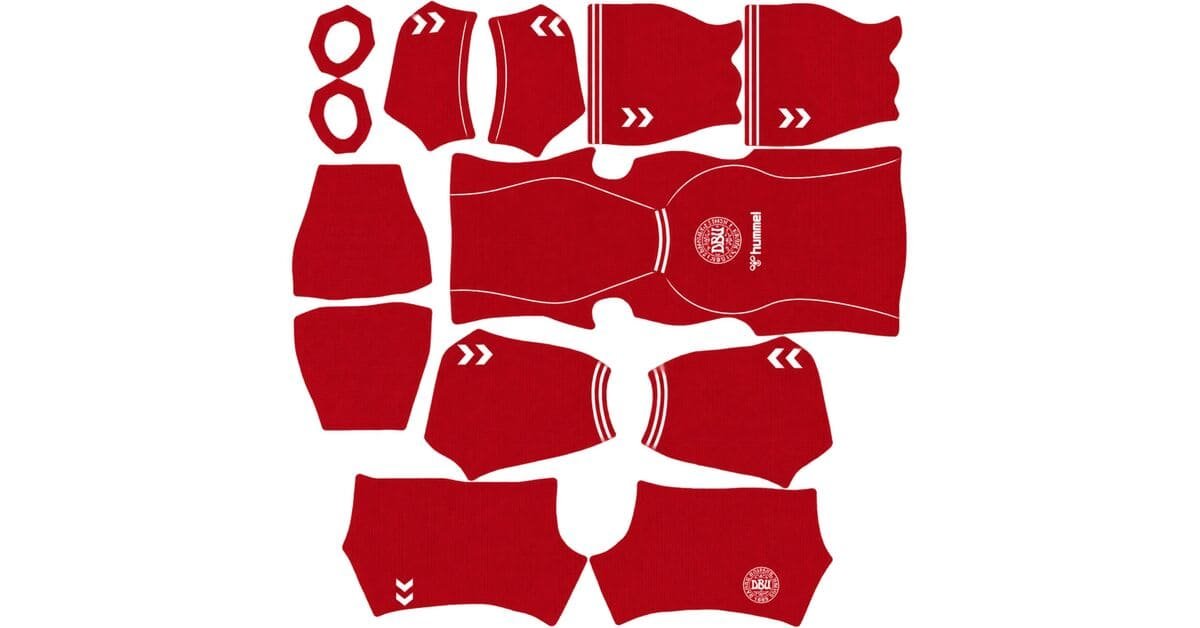
Denmark Home Kit
Home Kit 512×512 (2026/27)

Denmark Away Kit
Away Kit 512×512 (2026/27)

Denmark GK Home Kit
GK Home Kit 512×512 (2026/27)
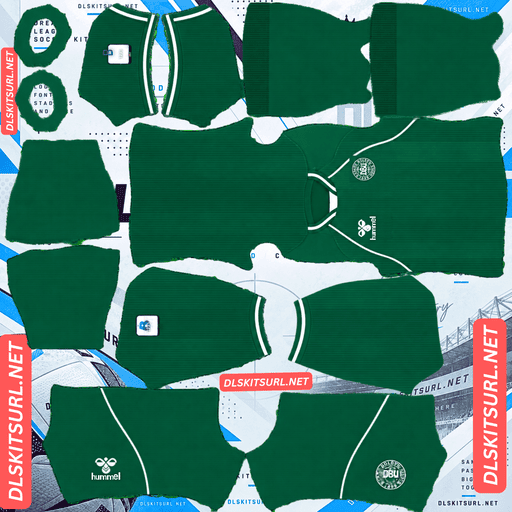
Denmark GK Away Kit
GK Away Kit 512×512 (2026/27)
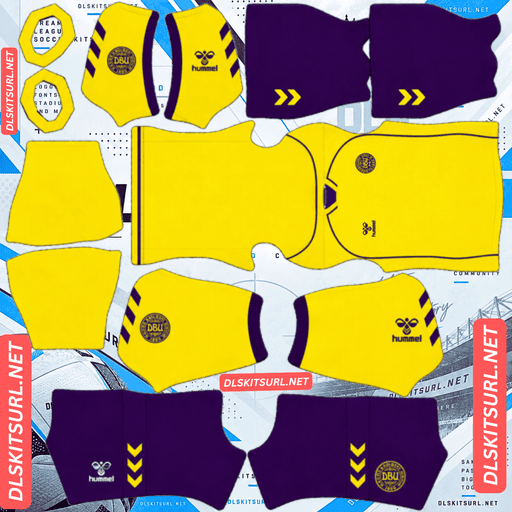
Denmark GK Third Kit
GK Third Kit 512×512 (2026/27)
The away kit has one clever detail that DLS is almost guaranteed to overwrite. That matters before you judge the file.
The flag emerges where your badge lands
Released in March 2026, Denmark’s away shirt is predominantly white, covered by an intricate grid of narrow red pinstripes running vertically and horizontally. At the chest, the pattern breaks to create the cross of the Danish flag around the red Hummel and DBU marks.
The design references the Roligan supporter movement and the famous “we are red, we are white” chant from 1986, while the pinstripe layout draws from Denmark’s EURO 1988 shirt.
The pinstripes themselves will survive
Red against white is maximum contrast.
That puts this grid at the safest end of the pinstripe scale. Across fourteen clubs now, the same rule keeps appearing: maximum contrast survives, moderate contrast is borderline, and minimal contrast disappears. Midtjylland demonstrated all three outcomes at the same stripe width only recently.
Denmark’s red-on-white combination sits at the top of that scale.
A genuine 512×512 file should keep the grid intact. Count the lines at full size. If you can separate individual horizontal and vertical stripes, the file is doing its job. If everything has merged into a pink wash, the source is probably undersized.
But the flag is negative space at the chest
The clever part of the shirt is actually created by absence.
The red pinstripes stop at the chest, and the empty space forms the Danish flag cross.
Then DLS draws your imported crest over that exact area.
So the one part of the design that depends on an empty space is the part the game covers.
Expect to keep the grid and lose the flag effect.
Which makes this a specific kind of badge collision
Most badge collisions cover something that was printed on the shirt. Here, the badge covers nothing — an intentional gap in the pattern — and therefore removes the shape that gap was creating.
That is why a negative-space design cannot survive the imported badge in the same way a stripe or band can.
A sash continues on both sides of a badge. A chest band continues past it. The Danish flag break does not.
Fiorentina’s centenary mark, Alianza FC’s gothic A and Ghana’s Black Star face the same basic coverage problem, while Lugano’s V and Brøndby’s chest band remain readable because their shapes continue beyond the badge area.
So check the grid, not the flag
Count the pinstripes at full size.
If the individual lines remain visible in both directions, you have a good quality indicator. If they have merged, the file is too small or has been poorly prepared.
A two-axis grid at pinstripe width is particularly useful as a test because it is demanding in both directions.
Confirm the dimensions as well. On a computer, right-click the image and open it in a new tab so your browser can report the actual image size.
And a grid has a second problem
The file has to align the pattern both horizontally and vertically at every seam.
That is what makes the grid harder than a normal stripe.
Croatia’s checkerboard is the useful comparison. The same basic problem applies: a pattern that looks perfect on the front can reveal errors when it crosses the side seams or sleeve junctions.
Import the file and inspect it from the side. Do the horizontal lines continue at the same height across the side seams? Do the vertical lines remain parallel where the sleeves meet the body?
A normal vertical stripe has one alignment problem.
A grid has two.
Visibility
Dream League Soccer renders players small, so the base colour matters as much as the pattern.
White is the brightest base available and has no meaningful risk of blending into the pitch.
The red grid then adds constant internal contrast, making the away the more readable of Denmark’s two main shirts.
Use navy or black numbers on the away. White numbers on white are invisible, which is the standard mistake on a pale kit. The number colour comes from the game’s separate swatches, not from the shirt image itself.
The home’s centred crest is good news
Released on 4 March 2026, Denmark’s home is a classic red shirt with tonal stripes inspired by previous Denmark designs. It has a white V-neck with a red stripe, white raglan-sleeve piping, white shoulder chevrons and white cuffs with red stripes.
The Denmark crest sits centrally on the chest, with the Hummel wordmark and bee logo directly underneath in white.
Which matches where the game puts a badge
DLS draws your imported crest on the chest.
Most clubs place their real crest on the left, so the game’s badge position can look slightly different from the authentic shirt.
Denmark is unusual here because the real crest is already central.
That means your imported badge lands roughly where the real one belongs, giving the home a small but genuine advantage over most club shirts.
Juárez, Universidad de Chile, Croatia and Heidenheim benefit from the same basic placement.
The Hummel wordmark directly underneath the crest is another matter. Your imported badge will partly cover it, so expect that detail to disappear.
But the tonal stripes will not survive
A tonal stripe is simply the same colour in a different shade.
There is no strong colour boundary for a 512×512 PNG to preserve, and the range available within a saturated red base is limited.
So expect the home to become a clean red shirt.
That is a contrast limitation, not necessarily a bad file. A stronger source cannot make a tonal detail survive if the game has too little visual separation to reproduce it.
Bayern’s tonal pinstripes, Servette’s garnet home, Brøndby’s women’s shadow striping and Odense’s chequered third run into the same limitation.
And the white detailing is what you check
White against red is maximum contrast.
That means the V-neck, sleeve piping, cuffs and Hummel chevrons should all survive. They may look less detailed than on the real shirt, but the boundaries should remain present and clean.
The chevrons are the best quality gauge.
Hummel’s signature trim is a row of small repeated shapes across the shoulders. They are fine, repetitive and high-contrast, making them one of the most sensitive elements on a Hummel kit.
Use them to judge both Denmark files.
Odense, AC Horsens and Brøndby give you the same Hummel quality test.
The neckline text goes
“- FOR DANMARK -” is printed inside the neckline.
That text is not going to import.
The DLS kit template does not map interior surfaces, regardless of manufacturer or image resolution.
Expect it to be absent.
Nacional’s collar inscription, LAFC’s collar message and Alianza Lima’s slogan have the same problem.
Visibility
Red sits close to green’s opposite, making it one of the strongest shirt colours for match visibility.
Once the tonal stripes disappear, the home becomes a clean saturated red shape with the white collar, cuffs and chevrons breaking it up.
It is still a strong DLS kit — just a simpler version of the real shirt.
Use white numbers on the home.
You get a choice of shorts
This is one place where the game actually lets you reproduce the real options.
Hummel made the home available with red and white shorts.
DLS maps the shirt, shorts and socks separately, so either combination can be used.
Which is worth thinking about
An all-red combination reads as one bold block at match distance. It is strong, but visually uniform.
A red shirt with white shorts breaks the player into two sections, making the figure slightly easier to track.
For pure readability, white shorts are the better choice.
For authenticity, use whichever combination Denmark wore for the match or period you are trying to reproduce.
Bahía, Young Boys, Rosario Central and Brøndby also split their colours across different garments this season, but Denmark is unusual in giving you two official home-short options to choose from.
Which Denmark kit survives best?
The home becomes a strong red shirt because the tonal stripes disappear, but the white trim survives cleanly. It is also highly visible on the pitch.
The away keeps its red pinstripe grid, although the flag break at the chest is covered by the imported badge. It is the more demanding file because the grid has to align in two directions, but it is also the more readable of the two.
The away is the best overall quality test, while the home is the simpler match-day shape.
These kits run to 2028
This is worth knowing because it changes how long your files remain useful.
Hummel designed the collection for the 2026-28 international cycle, covering the Nations League and Euro 2028 qualifying as well as the 2026 window.
That means a file saved now should remain current for considerably longer than a normal club shirt.
And a note on the labelling
These shirts are often catalogued as “2026 World Cup” kits because they were released during the qualification campaign.
Denmark did not qualify, losing a play-off final to the Czech Republic on penalties.
That does not change the shirts themselves. They remain Denmark’s current designs through the 2028 cycle.
So a file labelled “Denmark World Cup 2026” can be the same kit as one labelled “Denmark 26-28.”
Check the design, not the tournament name.
How to tell if a Denmark file is current
Four checks will settle it.
First, look for Hummel branding, although Hummel have supplied Denmark for decades, so the logo alone will not date the file.
Second, the home should have the centrally positioned crest with the Hummel wordmark underneath.
Third, the away should have the red pinstripe grid with the break at the chest.
Finally, compare the actual image with the cards above. Denmark’s red shirts can look broadly similar across different eras, so the design is more useful than a filename.
The central crest placement is the strongest visual marker for this particular collection.
How to use a Denmark DLS kits URL
Copy the link from the copy button on the kit card, not from the browser address bar. The browser address usually points to the page rather than the direct image.
Open Dream League Soccer and go to My Club → Customise → Kit. Do not choose Logo; the badge is imported separately.
Select your slot before pasting because the selected slot is the one that gets replaced. Press and hold the URL field, tap Paste, then Confirm. Older builds may call that button Download.
With a home and away available, the third outfield slot is free. Hummel also released goalkeeper shirts in yellow, green and dark grey, so one of those can be used as another outfield option if you prefer.
Set the shorts deliberately as well. Denmark’s red and white options are mapped separately from the shirt.
The first custom kit requires a one-time gem unlock. After that, changing kits costs nothing.
Test the link first
Open the URL in a browser before putting it into the game.
The image should fill the screen by itself, and the address should end in .png.
If you see a webpage with headers, buttons or other content around the image, it is a viewer page rather than a direct image file, and DLS cannot use it.
On the away, count the pinstripes in both directions. A two-axis grid at pinstripe width is a very sensitive quality check. Merged lines are a warning that the source is undersized.
On the home, check the Hummel chevrons.
Do not judge either file by the flag break or the tonal stripes. The flag break is covered by the imported badge, while the tonal stripes lack enough contrast to survive in the first place.
Why do Denmark kit URLs stop working?
Three things account for most broken kit links.
Free image hosts delete files. Unused uploads can be cleared after months or years while the original reference remains. Denmark are a well-covered national side, and the 1986 connection gives collectors another reason to preserve older shirts, so current files are relatively plentiful.
National-team files can still become harder to find once a cycle ends.
These kits run through 2028, giving you a longer window than usual, although the goalkeeper shirts are the higher-risk files because fewer people tend to preserve them.
Hotlink protection can also be enabled. The host may allow the image to open in your browser but reject requests from another application. That is why a URL can work when clicked and fail when pasted into DLS.
The preview and the direct link can also be different files. A page might display a thumbnail hosted locally while giving you a URL pointing somewhere else. The preview remains visible even after the actual direct file has disappeared.
Here, the shirt shown and the copied URL are the same file on the same server.
The Denmark badge
Set the crest during the same session, but choose Logo rather than Kit.
The DBU crest carries the Danish flag with the federation lettering inside a shield.
The flag cross is an excellent shape for DLS. It consists of bold perpendicular bars with strong contrast and little fine detail to lose, so the main symbol remains clear even when rendered small.
The lettering is more vulnerable and will soften, which is why a genuine 512×512 badge file is preferable to an enlarged one.
DLS crops every badge into a circle. Because the shield narrows toward its base, leave clear space around the complete design rather than trimming the image tightly to the artwork.
The badge is especially important on the away because it lands exactly where the shirt’s own flag motif was designed to appear.
In effect, your imported crest replaces one Danish flag treatment with another.
Keeping your Denmark kits
Custom kits are stored on your device rather than in your account.
Updating the game normally keeps them, but reinstalling it or changing phones can remove the custom kits and badge.
These shirts run through 2028, so files saved now should remain useful for a much longer period than a normal club kit.
Save all four URLs in a notes app before importing them, and record which shorts colour you chose.
FAQ FOR RANK MATH
What is a Denmark DLS kits URL?
A direct link to a 512×512 PNG Denmark shirt that you paste into Dream League Soccer’s kit screen. A working direct image link ends in .png.
Will the flag on the away kit show up?
Not fully. The flag is created by a break in the red pinstripe grid at the chest, and that is exactly where DLS places your imported crest. The badge therefore covers the negative space that creates the flag shape.
Do the away pinstripes survive?
Yes. Red against white has maximum contrast, so the grid should remain visible in a genuine 512×512 file. Count the horizontal and vertical lines; merged stripes are a warning that the source is undersized.
Why don’t the home kit’s tonal stripes appear?
They use the same red in a slightly different shade. There is not enough colour separation for the subtle pattern to survive reliably at 512×512. Expect the home to become a clean red shirt.
How do I check the quality of the home file?
Use the Hummel chevrons on the shoulders. They are small, repeated and high-contrast, making them one of the most sensitive details on a Hummel shirt.
Should I use red or white shorts?
Both are official options. White shorts break the player’s silhouette into two sections and can make the player easier to track, while all-red creates one strong uniform block.
Is a file labelled “Denmark World Cup 2026” the right one?
Yes. These shirts were released during the qualification campaign and belong to the 2026-28 cycle, so a “World Cup 2026” label and a “Denmark 26-28” label can refer to the same design.
How long will these kits stay current?
Through the 2026-28 international cycle, including Euro 2028 qualifying, which gives them a considerably longer lifespan than a normal club kit.