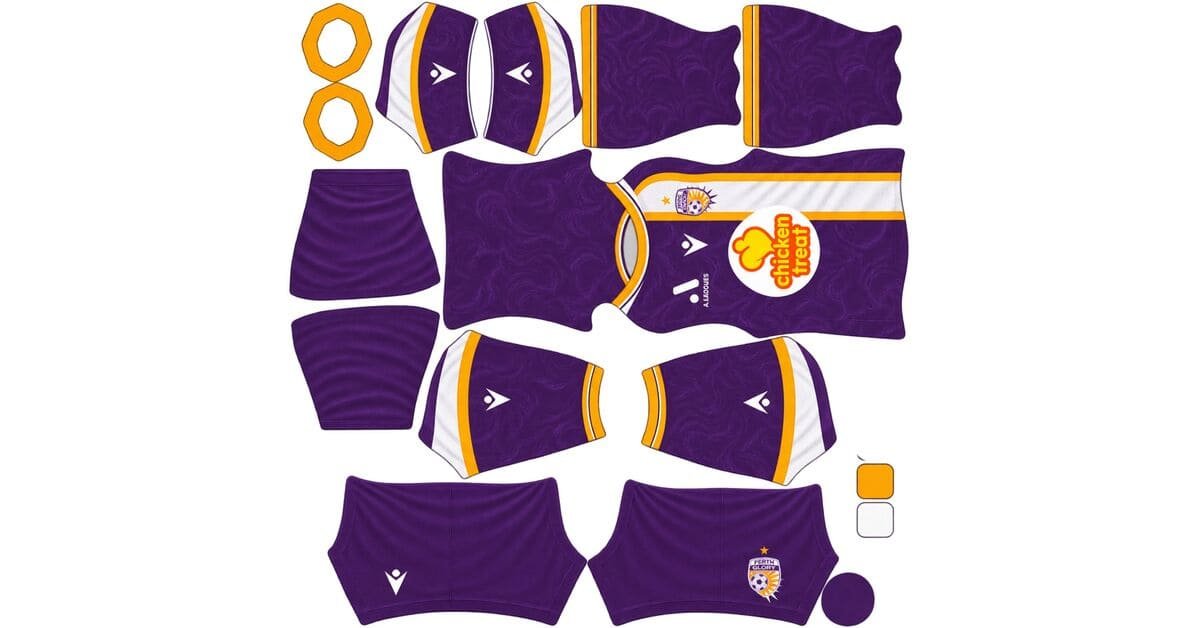
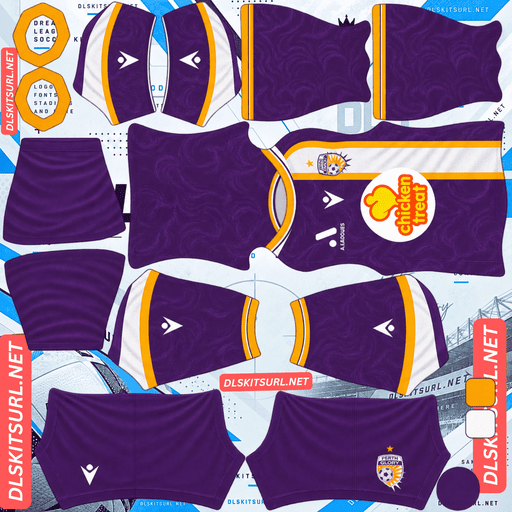
A Perth Glory DLS kits URL is a direct link to a 512×512 PNG Glory shirt you paste into Dream League Soccer. All four slots are below, with each file loaded into the game before it went on this page.
Perth Glory Logo
Official Logo 512×512 (2026/27)
Perth Glory Home Kit
Home Kit 512×512 (2026/27)

Perth Glory Away Kit
Away Kit 512×512 (2026/27)
Purple and orange make a striking shirt, but they do not compress as cleanly as the colour combination suggests.
Purple and orange looks bolder than it compresses
Perth’s identity is built around purple and orange, and the two colours behave differently from what your eye expects.
The hue contrast is strong, but the value contrast is not
Purple is cool, orange is warm, and they sit close to opposite sides of the colour wheel. That is why the combination looks so bold on the actual shirt.
But hue and value are different things.
A saturated purple and saturated orange can be surprisingly close in lightness. Turn them into greyscale and the difference becomes much smaller than it appears in colour.
That matters in a compressed 512×512 image because lightness is preserved with much more detail than colour information. Colour boundaries are averaged over larger areas, so an edge relying mainly on hue can soften even when it looks perfectly sharp on the original shirt.
That is why Perth’s purple-and-orange boundaries can arrive softer than expected. Narrow orange piping, collar inserts and cuff bands are the first places to notice it.
What to check
Open the orange detailing at full size before importing. Look closely at trim, piping, collar inserts and cuff bands rather than judging only the overall shirt.
White is a much better quality gauge. Perth’s 22-23 home used white sponsor logos alongside orange trim, and white against purple creates a genuine lightness difference. If that white remains crisp, you have a much better indication that the file itself is good.
Check the dimensions as well. Open the image in a new browser tab and verify the actual pixel size rather than trusting the filename.
Both colours still play well in DLS
There is an upside to the pairing.
DLS players are viewed at relatively small sizes, so the distance between the shirt colour and the pitch matters more than fine colour separation.
Purple sits a long way from pitch green and remains a distinct, saturated shape. Orange performs even better because it is bright and warm.
So Perth has an unusual combination: excellent overall visibility but weaker fine colour definition.
Fiorentina, Austin FC, Orlando City, Elche, Alianza Lima’s Morada and Hoffenheim’s lilac third benefit from the same general advantage of purple-based shirts.
Number colour
DLS gets number colours from the small swatches in the kit template rather than from the shirt image itself. One controls the shirt numbers and another controls the shorts.
Use white on a purple shirt.
Orange may look like the obvious second choice, but it is too close to the purple base in lightness. The result is less readable than the colour’s brightness suggests.
For Perth, white is the safer option.
Macron’s new fabric will not appear
This affects the entire Macron 26-27 range.
Macron built the collection around 3D knit jacquard fabrics, where the pattern is created through the structure and relief of the material.
A flat PNG cannot carry the surface
A jacquard pattern depends on how the threads are woven. A 3D knit adds raised and recessed areas on top of that.
A 512×512 PNG has neither threads nor physical depth.
There is therefore no compression problem to solve. The surface effect simply has nowhere to go.
If a Perth shirt looks flatter in DLS than it does in launch photography, that does not automatically mean the file is poor. The original design contains information that the game’s flat kit image cannot reproduce.
Basel, Lausanne-Sport, Servette, Sion, Thun, Alavés, Bologna, Udinese and Hoffenheim are among the other Macron clubs facing the same limitation.
Marseille’s woven chassis, Croatia’s woven away and Nacional’s jacquard map fall into the same category.
Let the colour blocking carry the shirt
That part survives.
Defined colour blocks, panels, trim and logos have actual contrast and geometry for the PNG to preserve. Fabric depth does not.
So judge a Perth file by the blocked areas and trim, not by whether the shirt looks as rich or textured as the original product photography.
The 30th anniversary details will not travel
Perth’s 26-27 home and away mark the club’s 30th anniversary season.
Anniversary markings occupy difficult areas
Milestone details are often represented with small text, dates or fine graphics. Unfortunately, the common locations for those details are exactly the areas DLS handles poorly.
A marking on the chest is covered by your imported badge.
A mark on the upper back or around the neck sits in a small, low-resolution area and competes with the squad number.
A hem detail is rendered very small and can partly disappear beneath the shorts.
Anything inside the collar is not represented by the kit template at all.
So expect much of the anniversary material to be absent.
That is a limitation of the game rather than evidence of a bad PNG.
Luzern’s 125th anniversary home, AGF’s 1880 tribute, Lausanne’s 130-year kit and Unión de Santa Fe’s 1996 reference run into the same problem.
The retro collar is another weak area
Perth’s 25-26 home used a retro collar with an orange tint, referencing the club’s National Soccer League era.
Collars are among the smallest areas on a DLS kit template, and orange against purple is already the weaker colour pairing described above.
Expect a retro collar to become a thin, simplified line rather than a perfectly reproduced piece of the original shirt.
Monza’s collar-led home, Paris FC’s wavy collar and D.C. United’s woven cuffs show similar limitations.
The home and away
Both 26-27 kits were released together in October 2026 and are made by Macron.
Compare each file directly with the kit cards rather than relying on descriptions elsewhere. The important checks remain the same: colour boundaries, trim, logos, sponsor clarity and image dimensions.
The home was poorly received
Perth’s 26-27 home ranks among the lower-rated A-League kits this season.
That can have a practical effect on DLS files. A design that attracts little enthusiasm usually attracts fewer people willing to make and host a 512×512 version.
Expect fewer working options, particularly for the less popular designs. When you find a good file, save it.
Brisbane Roar’s away and third, Luzern’s gold third and Vaduz’s teal third face a similar problem.
Watch for a tonal away
Perth’s 25-26 away is worth remembering because it demonstrates another common DLS failure.
It was catalogued as purple on purple, using a tonal graphic.
A tonal pattern relies on one colour appearing in slightly different shades. There is little colour separation for the image compression to preserve.
The result is a shirt that can arrive looking almost completely plain purple.
The awkward part is that the shirt was well received by supporters. A design can therefore be popular in real life while being almost impossible to reproduce faithfully in DLS.
If the 26-27 away also uses a tonal treatment, inspect the flat PNG carefully. If you can clearly see the pattern through actual contrast, it has a chance of carrying over. If the effect depends on depth, sheen or subtle surface variation, expect it to disappear.
Bayern’s tonal pinstripes, Servette’s garnet home, Sydney’s Cove third and Brøndby’s shadow striping face the same issue.
Which Perth Glory kit survives best?
The home is structurally straightforward. The purple base survives strongly, while fine orange elements are the first details worth checking.
The away needs closer inspection because its success depends on whether the graphic uses actual colour contrast or a tonal treatment.
In practical DLS terms, Perth’s strongest feature is its colour identity rather than its fabric effects. Purple remains highly visible, orange gives the shirt additional energy, and white elements provide the cleanest contrast.
Macron have supplied Perth since 2013
Macron’s partnership with Perth began in 2013 and has been extended repeatedly.
Which means the logo does not date the kit
Unlike clubs that change manufacturers every few seasons, Perth have had the same supplier for more than a decade.
A Macron logo therefore tells you very little about whether a file is from 2013, 2020 or 2026.
You have to date the shirt from its design and sponsor instead.
La Vida Homes appeared on the 25-26 away, for example, giving you a tighter clue than the Macron logo itself.
Sion, Thun, Odense, Nordsjælland, Brøndby and SønderjyskE have the same problem: the supplier remains useful for identifying the club but not the season.
Macron is still practical for DLS
Outside the new jacquard fabrics, Macron’s construction is generally straightforward: colour blocking, defined panels and clear trim.
That is good news for Perth.
The structure of the kits can reproduce well even when the fabric texture cannot. Judge the actual shapes and colour boundaries rather than expecting the PNG to recreate the physical material.
The back catalogue is worth a look
Older Perth shirts can make useful alternatives if you find working 512×512 files.
Recent examples include a 2020 AFC Champions League home in purple and orange with a modern front graphic, a 24-25 home with matching purple shorts and socks, and a 22-23 home with a purple V-neck, orange trim and white sponsor logos.
All of them can be imported into DLS. The game does not require the shirt to be from the current season.
The 22-23 home is particularly useful
The white sponsor logos against purple provide genuine value contrast, making the shirt sharper in the game than a design relying entirely on purple and orange.
The 24-25 all-purple set has a different advantage. The shirt, shorts and socks form one large purple block, which gives the player a strong silhouette at distance.
You can also split the colours yourself because DLS maps the shirt, shorts and socks separately.
For example, a purple shirt with white or orange shorts can give the player more definition than an entirely purple outfit.
How to tell if a Perth file is current
Four checks will narrow it down.
First, look for Macron, but remember that the logo alone does not identify the season.
Second, check the sponsor, which gives you a much tighter timeframe.
Third, remember that the 26-27 collection marks Perth’s 30th anniversary season. Anniversary details may not survive the DLS import, but they can still help identify the source design.
Finally, compare the file directly with the kit cards above.
Perth is one of the harder clubs to date because there is no manufacturer change to provide an easy dividing line.
A note on the A-League season
The A-League runs across two calendar years, with the season played through the Australian summer from roughly October to May.
That is why Perth’s current collection is labelled 26-27.
The club also releases its new shirts relatively late, with recent launches arriving in early October.
A file labelled simply 2026 could therefore refer to more than one kit set.
Check the design rather than trusting the year in the filename.
How to use a Perth Glory DLS kits URL
Copy the link with the button on the kit card, not from the browser address bar. The address bar often gives you the webpage containing the shirt rather than the direct image.
In Dream League Soccer, open My Club → Customise → Kit. Do not choose Logo; the badge is handled separately.
Select the kit slot before pasting because that is the slot the game will replace. Press and hold the URL field, tap Paste, then choose Confirm. Older versions may call the button Download.
Once the home and away are installed, the third slot gives you room for an older Perth design such as the 2020 AFC Champions League shirt.
Set the shorts and socks deliberately as well. An all-purple combination creates one large block, while a contrasting lower half can give the player more definition.
The first custom kit requires the one-time gem unlock. After that, changing custom kits is free.
Test the link first
Open the URL in a browser before entering it into the game.
The image should appear by itself, and the address should end in .png.
If the page contains headers, buttons or other website elements around the shirt, it is a viewer page rather than the direct file.
For Perth, inspect the orange detailing particularly closely. Purple and orange look dramatically different in colour but have less lightness separation than the eye suggests, making the orange edges more vulnerable to softening.
Any white elements are a better sharpness check.
Why do Perth kit URLs stop working?
Three problems account for most dead kit URLs.
Free image hosts can delete files. Old uploads may disappear after months or years while the original page still looks intact. A-League kits generally receive less coverage than the biggest European clubs, and a poorly received shirt can have even fewer replacement uploads.
Older Perth designs and the AFC Champions League kits are among the files worth saving when you find them.
Hotlink protection can block DLS. Your browser may load the image because the request comes from the host’s own website, while DLS is refused because it requests the image directly.
That is why a URL can work perfectly when you click it and fail after you paste it into the game.
The third issue is a preview/direct-file mismatch. A website may show a thumbnail from one location while its copy button points to a different file. The preview can remain visible even after the actual direct link has died.
For the files on these cards, the shirt shown and the copied URL are the same file on the same server.
The Perth Glory badge
Set the crest through the same general area, but choose Logo rather than Kit.
Perth’s badge carries the club’s purple-and-orange identity along with the club name and stylised central artwork.
DLS crops imported badges into a circle, so use a file with enough clear space around the artwork rather than one tightly cropped to its edges.
The purple-and-orange issue matters here too. At badge size, colours that differ strongly in hue but not much in value can begin to merge.
Look for a version with a white or black outline separating the major elements. That outline gives the badge a much stronger edge when it is reduced inside the game.
Use a genuine 512×512 badge rather than an enlarged low-resolution image.
Keeping your Perth kits
Custom kits are stored on your device rather than permanently attached to your account. Updating the game usually leaves them in place, but reinstalling DLS or changing phones can remove the saved kits and badge.
Perth is especially worth documenting because Macron does not provide a useful supplier change for dating the files.
Save all four working URLs in a notes app and record the sponsor or design beside each one.
That makes it much easier to tell your 26-27 files apart from older purple Macron shirts later.
FAQ FOR RANK MATH
What is a Perth Glory DLS kits URL?
A direct link to a 512×512 PNG Glory shirt that you paste into Dream League Soccer’s kit screen. A working direct link normally ends in .png.
Why does purple and orange degrade faster than it looks?
Because the two colours differ strongly in hue but not as much in lightness. Compression preserves lightness in much more detail than colour, so edges that depend mainly on hue can soften.
What should I check on a Perth kit?
Check the orange detailing at full size, especially trim, piping and collar inserts. White elements are an even better quality gauge because they create a stronger value difference against purple.
What number colour should I use?
White is the safest choice on purple. Avoid orange where possible because its lightness is too close to the base colour, making the number less readable than expected.
Is purple good for DLS?
Yes. Purple sits well away from pitch green and remains a distinct, saturated shirt colour, making it one of the stronger bases for visibility.
Why doesn’t the Macron fabric texture appear?
The 26-27 range uses 3D knit jacquard construction with physical woven relief. A flat 512×512 PNG contains no threads or depth, so the fabric effect cannot be reproduced.
Will Perth’s 30th anniversary marking appear?
Not reliably. Anniversary details placed on the chest, back, hem or inside the collar are either covered by the imported badge, reduced heavily, partly covered by the shorts or not mapped by the kit template.
Why did the 25-26 away look plain in DLS?
Its purple-on-purple tonal graphic depended on subtle shade variation rather than strong colour contrast. That type of pattern can disappear when transferred to a compressed 512×512 image, even if the original shirt was well received.