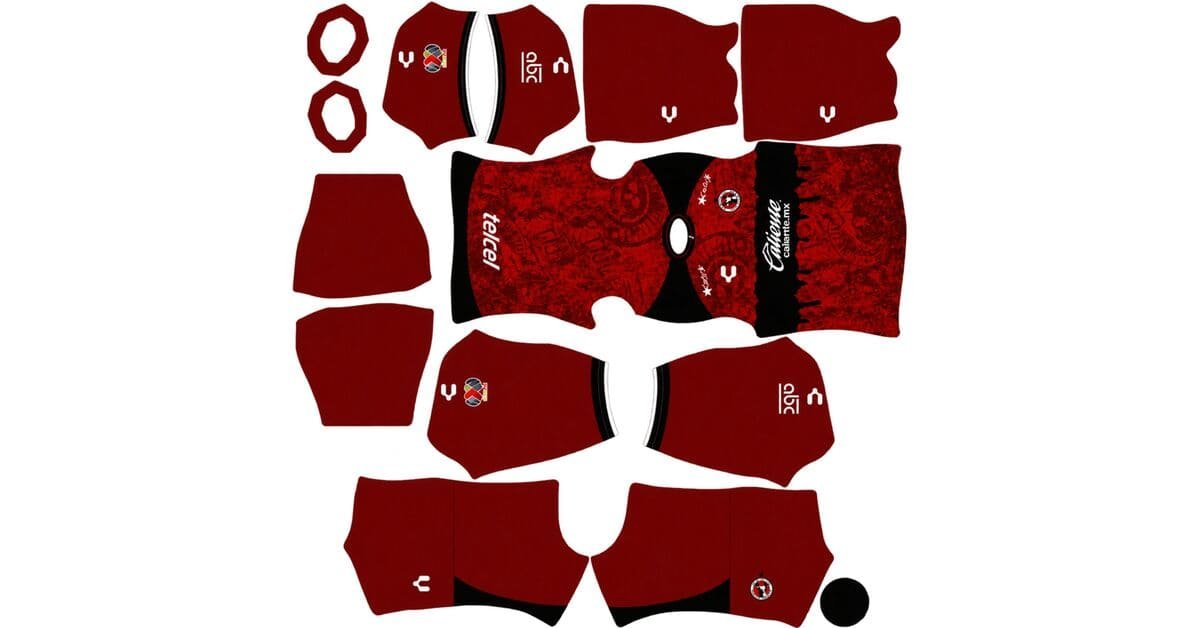
A Tijuana DLS kits URL is a direct link to a 512×512 PNG Xolos shirt you paste into Dream League Soccer. All four slots are below, with each file loaded into the game before it was added to this page.

Tijuana Logo
Official Logo 512×512 (2026/27)
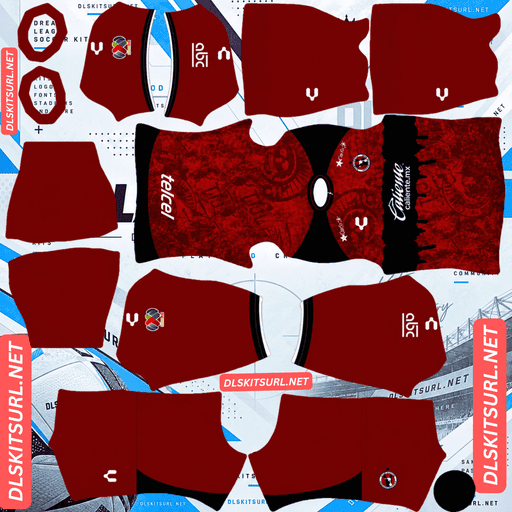
Tijuana Home Kit
Home Kit 512×512 (2026/27)
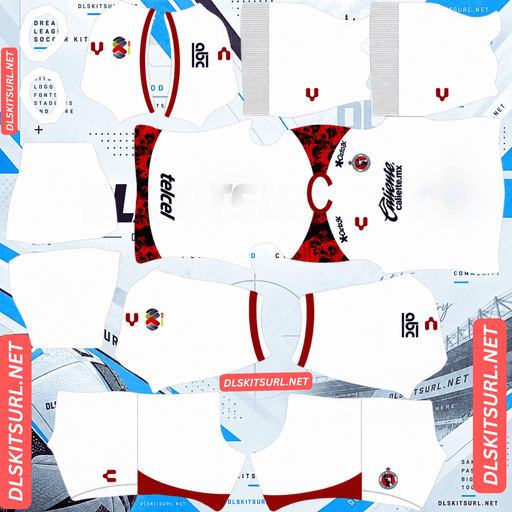
Tijuana Away Kit
Away Kit 512×512 (2026/27)
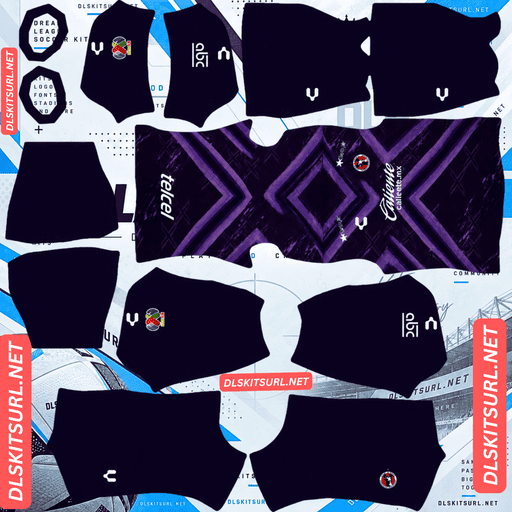
Tijuana GK Home Kit
GK Home Kit 512×512 (2026/27)

Tijuana GK Away Kit
GK Away Kit 512×512 (2026/27)

Tijuana GK Third Kit
GK Third Kit 512×512 (2026/27)
Reebok returned to Mexican football with these kits, and both shirts present a different problem at 512×512. The home asks too much from the file’s ability to preserve detail, while the away depends on accurate geometry.
The home’s DNA pattern is made of letters
Launched at the Estadio Caliente, the home carries Tijuana’s red and black identity with a DNA-inspired pattern that combines the letters “X” and “TJ.” The idea represents the connection between the club and its supporters.
Which stacks three problems
The first problem is lettering. Small letters are among the hardest details for Dream League Soccer to reproduce because their internal shapes need enough pixels to remain distinct. At 512×512, there simply is not much room once the pattern covers an entire shirt.
Then there is the fact that it is repeating pattern work. Small motifs placed next to one another begin to merge before the design has even reached the base colour.
Finally, the pattern is built as a DNA strand, with fine lines twisting, overlapping and changing direction across the shirt.
The realistic expectation is therefore a pattern reduced to texture, or sections of it disappearing completely.
That is a problem of contrast and density rather than file quality. A sharper source cannot create the missing pixels, so no version of the 512×512 file is going to reproduce the real pattern in full.
Cruz Azul’s crest pattern, Monaco’s embossed monogram, Alavés’s crowd photograph and Lugano’s city map all run into the same basic limitation, just at different points on the scale.
And red and black is a moderate pairing
Red is a saturated mid-value colour, while black is the darkest value available. There is a visible difference between them, but it is nowhere near the separation you get from red against white.
That matters when the DNA pattern itself depends on the two colours being clearly separated. Whether the pattern is black over red or red over black, the design has less contrast to work with than it appears to have in the original shirt.
For comparison, red on white has maximum internal contrast, red on black is moderate, while green on black is weak.
Check the crest, Reebok logo and sponsor instead. Those have defined edges and are much better indicators of whether the file is clean. Also confirm the actual image dimensions in your browser. On a computer, right-click the image and open it in a new tab to inspect it directly.
Visibility
Dream League Soccer displays players at a small size, so the base colour matters almost as much as the shirt design.
Red sits well away from pitch green and is one of the stronger colours for player visibility. Black also separates from the grass, although it does not add any brightness.
Once the DNA pattern disappears, the home effectively becomes a red and black shirt with much less internal definition than the real version.
Use white numbers on the home. They remain distinct against both red and black, while darker number colours can disappear into one of the two sections.
The away’s X lines are crossing diagonals
The 26-27 away is built on a white base and takes its inspiration from Mictlán, the underworld of Mexica belief. The lines across the front form X shapes, representing the staircases descending into the underworld.
Which is demanding geometry
A diagonal has to maintain both its position and angle as it crosses each shirt panel. If you correct the position without correcting the angle, the line can still look wrong when it reaches the next seam.
An X makes that problem harder because it contains two diagonals moving in opposite directions. Both have to line up, and they also need to meet correctly at the crossing point.
A vertical stripe is comparatively simple because its edges only need to stay in the correct position. A horizontal band has several alignment points across the template. A diagonal sash introduces position and angle checks at every seam. Crossing diagonals add the second opposing line and the junction where they meet. A checkerboard creates another two-axis alignment problem across the whole shirt.
Deportivo La Coruña’s saltire third is the closest comparison on this site. It creates the same two-directional alignment problem and sits near the top of the difficulty scale.
But the contrast should carry it
The good news is that the away starts with a white base, giving the lines plenty of contrast regardless of their exact colour.
The X shapes should therefore survive clearly. The issue is placement rather than visibility. This is the same distinction seen with Croatia’s checkerboard and Monaco’s diagonal designs: the pattern can survive while its alignment goes wrong.
Import the file and check it from the side. The important question is whether the diagonals continue at the same angle when the front panel reaches the side. Also check whether the crossing point sits where it should.
And your badge lands near the crossing
Dream League Soccer places your imported crest on the chest, which means the badge sits at or close to the point where the two diagonals meet.
That does not destroy the entire design, though. An X spreads in four directions, so its arms continue well beyond the badge.
You lose the central junction while keeping the overall X shape. That is similar to what happens with Lugano’s V and Vélez’s chevron, and it is a much better situation than a design that depends entirely on one central emblem.
And white needs the right number colour
Dream League Soccer does not take the number colour from the shirt image. It uses two small colour swatches in the kit template: one for shirt numbers and another for shorts numbers.
That makes white numbers on the white away shirt invisible. It is one of the easiest mistakes to make with a light kit, and the shirt preview does not necessarily reveal it because the numbers are controlled separately.
Use red or black for the away numbers.
Visibility
White gives the away excellent separation from the pitch and is one of the brightest shirt bases available.
The X lines also give the shirt a strong silhouette and visible internal structure. As a result, the away is the more readable of the two Tijuana kits once imported.
Reebok returned after 14 years
These are Reebok’s first Tijuana kits, marking the brand’s return to Mexican football after a fourteen-year absence.
Which makes file dating simple
A Reebok logo on a Tijuana shirt is a very strong indicator that you are looking at the 26-27 range. There is no recent Reebok Tijuana period to create confusion.
Earlier files use different manufacturers:
Charly — 17-18 through 25-26
Adidas — 2015 to 2017
Nike — before that
That makes Tijuana unusually easy to date from the shirt itself. The supplier logo gives you a useful first check before you even inspect the rest of the design.
Pachuca’s move to Skechers this season provides a similar dating clue, while Grasshoppers are the opposite case because their Adidas branding spans two separate eras.
Which Tijuana kit survives best?
The home keeps its red and black identity well, but the DNA lettering pattern is likely to disappear or reduce to faint texture. It remains a good playable kit because the base colours survive strongly.
The away keeps its white base and X-shaped lines much more successfully. The lines should render clearly, but you need to check their alignment across the side seams. Overall, it is the better of the two for 512×512 reproduction.
Tijuana make a lot of special kits
This is worth knowing before you start searching because Tijuana have produced a large number of special and one-off designs.
Recent and current examples include the “De la Frontera pa’l Mundo” Reebok special built around the club’s border identity, a Mexico tribute shirt using national colours and a xoloitzcuintle silhouette, the 2020 Día de Muertos kit with bone-shaped numbers, Star Wars kits from 19-20, and a Lucha Libre-inspired third from the Charly era.
All of these can work in Dream League Soccer as long as you have a working 512×512 image URL. The game does not care how old the original shirt is.
With one that cannot work
The signature feature of the 2020 Día de Muertos shirt was its bone-shaped numbers.
That part cannot be imported. Dream League Soccer uses its own fixed font for names and numbers, and the kit image cannot replace it.
The shirt design itself can be reproduced, but the numbers will appear using the game’s normal lettering instead of the original bone-shaped type.
Santos Laguna have an even more restrictive example this season: their Día de Muertos tribute was a special font rather than a separate shirt, so there is no kit file to import for that design.
And the xolo silhouette should survive
A dog silhouette is exactly the sort of graphic that handles 512×512 well. It has a bold, recognisable outline rather than depending on tiny internal details.
If you want a Tijuana special for the third outfield slot, the xoloitzcuintle design is one of the better choices. Its main graphic has the kind of strong shape that survives where the DNA pattern struggles.
Universidad de Chile’s Chuncho graphic works on the same principle.
There are women’s versions too
Reebok also produced women’s-specific versions of both kits, with their own colour palettes and design details, alongside goalkeeper versions aimed at collectors.
They can be used in the game, but make sure you know which version you are downloading because the colours and design details are not necessarily identical to the main men’s shirts.
Monterrey, FC Juárez, Pachuca and Young Boys also have women’s variants this season.
A note on Liga MX season labels
This matters when searching for the files.
Liga MX runs two tournaments in each season, with the Apertura in the autumn and Clausura in the spring, spanning two calendar years.
Because of that, Tijuana’s current shirts may be described as either 2026 or 26-27 depending on the source. In this case, both labels refer to the same kit range.
Use the actual shirt design as your final check rather than relying on the year in a filename.
How to tell if a Tijuana file is current
Four checks make the identification straightforward.
First, look for Reebok branding. This is the strongest marker because it identifies the new 26-27 range.
Second, the home should show the DNA-style X and TJ pattern in the original source image, even though much of it may disappear after import.
Third, the away should have its white base with X-shaped lines across the front.
Finally, Charly branding means 25-26 or earlier.
The Reebok logo does most of the work here. No other recent Tijuana era used it.
How to use a Tijuana DLS kits URL
Copy the link using the copy button on the kit card, rather than taking the address from your browser. The browser address usually points to the webpage instead of the actual image.
In Dream League Soccer, open My Club, then Customise, and enter the Kit section. Do not choose Logo; the badge has its own import system.
Select the slot before pasting because the selected slot is the one that will be replaced. Press and hold the URL field, tap Paste, and then choose Confirm. Older versions of the game may call that button Download.
The home and away use two of the three outfield slots, leaving the third slot free. Tijuana’s collection of special shirts gives you plenty of options for that remaining space.
The first custom kit requires a one-time gem unlock. Once that is done, replacing or changing custom kits does not cost additional gems.
Test the link first
Open the URL in your browser before importing it. A proper direct file should display the image by itself, and the address should end in .png.
If you see a webpage with headers, buttons or other content surrounding the shirt, you are looking at a viewer page rather than the direct image file. Dream League Soccer cannot use that page as a kit URL.
For the home, do not use the DNA pattern as your quality test. It is expected to lose detail at this resolution. Check the crest, Reebok logo, sponsor and image dimensions instead.
The away needs another step. A crossing diagonal can look perfectly aligned when the image is viewed flat but shift when the shirt is wrapped around the game’s model. Import it and inspect the side panels before deciding the file is correct.
Why do Tijuana kit URLs stop working?
Three common problems can break a kit link, and only one is immediately obvious.
Free image hosts can delete files. Unused uploads may be removed after months or years, leaving a URL that looks normal but no longer returns the image. Tijuana are a second-tier Liga MX club in terms of size, but their reputation for unusual special kits gives them more kit coverage than their league position might suggest. Those one-off shirts remain the highest-risk files.
Hotlink protection can also be enabled. A host may allow the image to open when you visit it directly while refusing requests coming from another application. That is why a URL can work perfectly in your browser and fail when pasted into Dream League Soccer.
The third issue is that the preview and the direct file can be different files. A page may display a thumbnail hosted on its own server while the copy button points somewhere else. The page continues to work even after the actual image URL has died.
For the files listed here, the image shown and the URL provided are the same file on the same server.
The Tijuana badge
Set the crest during the same customisation session, but choose Logo instead of Kit when you enter the relevant menu.
Tijuana’s badge features the xoloitzcuintle, the hairless Mexican dog that gives the club its name, rendered in the club’s red and black colours.
That silhouette is well suited to Dream League Soccer because its main shape is bold and recognisable rather than dependent on tiny details. It should remain clear at the size used beside the score.
Red against black provides moderate contrast, so use a genuine 512×512 badge file rather than enlarging a smaller source.
Remember that Dream League Soccer crops imported badges into a circle. Leave clear space around the artwork instead of trimming the file tightly to the edges.
One thing you cannot reproduce
There is another part of Tijuana’s identity that has nothing to do with the shirt image.
Tijuana require their players to wear red boots, and only red boots.
Dream League Soccer does not provide a way to import or set boot colours, so that rule cannot be reproduced in the game.
It is still a useful reminder that a club’s visual identity extends beyond the kit file itself.
Keeping your Tijuana kits
Custom kits are stored on your device rather than attached to your account. A normal game update should leave them in place, but reinstalling the game or moving to another phone can remove the custom kits and badge.
Tijuana also have enough supplier eras and special editions to make old files easy to mix up. Save all four URLs in a notes app or another place outside the game before importing them.
FAQ FOR RANK MATH
What is a Tijuana DLS kits URL?
A direct link to a 512×512 PNG Xolos shirt that you paste into Dream League Soccer’s kit screen. A working direct image URL ends in .png.
Will the DNA pattern on the home kit show up?
It may survive as reduced texture, but much of it is expected to disappear. The design combines lettering, a repeating pattern and fine twisting lines, which are all difficult for a 512×512 image to preserve.
Then how do I check a home file?
Check the crest, Reebok logo, sponsor and image dimensions instead. The DNA pattern is not a reliable quality test at this resolution.
Do the X lines on the away survive?
Yes. The white base gives the lines plenty of contrast, so the shapes should remain visible. The main risk is alignment because two crossing diagonals must maintain their position and angle across the shirt seams.
Does my badge cover the X lines?
It can cover the central junction, but the four arms of the X continue beyond the badge. You lose the centre while retaining the overall shape.
Who makes Tijuana’s kits?
Reebok, returning to Mexican football after fourteen years. Reebok identifies the 26-27 range, while Charly marks 25-26 or earlier.
Can I get the Día de Muertos kit with bone numbers?
You can import the shirt design, but not the bone-shaped numbers. Dream League Soccer uses its own fixed font for names and numbers.
What number colour should I use?
Use white on the red and black home, and red or black on the white away. White numbers disappear against a white shirt, so avoid that combination on the away.