
A Brisbane Roar DLS kits URL is a direct link to a 512×512 PNG Roar shirt you paste into Dream League Soccer. All four slots are below, with each file loaded into the game before it was added here.

Brisbane Roar Logo
Official Logo 512×512 (2026/27)

Brisbane Roar Home Kit
Home Kit 512×512 (2026/27)
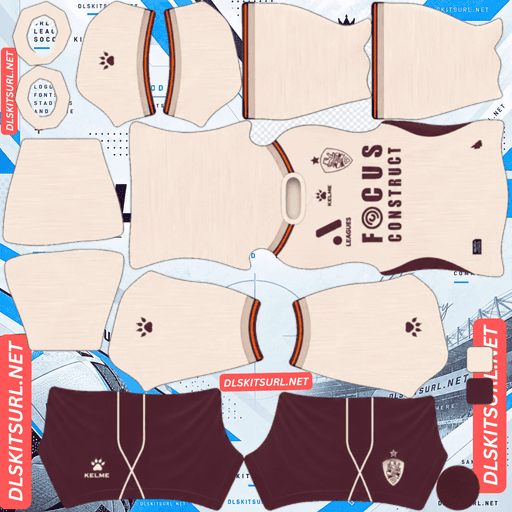
Brisbane Roar Away Kit
Away Kit 512×512 (2026/27)
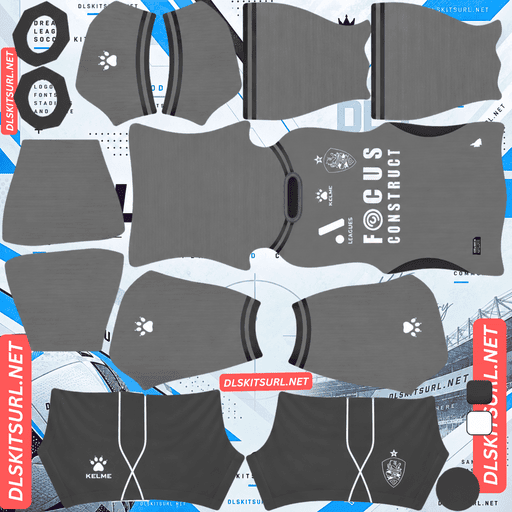
Brisbane Roar GK Home Kit
GK Home Kit 512×512 (2026/27)

Brisbane Roar GK Away Kit
GK Away Kit 512×512 (2026/27)

Brisbane Roar GK Third Kit
GK Third Kit 512×512 (2026/27)
The third kit is the interesting one. Two of its headline features disappear completely in DLS, but the shirt still works surprisingly well because the parts that remain are the parts the game handles best.
The third loses both of its headline features
Kelme introduced Brisbane’s 26-27 collection with a vibrant blue third kit, bringing back the club’s 2005 logo above an embossed lion graphic sweeping across the lower front, with orange detailing around the design.
The 2005 logo is overwritten
DLS draws the crest you import onto the chest. It does not preserve the badge printed into the original shirt file.
That means the retro 2005 logo is replaced by whichever Brisbane badge you have selected.
You can technically use the 2005 crest as your DLS logo and recreate the idea, but there is a catch: the badge is global. It would appear on your home and away kits too, not just the third.
With only one of the three kits benefiting from the old crest, the current badge is normally the more useful choice.
Houston Dynamo’s Archive Kit, Rosario Central’s retro-crest third, Odense’s original-logo third and Nacional’s period crests create the same problem: the historical badge works beautifully on one shirt but changes the identity of every kit once imported as the global logo.
And the lion fails twice over
The lion is embossed, so its appearance depends on raised and recessed areas of the fabric. A flat 512×512 PNG has no physical surface to reproduce that effect.
Its position makes things even harder. The graphic sweeps across the bottom of the shirt, where the kit template is already working with a relatively small area, and the shorts cover part of it once the player model is assembled.
So there are two separate reasons to expect it to disappear.
Monaco’s embossed monogram, Hoffenheim’s antler relief and Viborg’s embossed geometric pattern have the same construction problem. Al-Ittihad’s hem-level tiger claw, Puebla’s hem piping and Cagliari’s hem coordinates demonstrate the positional problem.
Brisbane’s third manages to have both.
Which leaves a vibrant blue shirt with orange trim
That is not necessarily a bad result.
DLS players are displayed relatively small, so the base colour matters more than subtle fabric effects. Vibrant blue sits clearly away from pitch green, giving the shirt a strong silhouette instead of allowing it to disappear into the field.
The orange detailing also has a useful contrast relationship with the blue. The colours are far enough apart in temperature and brightness that the visible trim remains defined.
You lose the heritage concept and the embossed lion, but you keep a readable kit.
That is similar to what happens with Houston’s away and Hoffenheim’s lilac third: the original design loses something in translation, but the remaining colour structure still works.
For numbers, white or navy are the sensible choices on the blue third.
So what do you check?
The orange detailing is the main thing worth inspecting. It is the part of the design with enough contrast and defined edges to tell you whether the file is good.
Check the dimensions as well. On a computer, open the image in a new tab and confirm the actual pixel size.
Do not judge the file by looking for the lion or the retro logo. Neither feature is expected to survive the DLS import.
Orange is Brisbane’s real advantage
Brisbane Roar’s traditional identity is built around orange, with maroon used as the secondary colour.
Which is near the top of the visibility scale
Orange is one of the easier colours to use in DLS. It sits a long way from pitch green, stays bright when the player is viewed from a distance and produces a clear shirt silhouette.
Yellow has the strongest separation in this group, but orange is close behind it. White is also highly visible, sky blue is generally good, while navy is more dependent on lighting and contrast. Traditional green is the difficult one because it can blend into the pitch.
That gives Brisbane an immediate advantage: if the home kit is predominantly orange, it belongs in your home slot.
FC Cincinnati, Lorient, Randers’ third, Olimpia’s orange third and Envigado benefit from the same basic colour advantage.
But maroon is the weaker partner
Maroon is a deep, muted red. It separates from the grass, but it does not have much brightness of its own.
Orange and maroon are also relatively close to one another. They both sit in the warm part of the colour spectrum, so the difference between them is much softer than orange against blue or white.
As a result, maroon detailing on orange will read gently, while orange detailing on maroon will stand out more clearly.
Any white elements do much more of the heavy lifting because white creates a strong contrast against both colours.
For numbers, use white or navy on orange, and white or orange on maroon.
The home and away
The home, away and third were released together as part of Kelme’s debut Brisbane collection.
Compare each file with the kit cards above rather than relying only on a description. The usual checks still apply:
Colour boundaries should be sharp rather than blurred.
Collar and cuff trim should have clean edges.
Kelme branding, the crest and sponsor should remain crisp.
The image should be the correct dimensions.
And note the away was poorly received
The away and third were both among the lower-rated A-League kits with supporters.
That matters when you are searching for DLS files because unpopular designs tend to attract fewer people making and hosting 512×512 versions.
So there may simply be fewer working options for these two.
If you find a good working file, save it rather than assuming another copy will be easy to locate later.
Luzern’s gold and navy third, Vaduz’s teal third and Thun’s navy third face a similar issue.
Watch for embossing across the range
The third’s embossed lion is a reason to inspect the other two shirts carefully as well.
If Kelme has used surface treatments elsewhere in the collection, a flat image may show the printed shape but not the effect itself.
Open each file at full size. A visible graphic with defined edges can survive; a fabric effect cannot be recreated by a flat PNG.
Which Brisbane Roar kit survives best?
The home needs to be checked against its actual card, particularly for any embossing. Its likely strength in DLS is the orange base.
The away should be judged the same way, with particular attention to any surface treatment and the clarity of the Kelme branding, crest and sponsor.
The third loses the 2005 logo and embossed lion, but still gives you a vibrant blue base with orange detailing. In practical DLS terms, it remains a strong-looking kit despite losing the two features that made it special on the original shirt.
Kelme replaced Cikers
Brisbane signed a three-year deal with Kelme covering 26-27, 27-28 and 28-29, replacing Cikers.
Which dates files cleanly
The Roar have changed manufacturers often enough that the supplier logo is one of the easiest ways to date an older file.
Kelme covers 26-27 onward.
Cikers supplied the club in 24-25 and 25-26.
Before that, New Balance covered 23-24, while Umbro supplied the kits from 14-15 through 17-18, with Puma appearing for 13-14.
That makes the manufacturer logo unusually useful when sorting Brisbane files. It can usually place a kit within a relatively small window.
Central Coast Mariners are the main comparison from this series, with even faster supplier turnover across six seasons.
And the three-year term matters
Kelme’s agreement runs through 28-29, so a Kelme-branded Brisbane shirt can remain current for three seasons.
That makes working files worth keeping rather than treating them as disposable links.
Kelme is a practical brand
Kelme is a mid-sized Spanish manufacturer, and its more straightforward construction is generally easier to reproduce at 512×512 than designs built around elaborate woven textures, three-dimensional knits or other surface effects.
The embossed lion is the obvious exception here.
Union Saint-Gilloise, Alianza FC, Adelaide United, Lyngby and the Mariners show the same general advantage with practical manufacturers: when the design is built from defined shapes and flat colour, the DLS file has less to lose.
The back catalogue has options
There are several Brisbane kits worth knowing about before you start searching.
The recent catalogue includes a 23-24 Indigenous kit, a 25-26 rain kit in claret and orange, a 13-14 third in silver-grey with an orange sash, and a 2026 Australia Cup kit by Kelme.
All of these can work in DLS if you have a functioning 512×512 URL. The game does not care whether the original shirt was designed for a league fixture, cup match or special occasion.
With two notes
The Indigenous kit is likely to contain more intricate artwork. At 512×512, detailed artwork tends to reduce toward texture. Strong shapes can survive, but fine linework becomes much less reliable.
The 13-14 third has a more important technical issue: the sash is asymmetric.
It travels from one shoulder toward the opposite hip, so check the direction before importing it. A mirrored sash can look completely believable in a flat preview and still be wrong once you notice which shoulder it starts from.
Orange against silver-grey is also a moderate pairing, so expect the sash to remain visible without necessarily looking extremely sharp.
How to tell if a Brisbane file is current
Four checks settle most Brisbane searches.
First, look for Kelme rather than Cikers. That is the clearest marker for 26-27.
Second, the third should be the vibrant blue design with the 2005 logo and orange detailing.
Third, check whether the file is a league or Australia Cup variant.
Finally, compare it directly with the kit cards above.
The supplier logo does most of the dating work and should remain useful through the end of Kelme’s current contract.
A note on the A-League season
The A-League runs across two calendar years, with the season taking place through the Australian summer. That is why Brisbane’s current collection is labelled 26-27 rather than simply 2026.
Kits are generally released around August and September, later than many European clubs.
So a file labelled only 2026 is not enough to identify the season.
Check the manufacturer logo. Kelme or Cikers will settle the question much faster than the filename.
How to use a Brisbane Roar DLS kits URL
Use the copy button on the kit card, not the address shown in your browser. The browser address often points to the webpage containing the image rather than the image file itself.
In Dream League Soccer, go to My Club → Customise → Kit. Do not open Logo; the badge is handled separately.
Choose the slot you want before pasting. Press and hold in the URL field, tap Paste, then select Confirm. Older versions may label the final button Download.
The three outfield kits occupy the three regular kit slots, while the goalkeeper has a separate slot. Brisbane’s maroon goalkeeper shirt, with its retro crest and orange piping, is also an interesting alternative if you want something outside the usual three.
Set your badge version first if you are considering the 2005 crest. The badge is shared across your kits, so changing it for the third also changes it everywhere else.
The first custom kit requires the one-time gem unlock. After that, changing imported kits is free.
Test the link first
Open the URL in your browser before putting it into the game.
A correct direct file should display the image by itself, and the address should end in .png.
If you see a webpage with a header, buttons or other content around the shirt, you have a viewer page rather than the direct image.
For Brisbane’s third, the orange detailing is the useful visual check. Do not use the missing lion or retro logo as evidence that a file is broken. Those features are lost because of how the game handles the kit, not because the PNG is necessarily bad.
Why do Brisbane kit URLs stop working?
Three problems account for most dead kit URLs.
Free image hosts can delete files. Old uploads may be removed after periods of inactivity, while the original article or card still appears to be intact. Brisbane’s lower-profile away and third, along with special Indigenous, rain and Australia Cup variants, are especially likely to have fewer replacement uploads.
Hotlink protection can also block DLS. A browser may display the image because the request came directly from the host’s own page, while the game’s request is refused. That creates the frustrating situation where a link works when you click it but fails after you paste it into DLS.
The third issue is a preview/direct-file mismatch. A site can display a thumbnail from one location while the copy button points somewhere else. The preview can continue working after the actual file URL has disappeared.
For these Brisbane files, the image shown on the card and the copied link are the same file on the same server.
The Brisbane Roar badge
Set the badge during the same general process, but choose Logo instead of Kit.
There are two relevant versions here: the current Brisbane crest and the 2005 original revived on the third.
The Brisbane badge uses the club’s orange and maroon identity with the lion at its centre. The overall lion shape should reproduce reasonably well because it is a strong, recognisable silhouette, although fine mane details can soften at the small size used in the game.
Orange and maroon are also a relatively narrow pairing at badge size. If the source image is too small or poorly compressed, those colours can begin to merge.
Use a genuine 512×512 badge file where possible, and favour a version with enough white or black separation to keep the elements distinct.
Remember that DLS crops badges into a circle. Leave clear space around the artwork instead of using a file where the design is already pushed against the edges.
Keeping your Brisbane kits
Custom kits are stored on your device rather than attached permanently to your account. Updating the game normally keeps them, but reinstalling DLS or changing phones can remove the saved kits and badge.
Keep the URLs somewhere outside the game.
It is also worth recording which badge version you used, especially with Brisbane because the 2005 crest is part of the current third-kit concept but is not necessarily the best global badge choice.
The Kelme deal runs through 28-29, so the files you save now can remain current for three seasons. Put all four working links into a notes app before you start.
FAQ FOR RANK MATH
What is a Brisbane Roar DLS kits URL?
A direct link to a 512×512 PNG Brisbane Roar shirt that you paste into the kit screen in Dream League Soccer. A working direct file normally ends in .png.
Will the 2005 logo on the third kit appear?
No. DLS draws your selected crest over the chest area of the imported shirt. You can use the 2005 crest as your global badge, but that would place it on every kit you own.
What happens to the embossed lion?
It does not reproduce. Embossing depends on a physical surface, which a flat PNG cannot contain, and the graphic is positioned low on the shirt where the shorts also cover part of it.
Is the third kit still worth using?
Yes. The retro logo and embossed lion disappear, but the vibrant blue base and orange detailing remain. Those colours give the shirt strong visibility in the game.
Is orange a good DLS kit colour?
Yes. Orange separates well from the green pitch and remains easy to see at player size, making an orange-based home kit a strong choice for the main slot.
Which number colours work best?
Use white or navy on orange, white on the vibrant blue third, and white or orange on a maroon shirt.
Who makes Brisbane Roar’s kits?
Kelme, under a three-year deal running through 28-29, replacing Cikers. The Kelme logo is therefore one of the easiest ways to identify a current Brisbane file.
Why are there fewer away and third files?
Both received relatively poor supporter ratings, which can mean fewer people bother producing and hosting 512×512 versions. If you find a working copy, save it rather than relying on another upload appearing later.