
A Central Coast Mariners DLS kits URL is a direct link to a 512×512 PNG Mariners shirt you paste into Dream League Soccer. All four slots are below, with each file loaded into the game before it went on this page.

Central Coast Mariners Logo
Official Logo 512×512 (2026/27)
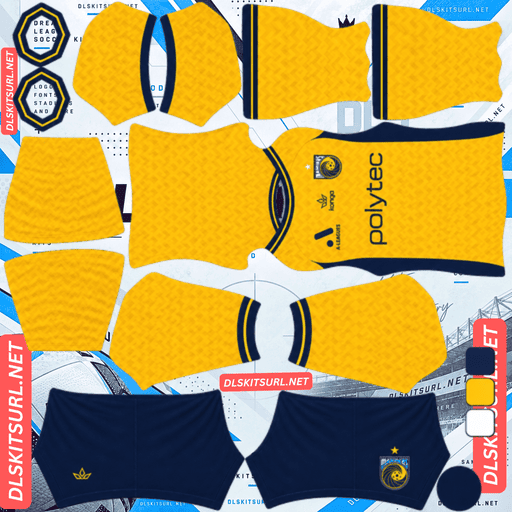
Central Coast Mariners Home Kit
Home Kit 512×512 (2026/27)

Central Coast Mariners Away Kit
Away Kit 512×512 (2026/27)

Central Coast Mariners Third Kit
Third Kit 512×512 (2026/27)
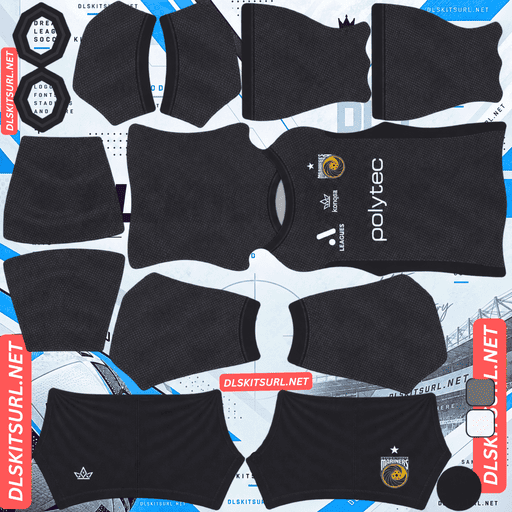
Central Coast Mariners GK Home Kit
GK Home Kit 512×512 (2026/27)

Central Coast Mariners GK Away Kit
GK Away Kit 512×512 (2026/27)
The Mariners have changed kit supplier four times in six seasons, which makes dating their files unusually easy.
The logo dates the file almost exactly
Central Coast announced a new deal with Konqa for 26-27, built around the brand’s grassroots heritage and the club’s community focus.
That makes Konqa the fourth supplier in six seasons.
Paladin covered 21-22 and 22-23. Cikers followed for 23-24 and 24-25. O’Neills took over for 25-26, and Konqa is the 26-27 manufacturer.
Which is the best dating tool on this site
Most clubs keep one manufacturer for several years, so the supplier logo often tells you very little. Sion, Thun, Odense, Nordsjælland and Brøndby all have that problem.
The Mariners are the opposite.
Their supplier logo can place a file within one or two seasons without needing a reference image or a detailed design comparison.
Check the brand first. It does more dating work here than on almost any other page.
And all four help your file
Paladin, Cikers, O’Neills and Konqa are all small or practical manufacturers.
None is built around the premium treatments that cause problems in a flat 512×512 PNG: sublimated weaves, 3D knits, embossed relief and similar surface effects are not the defining feature of these ranges.
So Mariners kits should reproduce faithfully regardless of which recent era you choose.
That is the same advantage Union Saint-Gilloise get from O’Neills, Alianza FC get from Adidas teamwear and Adelaide get from UCAN: the simpler the manufacturing approach, the easier the shirt is to reproduce accurately in a flat file.
With the usual trade-off
The downside is coverage.
Small manufacturers generate fewer kit files, and the A-League receives less kit-site attention than the major European leagues.
Expect fewer working files than you would for a European club of similar standing. Save good links when you find them.
Navy and yellow is a strong palette
The Mariners play in navy and yellow, which is a very useful combination in Dream League Soccer.
Which gets the important thing right
DLS renders players relatively small, so visibility depends heavily on how far the shirt colour sits from the grass.
Yellow is one of the strongest colours available for pitch visibility. It is bright, saturated and sits well away from green.
Yellow against navy also gives you a large value difference. The pairing is close to the maximum internal contrast available on a football shirt.
A yellow-led Mariners kit is therefore among the easiest to see in a match.
A navy-led shirt is different. Navy separates from the pitch cleanly, but it has little brightness of its own.
Open all three files at full size and see which colour dominates. If one of the current kits is yellow-led, that is the logical choice for the home slot because DLS uses that kit most often.
St. Gallen, Viborg, Auckland and Minnesota create similar opportunities this season: the most interesting design is not always the most useful shirt in a match.
Number colour
Dream League Soccer reads number colours from two small swatches on the kit template rather than from the PNG itself. One controls shirt numbers and the other controls shorts numbers.
Use navy on a yellow shirt, and white or yellow on a navy one.
Avoid white on yellow. The two are both light, so the number loses the contrast it needs to remain readable.
The home, away and third
All three 26-27 kits were released together and are made by Konqa.
The home has been rated as the best A-League home kit of the season among supporters, which also means it is more likely to have attracted 512×512 file makers.
Compare each file against the cards above rather than relying on descriptions elsewhere.
The usual structural checks still apply:
Any navy-to-yellow boundary should be razor sharp because the colours provide strong contrast.
Collar and cuff trim should have clean edges.
Konqa branding, the crest and sponsor should remain crisp.
Confirm the actual dimensions. On a computer, open the image in a new tab and check the size reported by the browser.
And check all three against each other
You have three outfield slots, so those three shirts represent the entire visual range of your team.
The Mariners’ recent third kits have often used navy and white or white and navy. That can make a third look extremely similar to a navy-led home.
Put all three source images side by side at thumbnail size before importing.
If two shirts read as essentially the same shape, replace one.
Lyngby Boldklub shows the problem clearly this season, with a navy third competing against a blue home. Having three technically different shirts does not necessarily mean having three visually useful slots.
The cup kits are a trap worth knowing about
Central Coast produce more shirt variants than you might expect.
In 23-24 alone, the club had a home, away, third, special shirt, Cup Home, Cup Away, Cup Third and Cup Final variant. In 24-25 there was also an ACL Home and a Cup goalkeeper shirt. Separate 2026 Australia Cup kits add another layer.
Which makes filenames almost useless
A file labelled “Mariners home” could refer to the league shirt, a cup version, an ACL version or a final-specific variant.
That is why the supplier logo is so useful here.
Check the design against the cards, then use the manufacturer to place it in the correct season.
And check what actually differs before you hunt
Cup and continental variants can differ from league kits only through competition patches and badge treatment.
That distinction has little value in DLS. The imported badge replaces the shirt crest, while sleeve patches are rendered too small to carry much useful detail.
So if the only difference is a competition patch or badge treatment, the variant will effectively look the same in-game.
A cup shirt that changes its colour or layout is worth finding. One that only changes its badges is not.
FC Thun, Basel, Lausanne-Sport, Union Saint-Gilloise and Adelaide United create the same decision this season.
Which Mariners kit survives best?
The manufacturer settles most of the reproduction question: Konqa’s current shirts should reproduce cleanly.
The remaining issue is the colour balance.
The home, away and third should all be judged against the cards, but the yellow-led shirt is the one to favour for visibility. A predominantly yellow design is far more useful in the home slot than a predominantly navy one.
If two of the three current files look almost identical at thumbnail size, use the third slot for something from the back catalogue instead.
The palm tree kits are worth finding
The Mariners have one particularly distinctive design in their history.
Their 2015-16 kits featured the club’s iconic palm tree on the front, with yellow shorts and socks on the home.
Which reproduces well
A palm tree is a bold botanical silhouette. It is one recognisable shape with clear edges rather than a field of tiny detail.
That is exactly the kind of graphic that survives a 512×512 PNG.
There is one complication: the large chest motif occupies the same general area as the badge you import into DLS.
Expect your badge to cover part of the palm tree.
It should still remain visible above and below the crest if the original motif is large enough.
Check its size in the source image before importing. The larger the palm tree, the more of it survives around the badge.
Universidad de Chile’s Chuncho, Tijuana’s xolo and Nordsjælland’s tiger work in the same general territory: large, recognisable silhouettes are much easier to preserve than fine illustrations.
But expect very few files
A kit from a decade ago, belonging to a relatively small Australian club in a league that receives limited kit-site coverage, is always going to be harder to find.
If you find a working palm tree file, take it.
How to tell if a Mariners file is current
Four checks will settle it:
Konqa branding — the clearest 26-27 marker because the deal is new for this season.
O’Neills means 25-26; Cikers means 23-24 or 24-25; Paladin means 21-22 or 22-23.
Check whether it is a league or cup variant, because Central Coast produce both.
Compare the shirt against the cards above.
Point one does almost all the work.
That is unusual enough to make the supplier logo your first check every time.
A note on the A-League season
The A-League runs across two calendar years, with its Australian summer season extending from October into May.
So the Mariners’ current range is labelled 26-27, even though files may also appear under individual calendar years.
Kits are released around August and September, later than many European clubs.
That makes a file labelled simply “2026” ambiguous.
Check the supplier logo. On Central Coast’s kits, that settles the season much faster than the design does.
How to use a Central Coast Mariners DLS kits URL
Copy the link with the button on the kit card, not from your browser address bar. The address bar usually takes you to the webpage rather than the direct image.
In Dream League Soccer, go to My Club → Customise → Kit. Do not use Logo; that is a separate system.
Select the slot before pasting because the selected slot is the one that gets replaced. Press and hold the field, tap Paste, then Confirm. Older versions may call the button Download.
Three outfield kits fill the three outfield slots, leaving the goalkeeper slot separate.
Decide your slot order before importing. If one of the three current shirts is predominantly yellow, it is the strongest candidate for the home slot.
Set the shorts and socks deliberately as well, because DLS treats each part independently. That is especially useful with the Mariners, who have used yellow shorts with navy shirts in past seasons.
The first custom kit requires a one-time gem unlock. After that, changing kits is free.
Test the link first
Open the URL in your browser before taking it into the game.
The image should fill the screen by itself, and the address should end in .png.
A webpage with headers, buttons or other surrounding elements is a viewer page, not the direct file DLS needs.
Check the supplier logo first. On this club it can tell you the season before the actual design does.
Then inspect the navy-and-yellow boundaries. Given the strong contrast between the colours, those edges should be clean rather than blurred.
Why do Mariners kit URLs stop working?
Three problems account for most broken kit links.
Free image hosts delete files. Unused uploads can be cleared after months or years while the surrounding page remains online. The Mariners are a small club in a modestly covered league, and the suppliers themselves generate fewer files than major brands.
That combination means fewer alternatives when an old URL disappears.
Cup variants, ACL shirts and the 2015-16 palm tree kits are among the higher-risk files.
Hotlink protection can also be switched on. The host may allow the image to load on its own website while refusing requests from the game. That is why a URL can work perfectly in a browser but fail when pasted into DLS.
The preview and the direct file can be different. A page may display a thumbnail from its own server while handing out a URL pointing somewhere else. The preview can remain visible after the direct file has disappeared.
Here, the shirt shown on the card and the copied link are the same file on the same server.
The Central Coast Mariners badge
Set the crest during the same session by opening Logo instead of Kit.
The Mariners’ crest uses the club’s navy and yellow identity with maritime imagery.
Dream League Soccer crops imported badges into a circle, so use a file with clear space around the complete design rather than one trimmed tightly to the artwork.
Yellow against navy provides close to maximum contrast, which makes the badge relatively easy to read at the small size used beside the score.
Fine details will soften at that size. That is a rendering limitation, not necessarily a bad file.
Use a genuine 512×512 badge rather than an enlarged version.
The badge matters particularly on a navy-led kit because the dark shirt leaves it as one of the few strongly defined elements.
Keeping your Mariners kits
Custom kits are stored on your device rather than in your account. Updating the game normally keeps them, but reinstalling or changing phones can remove the kits and badge.
Note the supplier alongside every URL you save.
With four manufacturers across six seasons, that is the fastest way to identify an old Mariners file later.
Save all four links in a notes app before importing them.
FAQ FOR RANK MATH
What is a Central Coast Mariners DLS kits URL?
A direct link to a 512×512 PNG Mariners shirt that you paste into Dream League Soccer’s kit screen. A working direct link ends in .png.
How do I date a Mariners file?
Check the supplier logo. Konqa means 26-27, O’Neills means 25-26, Cikers means 23-24 or 24-25, and Paladin means 21-22 or 22-23. Four suppliers in six seasons make the Mariners unusually easy to date.
Do Mariners kits reproduce well at 512×512?
Yes. The recent suppliers are small or practical manufacturers without the heavy reliance on sublimated weaves, 3D knits and embossed finishes that tend to disappear in a flat PNG.
Which Mariners kit should go in my home slot?
Whichever current shirt is predominantly yellow. Yellow sits well away from pitch green and is much brighter than navy, making it easier to follow during a match.
What number colour should I use?
Use navy on a yellow shirt, and white or yellow on a navy shirt. Avoid white on yellow because the contrast is too weak.
Should I look for the cup kits?
Only if the design actually changes. If a cup version differs only through competition patches or badge treatment, DLS will effectively produce the same result because your imported badge replaces the crest and sleeve patches are too small to matter.
Are the 2015-16 palm tree kits worth finding?
Yes. The palm tree is a large, recognisable silhouette that survives 512×512 well. Your imported badge will cover part of the chest graphic, but a large enough palm tree will remain visible around it.
Why are older Mariners files hard to find?
The club is relatively small, the A-League receives modest kit-site coverage, and older variants such as cup, ACL and special shirts were produced in smaller numbers. If you find a working older URL, save it.