

A Wellington Phoenix DLS kits URL is a direct link to a 512×512 PNG Nix shirt you paste into Dream League Soccer. All four slots are below, with each file loaded into the game before it went on this page.
Wellington phoenix FC Logo
Official Logo 512×512 (2026/27)

Wellington Phoenix Home Kit
Home Kit 512×512 (2026/27)
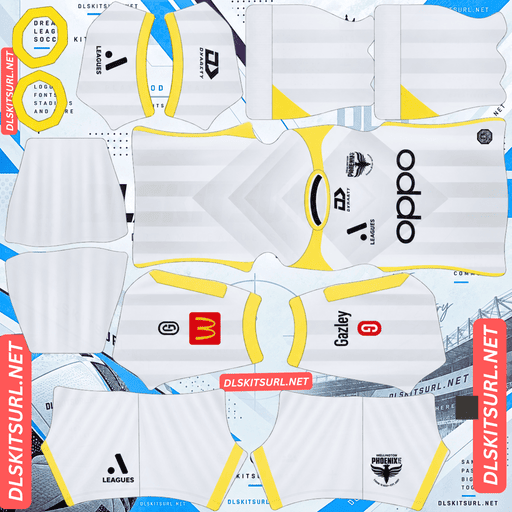
Wellington Phoenix Away Kit
Away Kit 512×512 (2026/27)
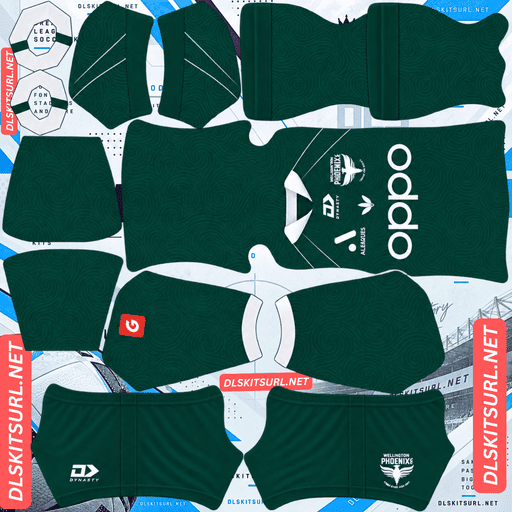
Wellington Phoenix Third Kit
Third Kit 512×512 (2026/27)

Wellington Phoenix GK Home Kit
GK Home Kit 512×512 (2026/27)
The home kit uses curves where most designs use straight lines, and that changes what you need to check.
Curves forgive what straight lines expose
Released on 30 September 2026 by Dynasty Sport, the home is predominantly black, with curved yellow and white panels sweeping across the shoulders and flanks as a reference to the club’s debut kit. Entelar Group sponsors the men’s shirt, while OPPO appears on the women’s version.
The panels cross the two hardest joins
The shoulders are the body-to-sleeve junction, where panels have to move from the torso onto a sleeve that wraps around a different shape.
The flanks are the side seams.
Wellington’s panels cross both areas, which would normally make the design particularly demanding to reproduce.
But there is an important difference here.
A curve hides a small error
Straight lines create an expectation. Your eye follows the line and immediately notices when it steps at a seam or changes direction unexpectedly.
Curves are more forgiving.
If a curved panel continues slightly off when it crosses a seam, your eye still reads the overall sweep as a curve rather than identifying the small mismatch as a clear fault.
That makes Wellington unusual. The panels sit in some of the hardest positions on the kit template, but their shape is more tolerant of small alignment errors.
Lausanne’s hoops crossing onto the sleeves are the stricter version of the same problem.
The colours make the panels even easier to reproduce
Yellow against black gives you an extremely strong value difference. White against black does the same.
That means the large panels have plenty of contrast for the PNG to preserve.
The home should therefore arrive looking close to the source design, even if a tiny seam transition is not perfectly aligned.
The weaker edge is actually yellow against white.
Both are light colours, so the value difference is much smaller. If the file has softened anywhere, that is the boundary most likely to reveal it.
Check that edge at full size, and confirm the image dimensions before importing. On a computer, open the image in a new tab and check the actual pixel dimensions rather than trusting the filename.
This is a black kit that works
DLS players are viewed relatively small, so a black shirt can easily become one dark shape against the pitch.
Black on its own is the problem
An all-black kit can lose much of its internal definition at match distance.
Sydney’s Cove third, Inter Miami’s Presagio away and Sport Recife’s All Black demonstrate the problem: once the design relies heavily on dark-on-dark treatment, there is very little left for the eye to separate.
Wellington uses enough bright area to avoid it
The Phoenix home does something different.
The yellow and white are not tiny pieces of trim. They sweep across the shoulders and flanks, creating large bright areas that remain visible even when the player is small on screen.
That puts Wellington closer to a genuinely two-tone kit than a black shirt with a few bright accents.
Zamalek’s fluorescent away and Alavés’ pastel-pink away work for a similar reason, while Inter Miami’s anthracite away and Dortmund’s tonal away demonstrate the weaker end of the scale.
Number colour
DLS reads number colours from two small swatches on the kit template rather than from the imported image. One controls shirt numbers and the other controls shorts numbers.
Use yellow or white on the home.
Both have very strong contrast against black. Ideally, choose whichever colour is used less heavily on the shirt so the number also separates from the bright panels rather than disappearing into them.
The tohu is a design element worth locating
A tohu gifted to the Phoenix by local iwi Te Āti Awa has been an important part of the club’s recent kits, appearing on both the home and away shirts in 25-26.
Position determines what survives
Find the tohu in the source image before deciding how much of it you expect to see in DLS.
A large, bold mark in a contrasting colour has a good chance of surviving.
Fine linework is more vulnerable because it can reduce into texture at 512×512.
A chest placement is another problem because your imported badge occupies that area.
Marks around the neck, upper back or hem are also vulnerable because those zones are smaller in the game or compete with other mapped elements.
If the tohu is one of the main reasons you want a particular Phoenix kit, check its size and location first.
A large yellow mark on black has everything it needs to remain visible. A fine mark, particularly one placed on the chest or another small zone, does not.
Wellington run two away kits
This is worth knowing before you search because “away” is not specific enough for Wellington.
Dynasty produce two alternate away strips for the Phoenix, allowing the club to use its home colours when playing in Wellington or Christchurch.
Which makes the filename ambiguous
A file called “Wellington Phoenix away” could refer to either shirt.
Compare the actual design with the cards above rather than trusting the slot name.
This is a case where the thumbnail is more useful than the filename.
The third kit is another option
Wellington introduced a third kit for the first time in 25-26.
It is predominantly black with yellow detailing, with the badge, commercial partners and A-Leagues logo also rendered in yellow.
The design was the best-received Dynasty kit of that collection, ahead of the home, away and women’s shirts.
That yellow-on-black treatment is also useful in DLS. The strong contrast keeps the sponsor and league markings much sharper than a tonal or dark treatment would.
If you find a working 512×512 URL, it is a natural candidate for the third slot.
Lausanne-Sport, Servette, FC Copenhagen and Silkeborg all have their own kit-naming complications, but Wellington’s is particularly simple: two different shirts can both be labelled away because the club uses both by design.
Which Wellington kit survives best?
The 26-27 home is the strongest technically. Its curved yellow and white panels survive well against the black base, and the curved construction makes minor seam errors less obvious.
The two away kits need to be identified from their actual designs because the word “away” does not distinguish them.
The 25-26 third is also a strong DLS option. Its yellow logos and detailing sit against black, giving the shirt plenty of contrast.
Dynasty Sport helps your file
Dynasty is a New Zealand brand that began supplying the Phoenix in 25-26, their first season with the club.
The simpler construction is good for 512×512
Smaller manufacturers generally do not rely as heavily on the premium surface techniques that disappear in a flat kit image.
There are no major 3D knits, embossed reliefs, metallic applications or elaborate woven effects to reproduce here.
Dynasty’s Ecotek fabric, made from recycled plastic bottles, is a material story rather than a visual effect. It changes the physical fabric without giving the PNG additional information to carry.
So the Wellington designs should reproduce relatively closely.
That is the same advantage seen with Union Saint-Gilloise’s O’Neills, Adelaide’s UCAN, Lyngby’s Select and Central Coast Mariners’ Konqa: when the construction is straightforward, there is simply less for a 512×512 file to lose.
The downside is fewer files
Dynasty supply a relatively small group of clubs, while the A-League receives less kit-file coverage than the biggest European competitions.
That means you may encounter fewer working Wellington URLs.
When you find one that works, save it.
The supplier also dates the file
A Dynasty Sport logo indicates 25-26 onward.
Earlier Phoenix shirts carry Paladin, Adidas and other manufacturers, so the supplier is much more useful here than it is for a club such as Perth Glory, where Macron has remained for years.
Central Coast Mariners and Brisbane Roar benefit from the same easy supplier-based dating.
How to tell if a Wellington file is current
Four checks will settle most searches.
Dynasty Sport branding — this puts the kit in the 25-26 onward period.
Check the sponsor — Entelar Group identifies the men’s shirt, while OPPO identifies the women’s version.
Check the design — the 26-27 home is black with curved yellow and white panels across the shoulders and flanks.
Compare the file against the cards above.
The sponsor check is particularly useful because it can distinguish both the season and the men’s version from the women’s shirt.
A note on the A-League season
The A-League runs across two calendar years, with its summer season stretching roughly from October into May.
That is why Wellington’s current shirts are labelled 26-27.
The Phoenix also release their kits relatively late, with the 26-27 home arriving at the end of September.
A filename containing only “2026” therefore does not tell you enough.
Check the actual design.
How to use a Wellington Phoenix DLS kits URL
Copy the link with the button on the kit card, not from your browser address bar. The address bar normally gives you the webpage containing the image rather than the direct image file.
Open Dream League Soccer and go to My Club → Customise → Kit. Do not choose Logo; the badge is handled separately.
Select the slot before pasting because the selected slot is the one that gets replaced.
Press and hold the URL field, tap Paste, then select Confirm. Older versions may call the final button Download.
Because Wellington has two away designs, compare them side by side before deciding which three shirts to keep. The game gives you three regular outfield slots, so choose combinations that look distinct rather than filling multiple slots with nearly identical designs.
Set the shorts and socks deliberately as well because DLS treats those areas separately from the shirt.
The first custom kit requires a one-time gem unlock. After that, changing imported kits costs nothing.
Test the link first
Open the URL in your browser before entering it into DLS.
The image should appear by itself, and the address should end in .png.
If you see a webpage with headers, buttons or other content around the shirt, you have a viewer page rather than a direct image file.
For Wellington’s home, pay particular attention to where the yellow meets the white. That is the least forgiving colour boundary on the shirt.
You do not need to obsess over tiny seam alignment. The curved panels are unusually forgiving, and a small mismatch can disappear into the overall sweep.
Why do Wellington kit URLs stop working?
Three problems account for most broken kit links.
Free image hosts delete files. Old uploads can disappear after months or years while the original page still looks normal. Wellington’s smaller supplier and the comparatively modest A-League kit audience also mean fewer replacement uploads are likely to appear.
The second away version and women’s shirts are particularly worth saving because they are less likely to have multiple copies circulating.
Hotlink protection can also block DLS. Your browser may load the image because the request comes directly from the host’s own site, while the game’s request is refused.
That creates the familiar situation where a link works when you click it but fails when pasted into DLS.
The third issue is a preview/direct-file mismatch. A website can show a thumbnail hosted on one server while its copy button points to another location. The preview can remain visible after the actual file URL has died.
For these files, the shirt shown on the card and the copied URL are the same file on the same server.
The Wellington Phoenix badge
Set the crest in the same general area, but choose Logo instead of Kit.
Wellington’s crest uses the club’s black-and-yellow identity with the phoenix at its centre.
A phoenix is a useful shape for DLS because its overall silhouette is recognisable, although fine detail in the wings and flames can soften when the badge is reduced inside the game.
The colour combination is excellent. Yellow against black gives the badge maximum contrast, so the main shapes should remain clear.
There is one thing to watch: the phoenix’s wings can extend toward the edges of the source image.
DLS crops badges into a circle, so use a file with enough clear space around the complete design. A tightly cropped badge can lose wing tips or other outer details when the circular crop is applied.
Use a genuine 512×512 badge file rather than enlarging a smaller image.
Beşiktaş, Austria, Eintracht Frankfurt and Iraq have similar issues with badges whose outer shapes extend toward the crop boundary.
Keeping your Wellington kits
Custom kits are stored on your device rather than permanently on your account. Updating the game normally keeps them, but reinstalling or changing phones can remove the kits and badge.
Because Wellington deliberately uses two away designs, record which away version each URL represents.
Put all four working links into a notes app before you start. That saves you from having to identify the shirts again if the game loses your custom kits later.
FAQ FOR RANK MATH
What is a Wellington Phoenix DLS kits URL?
A direct link to a 512×512 PNG Nix shirt that you paste into Dream League Soccer’s kit screen. A working direct link ends in .png.
Do the curved panels need perfect seam alignment?
Not to the same degree as straight stripes or bands. A small mismatch in a curve can be absorbed into the overall sweep, while a straight line immediately reveals a step or kink.
What should I check on the home kit?
Check the boundary where the yellow meets the white. Both are light colours, so that edge has less value contrast than either colour has against the black base.
Is the black home kit easy to see?
Yes. The large yellow and white panels provide enough bright surface area to keep the shirt readable. It is very different from an all-black or tonal-black design.
What number colour should I use?
Yellow or white. Both provide strong contrast against the black base. Choose the one that is used less heavily on the shirt so the number does not disappear into the panels.
Why are there two Wellington Phoenix away kits?
Dynasty produce two alternate away strips so Wellington can wear its home colours when playing in Wellington or Christchurch. A file labelled “away” can therefore refer to either design.
Will the tohu appear in DLS?
A large, bold tohu in a contrasting colour can survive. Fine linework may reduce into texture, while a chest placement can be covered by the imported badge. Neck, upper-back and hem placements are also more vulnerable because those areas are smaller in the game.
Who makes Wellington Phoenix kits?
Dynasty Sport, a New Zealand brand that began supplying the Phoenix in 25-26. The straightforward construction is helpful for 512×512 reproduction, although the smaller supplier means fewer working kit files may be available.