
A Club Olimpia DLS kits URL is a direct link to a 512×512 PNG Olimpia shirt that you paste into Dream League Soccer. All four slots are below, with each file loaded into the game before it was added here.
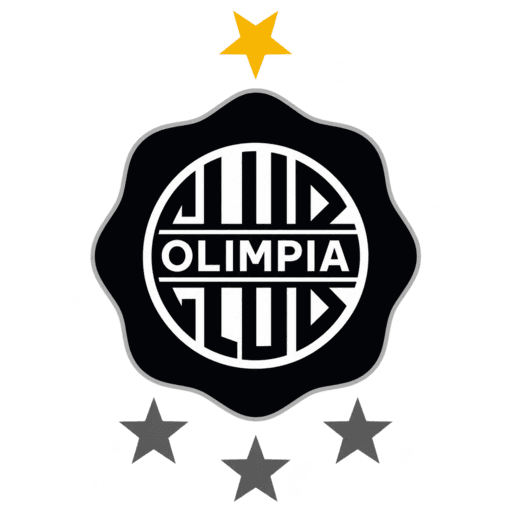
Club Olimpia Logo
Official Logo 512×512 (2026/27)
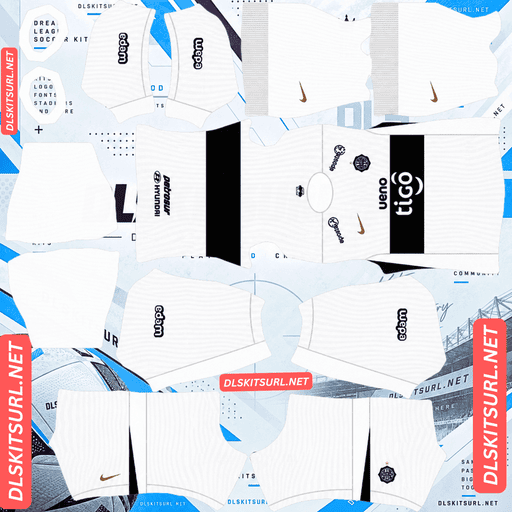
Club Olimpia Home Kit
Home Kit 512×512 (2026/27)

Club Olimpia Away Kit
Away Kit 512×512 (2026/27)
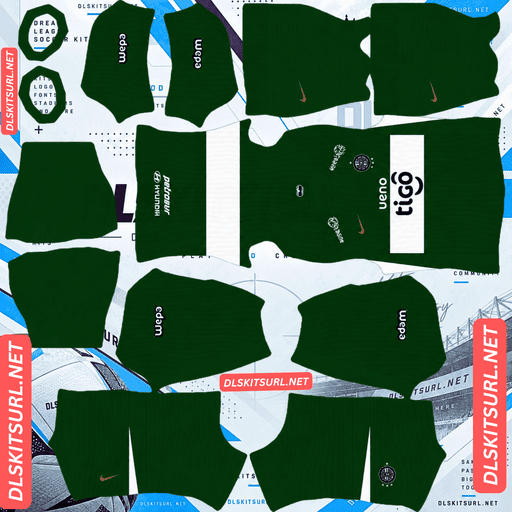
Club Olimpia Third Kit
Third Kit 512×512 (2026/27)

Club Olimpia GK Home Kit
GK Home Kit 512×512 (2026/27)

Club Olimpia GK Away Kit
GK Away Kit 512×512 (2026/27)

Club Olimpia GK Third Kit
GK Third Kit 512×512 (2026/27)
The home kit has an unusual problem: its main graphic was drawn by hand, and the tiny imperfections that make a drawing feel handmade are exactly what a flat 512×512 file struggles to preserve.
The sketch survives as shapes, not as drawing
Olimpia presented the home kit in early 2026 and debuted it against Guaraní at the Defensores del Chaco. It honours former president Osvaldo Domínguez Dibb, using an original hand-drawn sketch he created decades ago and which remained in the club archive.
Nike carried that artwork across the traditional black franja.
A flat image removes the part that makes a sketch look handmade
A hand-drawn line is more than its outline. It has changing weight, small wobbles, thicker sections where the pen pressed harder, thinner sections where it lifted and uneven ends where the drawing stopped.
Those details live in very small variations along the line.
That is precisely the information a 512×512 image has to simplify.
So the important distinction is this:
The drawing survives. The drawing quality does not.
The overall composition should remain recognisable, but the real shirt’s pencil-or-pen character will become much cleaner and more uniform.
That is different from a weave, tonal pattern or map disappearing completely. A sketch usually remains visible, but it gets tidied up until it looks more like a designed graphic than something drawn by hand.
Portland’s art deco arches, Austria’s Art Nouveau gold lines, San Lorenzo’s fileteado and Fiorentina’s Golden Ratio third all have a similar weakness. Ornamental styles depend heavily on line quality, and fine line variation is one of the first things lost at this resolution.
Check contrast rather than trying to preserve the character
Open the home kit at full size and look at the sketch elements against the white base.
If the graphics have clear contrast, they should carry into DLS as recognisable shapes.
If they are very subtle or close in tone to the shirt, they can disappear altogether.
Also confirm that the file is genuinely 512×512. On a computer, opening the image in a new tab and checking its reported dimensions is an easy way to verify it.
The important point is not to reject a file simply because the sketch looks cleaner than it does on the physical shirt. That part is a limitation of the format, not necessarily a bad kit file.
The franja is what you need to check after importing
Olimpia’s black band across the white shirt is one of the club’s defining visual features.
Unlike the sketch, there is no real question about whether the colours will survive.
The colours are about as strong as possible
Black against white gives you maximum contrast.
That means the franja should remain clearly visible even after compression and at DLS’s relatively small player scale.
The problem is not colour.
It is geometry.
A horizontal band has several places where it can go wrong
A horizontal chest band has to keep the same height as it crosses the body, side seams and sleeve junctions.
That creates six alignment points to watch: two side-seam joins and two sleeve junctions, with both the upper and lower edges needing to stay consistent.
This is why a horizontal band can look perfect on a flat image and still look wrong once the game wraps it around the player model.
A few pixels of vertical movement at a panel seam can create an obvious step in the franja.
Import the kit and inspect it from the side and back. Check whether the band stays at the same height all the way around and whether its thickness remains consistent.
That is something the flat PNG cannot tell you.
Boca Juniors’ yellow chest band provides a useful comparison because the same geometry problem applies there.
Your badge sits directly on the band
DLS places the imported crest on the chest, which is also where the franja runs.
The badge will therefore cover part of the band.
That is not a failure of the kit. The real shirt also has the crest occupying that area.
The useful approach is to use the standard Olimpia crest so the interruption occurs where you would expect it to.
You keep the band on either side of the badge; only the section underneath it disappears.
The home kit is easy to see in a match
DLS renders players relatively small, so shirt visibility matters almost as much as file accuracy.
White separates cleanly from the green pitch, and the black franja adds a strong horizontal break across the player model.
For the home shirt, use red or navy numbers.
White numbers would disappear into the white shirt, while black numbers would become difficult to read wherever they overlap the black franja on the back. A third colour gives you the safer contrast.
Nike replaced Olimpia’s own brand
Olimpia’s 2026 kits are made by Nike, which took over from Meta, the club’s own sportswear label launched in 2025.
That gives this kit a particularly useful dating marker.
The supplier logo almost dates the file by itself
A Nike swoosh means 2026 onward.
A Meta logo means 2025, and specifically that single-season in-house period.
Older Olimpia shirts use other suppliers again.
That makes the supplier logo more useful here than it is on most kit pages. Pachuca’s switch to Skechers, Tijuana’s move to Reebok and América de Cali’s move to Reebok provide similar examples, but Olimpia’s one-season Meta period is unusually narrow.
It should also help with file availability
Nike’s global reach should produce more uploads than the short-lived Meta era.
The 2025 shirts therefore have a smaller window of availability, while the Nike designs should attract wider coverage.
If you find a working Meta-era file, save it rather than assuming another one will always be available.
The third is deliberately untraditional
Olimpia launched its third kit in November 2026, describing it as something deliberately outside the club’s usual kit tradition while still connecting it to Olimpia’s historic achievements.
For this one, compare the actual file against the kit card rather than relying on a text description.
The basic checks remain the same:
Colour boundaries should be sharp, not blurred.
Collar and cuff trim should have clean edges.
Nike branding, crest and sponsor should remain crisp.
The file should actually measure 512×512.
Achievement details are the easiest part to lose
A shirt built around historic achievements often communicates that idea through small text, numbers or symbols.
Those details are vulnerable depending on where they are placed.
If they are on the chest, the imported badge can cover them.
If they are near the upper back or neck, they occupy one of the smallest and busiest areas of the DLS shirt and compete with the squad number.
If they sit around the hem, they are rendered very small and can also become partly hidden by the shorts.
So if the third’s historical connection is carried mainly through tiny text or symbols, expect some of that information to disappear in-game.
Which Club Olimpia kit survives best?
The home is the strongest all-round option. Its black franja has maximum contrast and its sketch graphics remain recognisable as shapes, even though their handmade quality is reduced.
The third needs to be judged directly against its card because its unusual achievement-based design depends on details that may not survive at 512×512.
The home is also the easier one to assess technically: the sketch needs a contrast check, while the franja needs an actual in-game alignment check.
Olimpia have good options in the back catalogue
The club has produced some unusual alternate shirts that remain perfectly usable in DLS.
Recent examples include the first orange shirt in Olimpia’s history, released as a third kit, and a celeste third honouring the Uruguayan players who have helped shape the club, including Luis Cubilla.
DLS does not care how old the real-world shirt is. If you have a working 512×512 URL, you can use it.
The orange one is the pick for DLS
Orange is a long way from pitch green.
It is bright, warm and easy to distinguish when the player is rendered at a small size.
It also has another advantage: a largely single-colour shirt does not ask much of a 512×512 file. There is little texture, geometry or fine pattern to lose.
That makes the orange shirt the most immediately readable Olimpia option if you can find a working file.
FC Cincinnati, Lorient, Envigado and Blackpool have similar advantages with their bright, simple designs.
The celeste is a good second option
A light-blue base also separates well from the pitch.
Nacional de Montevideo’s regular September celeste tradition is worth remembering if you search by colour rather than club, because a celeste Olimpia shirt can otherwise be easy to misidentify among older or commemorative designs.
One-off shirts are the ones to save
Special and one-off kits attract attention when they launch, but the number of working files usually falls later.
Paraguayan football also produces less upload volume than the biggest Brazilian and Argentine scenes.
So if you find a working link for an unusual Olimpia shirt, save it.
How to tell if a Club Olimpia file is current
Four checks make the current range easy to identify:
Nike branding — the clearest 2026 marker.
Meta branding — indicates the club’s 2025 season with its own sportswear label.
The home sketch graphics — they should appear alongside the traditional black franja.
The kit card — use the actual design as your final comparison rather than trusting the filename alone.
The first two together are particularly useful. A Nike file should not be confused with the single-season Meta range.
A note on Paraguayan season labels
Olimpia follows a calendar-year football structure rather than the European 26-27 format.
The season is split into the Apertura and Clausura tournaments, but both sit within the same calendar year.
So an Olimpia kit labelled 2026 is current for 2026.
As always, check the design rather than relying entirely on the year printed in a filename.
How to use a Club Olimpia DLS kits URL
Copy the image URL using the copy button on the kit card, not the browser address bar. The browser address will often point to the page displaying the image rather than the actual PNG.
In Dream League Soccer, go to My Club → Customise → Kit. Do not choose Logo; the badge is imported separately.
Select the slot before you paste anything. Then press and hold the URL field, choose Paste, and tap Confirm. Older versions of DLS may call the button Download.
You have three outfield kit slots, so the home, third, orange and celeste options give you more choices than you can store at once.
The first custom kit requires a one-time gem unlock. After that, changing the kit is free.
Test the link first
Open the URL in your browser before putting it into the game.
A proper direct file should display the shirt by itself, with the address ending in .png.
If you instead see a webpage with buttons, headers or other content surrounding the image, you have a viewer page rather than a direct image file.
For Olimpia’s home kit, the browser test only gets you halfway there.
First check whether the sketch graphics have enough contrast to survive.
Then import the shirt and inspect the franja across the seams.
Those are two different problems, so they need two different checks.
Why do Club Olimpia kit URLs stop working?
There are three common causes, and only one is obvious.
Free image hosts can delete files. An unused upload may be removed after months or years even though the old URL still looks valid.
Olimpia are one of Paraguay’s two biggest clubs, so domestic coverage is reasonably strong, but Paraguayan football does not generate the same upload volume as Brazil or Argentina. The Nike deal should increase attention around the current range, while the short-lived Meta kits are more vulnerable to disappearing.
Hotlink protection can also block DLS. A browser may load the image because the request comes from the host’s own website, while the game is refused because it requests the file from somewhere else.
That creates the confusing situation where a link works when you click it but fails when you paste it into DLS.
The third problem is a preview and direct-file mismatch. Some sites display a thumbnail hosted on their own server while the copy button points to another file or location. The page can continue displaying the shirt even after the actual direct link has died.
For these Olimpia files, the shirt displayed on the card and the URL you copy are the same file on the same server.
The Club Olimpia badge
Import the crest separately through My Club → Customise → Logo.
Olimpia’s badge uses the club’s black-and-white identity with its laurel wreath, O monogram and stars representing its continental honours.
Protect the stars
The stars deserve particular attention because DLS crops imported badges into a circle.
Stars positioned above the main crest are therefore close to the area most likely to be cut away.
Use a 512×512 badge with clear space around the entire design instead of one cropped tightly around the artwork.
That extra padding gives the circular DLS crop room to work.
Use a genuine 512×512 badge rather than an enlarged smaller image. Fine shapes in the wreath and lettering can become soft when the source has already been upscaled.
Black against white is excellent for visibility.
The laurel wreath is the part most likely to soften because it contains finer detail. If that happens, it is a limitation of the small image and game rendering rather than automatically a bad file.
Boca Juniors, Atlas, Palmeiras, Bahía, Tolima and Pereira face similar problems with badges that place stars near the top. Rosario Central is the useful exception because its major star sits in the centre of the crest.
Keeping your Club Olimpia kits
Custom kits are stored on the device rather than tied to your account.
Updating the game normally keeps them, but reinstalling DLS or changing phones can remove the custom kits and badge.
For Olimpia, it is especially worth recording the home URL that has the correct franja alignment at every seam.
Save all four links somewhere outside the game before importing them. A notes app is enough.
That way you can restore the kits without having to search for the files again.
FAQ FOR RANK MATH
What is a Club Olimpia DLS kits URL?
A direct link to a 512×512 PNG Olimpia shirt that you paste into Dream League Soccer’s kit screen. A working direct image link ends in .png.
Will the sketch graphics on the home kit show up?
Yes, as shapes. The handmade drawing quality will not fully survive. Fine changes in line weight, small wobbles and uneven pen marks are exactly the details a 512×512 file simplifies.
Is that a file problem?
Not necessarily. If the sketch looks cleaner than it does on the physical shirt, that is mainly a resolution limitation. The composition should still remain recognisable.
What should I check on the home kit?
Check the sketch for contrast in the browser, then check the black franja after importing. The franja has six important alignment points where the horizontal band crosses the shirt panels.
Will the black franja always show up?
It should. Black against white provides maximum contrast. The real risk is not whether the band survives, but whether it stays at the correct height across the seams.
Who makes Olimpia’s kits?
Nike from 2026. A Meta logo identifies the club’s 2025 season with its own sportswear brand.
Which Olimpia kit is easiest to follow in a match?
The orange shirt from the back catalogue, if you can find a working URL. Orange separates strongly from the pitch, and its simple base leaves very little for a 512×512 file to lose.
What number colour should I use on the home kit?
Red or navy. White would disappear against the white shirt, while black becomes difficult to read wherever the number overlaps the black franja.