
An Iraq DLS kits URL is a direct link to a 512×512 PNG Iraq shirt that you paste into Dream League Soccer. All four slots are below, with every file loaded into the game before it was added here.
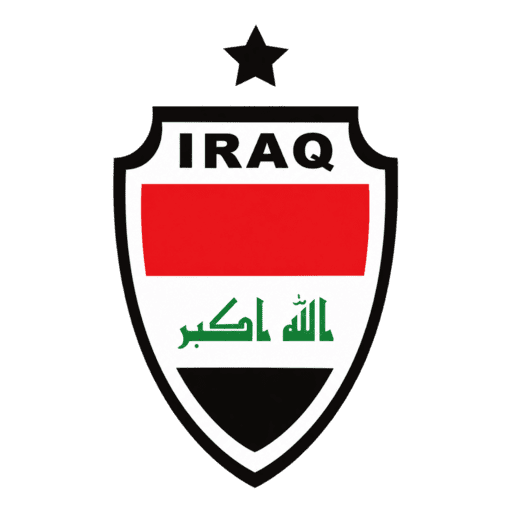
Iraq Logo
Official Logo 512×512 (2026/27)
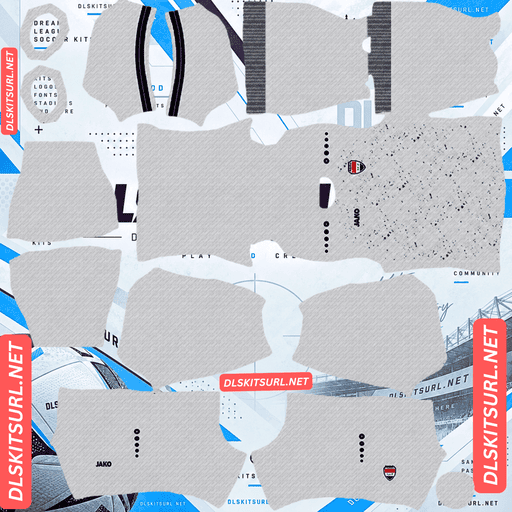
Iraq Home Kit
Home Kit 512×512 (2026/27)
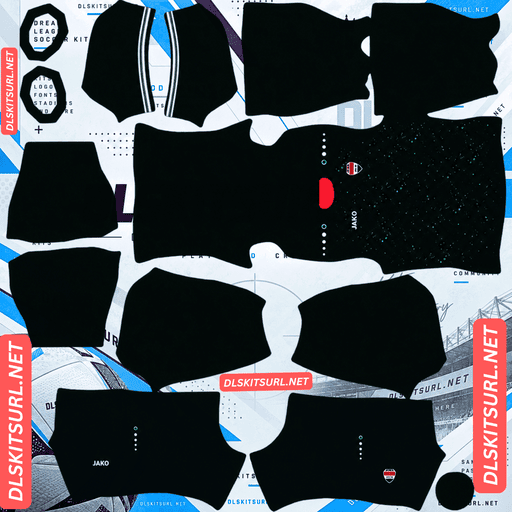
Iraq Away Kit
Away Kit 512×512 (2026/27)
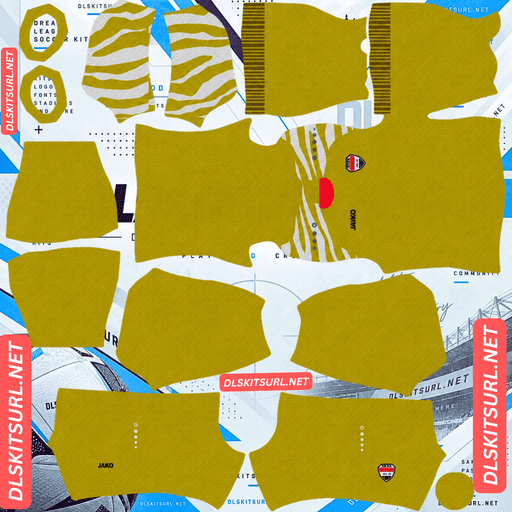
Iraq GK Home Kit
GK Home Kit 512×512 (2026/27)
Jako built the 2026 collection around an ancient Mesopotamian mosaic. The more faithfully that pattern is reproduced, the more aggressively 512×512 works against it.
The Uruk mosaic is made of dots, and dots go first
Released on 22 May 2026 for Iraq’s first World Cup appearance in forty years, the Jako collection takes its main graphic from ancient Uruk mosaics.
The design uses circular dot clusters and interlocking diamond shapes sublimated across the fabric.
The home shirt is white, with a V-neck and cuffs in the Iraqi flag colours and Jako’s circular logos running down the shoulders. White shorts and socks complete the set.
Which is historically exact and structurally fatal
Uruk cone mosaics were made from thousands of small clay cones pressed into walls, with their coloured ends creating geometric patterns.
A faithful modern reproduction therefore becomes a pattern made from dots.
And a dot is about as small as a repeating graphic can get.
At 512×512, the entire shirt is being represented at roughly thumbnail scale. Small circles start merging with neighbouring circles before they can remain individually defined.
So there is an unfortunate rule here:
The more accurately the mosaic is reproduced, the less of it the flat file can actually preserve.
The authenticity of the design is what defeats it.
Elche’s halftone dots, Monza’s dotted wave pattern and Gladbach’s small diamonds all have the same basic weakness. Iraq simply pushes the idea further because its pattern is even finer.
The home adds another problem: it is tonal
The mosaic on the white home is tonal, using variations of the same light colour to create depth rather than strong contrast.
That is almost the worst possible combination for a 512×512 image.
A light tone on white has very little separation, and the tiny dots are already competing for too few pixels.
Expect the home to become a plain white shirt.
That is not a poor file. It is the result of scale and contrast working together.
Sassuolo’s grey daffodils on white and Angers’ silver detailing disappear for the same reason.
Check the flag-coloured trim instead
The V-neck and cuffs carry Iraq’s red, white, black and green.
Four colours compressed into a collar is an extreme test because the collar is already one of the smallest zones on the shirt.
Do not expect all four colours to remain perfectly separated. They may compress toward one or two stronger bands, leaving you with the impression of coloured trim rather than a detailed miniature flag.
But those areas are still among the most defined elements on the shirt.
Use the collar and cuffs alongside the Jako shoulder logos and crest as your practical quality checks.
Confirm the dimensions too. On a computer, open the image in a new tab and check that it is genuinely 512×512.
Paris FC’s wavy collar, Nashville’s tricolour collar, Sweden’s cuffs and Cruz Azul’s collar stripes all run into the same resolution limit.
Visibility
DLS renders players small, so the base colour matters.
White is the brightest shirt base available and separates cleanly from the green pitch.
Once the mosaic disappears, the Iraq home is essentially a plain white shirt. That makes it easy to follow, even though much of the original design is gone.
White needs the right number colour
Dream League Soccer gets number colours from separate in-game swatches rather than from the shirt image itself.
One swatch controls the shirt numbers and another controls the shorts.
White numbers on a white shirt are invisible.
Use green, red or black on the home. All three are Iraqi national colours and all provide clear contrast against the white base.
The away may be the one that keeps the pattern
The away uses the same overall design in deep green, a colour strongly associated with Iraqi football and its green-and-white identity.
That changes the reproduction problem completely.
Contrast gives the mosaic a chance
If the mosaic is rendered in white against the green base, it has genuine contrast.
The individual dots will still soften because they are so small, but the pattern as a whole has a much better chance of remaining visible.
Open the away at full size and inspect the body:
White dots and diamonds clearly visible against green: the pattern should survive in simplified form.
Green-on-green tonal treatment: expect the same disappearance seen on the home.
Ghana’s 2026 kits demonstrate the same principle: a motif can survive on one colourway and disappear on another simply because the rendering changes from tonal to contrasting.
Deep green is the visibility problem
There is another trade-off.
Green is one of the hardest shirt colours to use in DLS because the pitch is also green.
A deep green is even more difficult. It is dark, muted and close to the grass in both hue and brightness.
Juárez’s radioactive green separates strongly. Schalke’s vivid green works well. Alavés’ turquoise reads more like blue, and Emelec’s petrol is adequate.
Iraq’s deep green is much closer to the grass, so it is the weakest visibility base of the three.
If the white mosaic survives, it is doing useful work by breaking up a shirt that would otherwise blend into the pitch.
Use white numbers on the away.
The third is black
Jako completes the collection with a black third, carrying the same Mesopotamian motifs.
Black gives tonal patterns even less room
Dark bases leave very little room for subtle tonal variation.
If the mosaic is rendered tonally on black, expect almost nothing to remain.
If it is rendered in white, green or gold, the situation changes. Light or contrasting colours against black have enough separation to survive much better.
So check the actual source image before deciding how well the third reproduces.
Zamalek’s fluorescent designs and Alavés’ pastel pink show how bright accents can rescue a dark kit. Dortmund’s tonal lightning and Inter Miami’s anthracite stripes show the opposite: dark-on-dark detail can disappear completely.
Visibility
An almost entirely black kit becomes one dark shape at match distance.
Whatever contrast the mosaic provides is therefore important.
Use white numbers on the third. They provide the strongest additional point of contrast you can add to a dark shirt.
One design, three colourways
This collection makes a useful comparison because Jako used essentially the same pattern across all three shirts.
White, green and black give you the same motif on three different bases.
That makes the range almost a controlled experiment for DLS.
If the pattern behaves differently between the kits, the difference is mainly coming from the base colour and whether the graphic was rendered tonally or with actual contrast.
That is the whole contrast rule in one collection:
A pattern survives where it has enough contrast. It disappears where it does not.
Look at all three source images side by side before choosing which one to import.
Which Iraq kit survives best?
The home is the easiest one to use in a match. Its tonal mosaic disappears, but white is highly visible against the pitch and leaves very little internal detail to cause problems.
The away has the best chance of retaining the actual mosaic if the dots are white against the green, but the deep-green base is difficult to see on the pitch.
The third depends heavily on how the mosaic is rendered. A contrasting version can work; a tonal black-on-black version will not.
So unusually, the home is both the least interesting visually after conversion and the most practical to play in.
The 1986 kits are worth finding
Iraq’s 2026 appearance marks their first World Cup in forty years. Their previous appearance was at Mexico 1986.
That makes the period shirts especially interesting for DLS.
Older designs reproduce better
Mid-1980s football shirts were built around flat colours and bold shapes because that was what the manufacturing technology of the period naturally supported.
There were no sublimated dot patterns, tonal textures or intricate digital graphics fighting the 512×512 limit.
An Iraq 1986 shirt can therefore arrive much closer to the way it looked originally, while the 2026 home loses its central visual concept.
Both the 1986 home and away are catalogued, so working files exist.
Cerro Porteño’s 1990s remake, Schalke’s 1980s Trefoil away, Boca’s 06-07 revival, Auxerre’s double-winning tribute and Grasshoppers’ 1989-90 third all benefit from the same structural advantage.
The crest creates another decision
Iraq’s crest has changed since 1986.
If you pair a period shirt with the current badge, the mismatch will be obvious. The important catch is that the DLS badge is global, so choosing a historical crest affects every kit you use.
Houston Dynamo’s Archive Kit and Rosario Central’s retro-crest third create the same problem.
You have to decide whether the historical shirt or the modern badge matters more to the overall setup.
There is a pre-match shirt too
Jako also released a Mesopotamian-inspired pre-match shirt alongside the match collection.
It is still a legitimate DLS option because the game accepts any working 512×512 kit URL regardless of what the garment was originally designed for.
The problem is availability.
Pre-match shirts are photographed less often than match kits, so fewer files tend to circulate. And because this one is also Mesopotamian-inspired, it may carry the same fine ornamental detail that the main collection struggles to preserve.
If you find a good file, save it.
How to tell if an Iraq file is current
Four checks will settle it:
Jako branding — Jako have supplied Iraq since 2022, so this alone does not identify 2026.
The circular Jako logos down the shoulders — these are a much stronger visual marker for this collection.
The colourways — white home, deep-green away and black third.
The kit cards above — use the actual design as the final comparison.
Point two is particularly useful because the Jako shoulder treatment helps distinguish the current collection from older Jako-era shirts.
How to use an Iraq DLS kits URL
Copy the link using the button on the kit card, not the browser address bar. The browser usually gives you the webpage containing the image rather than the direct PNG.
Open Dream League Soccer and go to My Club → Customise → Kit.
Do not select Logo. The badge is handled separately.
Choose your kit slot before pasting because the selected slot is the one that gets replaced.
Press and hold the URL field, tap Paste, then Confirm. Older versions may label the final button Download.
The three main Iraq kits fill the three outfield slots exactly. The goalkeeper slot remains available, and Jako produced several keeper options.
You can also replace one of the current shirts with an Iraq 1986 home or away if the historical design matters more to you.
The first custom kit requires a one-time gem unlock. After that, kit changes are free.
Test the link first
Open the URL in your browser before putting it into DLS.
The image should appear by itself, and the address should end in .png.
If you see a page with headers, buttons or other website elements around the shirt, it is a viewer page rather than a direct image.
For the home, do not judge the file by whether the mosaic survives. It will not.
Instead, check the flag-coloured collar, cuffs, Jako shoulder logos, crest and dimensions.
For the away and third, the mosaic is worth inspecting because its contrast determines whether the pattern has any chance of surviving.
Why do Iraq kit URLs stop working?
Three things cause most broken kit links, and only one is immediately obvious.
Free image hosts delete files. Unused uploads can be cleared after months or years while the old URL still appears valid.
Iraq’s first World Cup appearance in forty years creates an unusually large burst of attention, so files should be plentiful during this cycle.
But national-team uploads tend to thin out once a tournament cycle ends.
That makes now the best time to save the 2026 files. In four years, these kits may be much harder to find, just as the 1986 shirts are today.
Hotlink protection is another problem. A host can allow its own webpage to display the image while refusing requests coming from DLS. That is why a URL can work perfectly in a browser and fail inside the game.
The third issue is a preview/direct-file mismatch. A website may display a thumbnail hosted on one server while its copy link points somewhere else. The preview can continue working after the direct file has disappeared.
Here, the shirt shown on the card and the URL you copy are the same file on the same server.
The Iraq badge
Set the badge through the same menu, but choose Logo instead of Kit.
The Iraq Football Association crest uses the national colours alongside an eagle and Arabic lettering.
The eagle is actually a useful shape for DLS because its overall silhouette remains recognisable at small size.
The fine details are another matter.
The wings and talons will soften when rendered small, and the Arabic lettering will lose some definition for the same reason.
Use a genuine 512×512 badge rather than an enlarged smaller file.
DLS crops every badge into a circle, so leave clear space around the complete design. The eagle’s wingtips can sit close to the outer edges, and a tightly cropped source gives the circular crop very little room.
Beşiktaş, Austria and Eintracht Frankfurt supporters face similar problems with badges whose wings or other details extend toward the edges.
Keeping your Iraq kits
Custom kits are stored on the device rather than in your account.
Updating the game normally keeps them, but reinstalling DLS or changing phones can remove the custom kits and badge.
National-team files also tend to become harder to find once a World Cup cycle is over.
So this is a good time to save the links you actually want.
Paste all four URLs into a notes app before you start, and make a quick note of which one is the home, away, third or historical 1986 shirt.
FAQ FOR RANK MATH
What is an Iraq DLS kits URL?
A direct link to a 512×512 PNG Iraq shirt that you paste into Dream League Soccer’s kit screen. A working direct image link ends in .png.
Will the Uruk mosaic pattern show up on the home?
Not in any meaningful way. The pattern is made from very small dot clusters, and the white home also uses a tonal treatment with little contrast. The dots merge before the pattern can survive clearly.
Is that a file-quality problem?
No. The combination of tiny repeating elements, 512×512 resolution and low tonal contrast makes the mosaic unsuitable for reliable reproduction. A better file will not magically restore the detail.
Does the mosaic survive on the away?
It can. If the pattern is white against the deep-green base, there is enough contrast for the overall motif to remain visible. The individual dots will still soften, but the pattern has a much better chance than the tonal white version.
Which Iraq kit is easiest to follow in a match?
The white home. White separates strongly from the pitch, while the deep-green away is close to grass and the black third reads mainly as a dark shape.
What number colour should I use?
Use green, red or black on the white home and white on the green away and black third.
Why are the 1986 Iraq kits worth finding?
Their designs rely on flat colours and bold shapes rather than the fine tonal and dot-based graphics used in 2026. That makes them much more likely to arrive intact in DLS.
Who makes Iraq’s kits?
Jako. They have supplied Iraq since 2022, so the Jako logo by itself does not date the shirt. The circular Jako shoulder logos are a more useful marker for this 2026 collection.