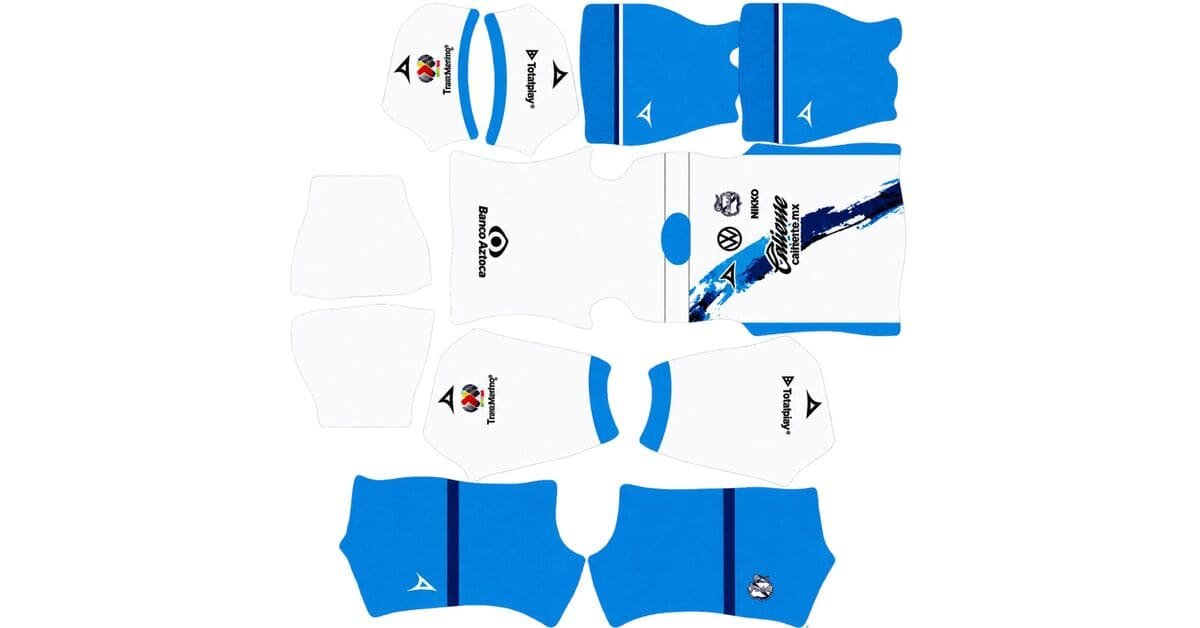
A Puebla DLS kits URL is a direct link to a 512×512 PNG Puebla shirt that you can paste into Dream League Soccer. All four slots are included below, and each file has been imported into the game before being listed here.

Club Puebla Logo
Official Logo 512×512 (2026/27)
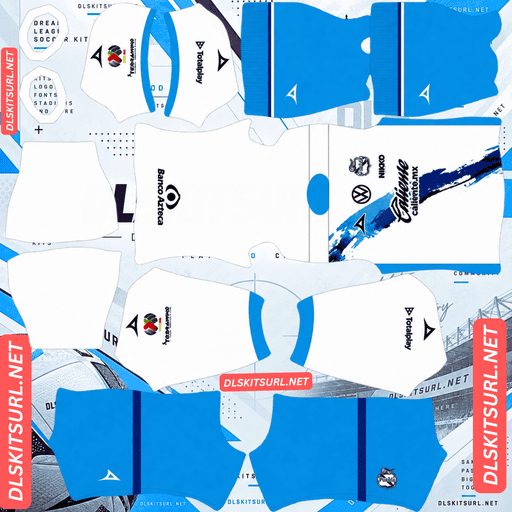
Club Puebla Home Kit
Home Kit 512×512 (2026/27)

Club Puebla Away Kit
Away Kit 512×512 (2026/27)

Club Puebla Third Kit
Third Kit 512×512 (2026/27)

Club Puebla GK Home Kit
GK Home Kit 512×512 (2026/27)

Club Puebla GK Away Kit
GK Away Kit 512×512 (2026/27)
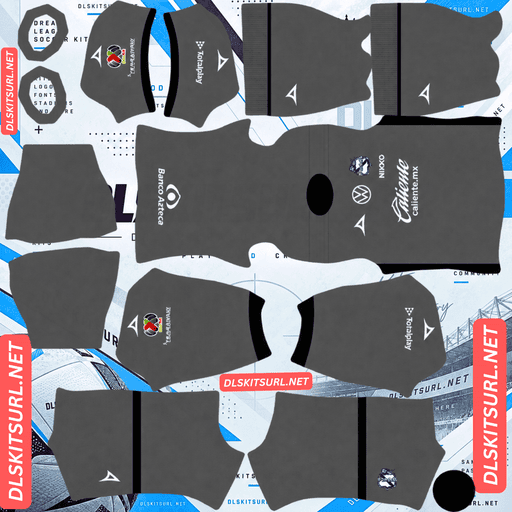
Club Puebla GK Third Kit
GK Third Kit 512×512 (2026/27)
The home shirt has two details that disappear for completely different reasons. One is a contrast issue; the other is down to where the kit template places it. Knowing the difference makes it much easier to judge the file.
The home kit takes inspiration from lucha libre
Released on 10 July 2026 for the Apertura, Puebla’s home shirt draws on Mexican lucha libre. It combines navy detailing around the collar and cuffs with a distinctive neckline: a mandarin collar at the back that transitions into a half crew neck at the front. There is also piping along the bottom hem.
The main design should reproduce well
Lucha libre artwork relies on bold shapes, symmetry and strong colour contrasts. Wrestling masks need to be recognisable from a distance, so their defining features are usually built around clear outlines and large visual elements.
That approach suits a 512×512 kit image. Large shapes and distinct colour blocks tend to survive, while small decorative details are much more vulnerable.
The broad lucha libre concept should therefore remain visible on Puebla’s home shirt. The risk comes with the smaller features. If the artwork includes fine mask outlines, lacing or tiny eye details, those elements may merge into the surrounding pattern.
Open the home image at full size and inspect the shirt body. If the main shapes are immediately clear in the flat image, they have a reasonable chance of carrying into DLS. If you already have to look closely to understand the design, expect the smaller features to disappear.
Universidad de Chile’s Chuncho graphic, Tijuana’s xolo silhouette and Necaxa’s Mexico 1998 tribute all demonstrate why bold, recognisable artwork works well at this resolution.
Two details disappear for different reasons
The navy detailing appears around the collar, cuffs and lower hem. Although the colour and width are similar, those three locations do not behave the same way in the game.
The collar and cuffs should remain visible
Small details are not automatically lost at 512×512. Their contrast and position matter just as much as their size.
Navy against white gives the trim a strong colour difference. The collar and cuffs should therefore remain visible, although the lines may look thinner than they do on the original shirt.
These are also the best places to judge image quality. Narrow, high-contrast details reveal compression damage much sooner than a large area of plain colour.
The same principle applies to Lugano’s black piping on white, Pachuca’s white lines on navy and Sporting’s black trim on gold.
The hem piping disappears because of its position
The lower piping is a different case. It has the same navy colour and similar width, but it sits at the bottom edge of the kit template.
That area has very little room for detail, and part of it is covered by the shorts when the player model is assembled. The piping can therefore disappear even though its contrast is perfectly adequate.
This is a position problem, not a colour problem. It would still be difficult to reproduce if the piping were fluorescent orange.
There are four separate reasons why kit details can be lost:
Contrast: There is not enough colour difference to distinguish the element, as with tonal patterns or gold on cream.
Density: Too much information is packed into a small area, as with maps and photographs.
Surface: The design depends on texture that a flat PNG cannot reproduce, such as a weave or embossed finish.
Position: The detail sits in an area the template cannot display clearly, such as the hem piping or upper back.
These causes should not be confused. A perfectly contrasted detail can still disappear because it sits in the wrong place.
Al-Ittihad’s hem-level tiger claw, Cagliari’s hem coordinates and Cremonese’s lower-section lines all demonstrate the same limitation.
The collar changes from front to back
Puebla’s neckline is unusual because it has a mandarin collar at the back but finishes as a half crew neck at the front.
There is no fundamental problem with that construction. The DLS template maps the front and back of the shirt separately, so the two sections can carry different shapes.
The difficulty is the back of the collar. It sits in one of the lowest-resolution areas of the template, with squad numbers positioned just below it.
Expect the front neckline to read more clearly than the rear section. In practice, the result should look closer to a standard crew neck, with much of the mandarin detail at the back lost.
Other shirts have suffered similar collar-detail problems, including Paris FC’s wavy collar, Nashville’s tricolour collar, Cruz Azul’s collar stripes and Sweden’s cuffs. Those examples are mainly contrast issues, whereas Puebla’s rear collar is limited by its position.
Visibility during matches
Dream League Soccer renders players relatively small, so a shirt’s visibility depends on how strongly its colours separate from the pitch.
Puebla’s blue-and-white combination works well. White is bright and has no blending problem against the grass, while navy gives the shirt a darker outline and keeps the overall design distinct.
The home should be easy to recognise during matches. How much of its internal lucha libre artwork remains visible will depend on how boldly the graphic is reproduced.
Choosing the number colour
DLS does not take squad-number colours from the imported shirt image. You select them separately using two small swatches on the kit template: one for shirt numbers and another for shorts numbers.
White numbers on a white shirt are effectively invisible. It is an easy mistake to make because the kit preview shows the shirt artwork, not necessarily how the numbers will look during a match.
For the home, navy is the safest choice. It matches the shirt’s detailing and provides strong contrast against the white sections.
If the lucha libre graphic covers a large part of the back, red or gold may be worth considering instead. The aim is to keep the number distinct from both the white base and the artwork.
The away and third kits
Puebla released the away alongside the home on 10 July 2026, with the third following later.
The third has received the strongest response from supporters, which may also make it easier to find in kit collections.
Use the cards above as your visual reference for both shirts. Check the main colour boundaries, collar and cuff edges, Pirma branding, crest and sponsor. All should appear clean rather than blurred or smeared.
It is also worth checking the actual dimensions. On a computer, right-click the image and open it in a new tab to see the size reported by your browser.
Watch out for the sash design
Puebla have a long association with the diagonal sash, which is the origin of their nickname, La Franja.
The club’s 25-26 third used a sky-blue and grey sash, and similar designs have appeared throughout Puebla’s history.
A sash is demanding geometry
A diagonal line has to maintain both its position and its angle as it crosses the kit. Unlike a vertical stripe, it cannot simply follow one alignment line down the body.
A sash runs across several sections of the shirt. It must connect properly from the front to the side, from the side to the back and, depending on the design, across the body-to-sleeve join.
That makes it one of the more demanding patterns to reproduce:
Vertical stripe: Two edges following one alignment.
Horizontal band: Multiple points that need to meet across the shirt.
Diagonal sash: Position and angle must remain consistent at every seam.
Double sash: More edges to align, but the same underlying geometric challenge, as seen on Emelec.
The direction matters too
A sash runs from one shoulder towards the opposite hip, so its direction is not interchangeable.
A mirrored image can look completely believable while showing the sash on the wrong diagonal. Check the original artwork before importing it. Once the image is wrapped onto the player model, identifying a mirrored design becomes much harder.
This applies to any Puebla sash, whether it is a current shirt or an older commemorative design.
The badge does not hide the entire sash
DLS places the imported crest on the chest, directly over part of the shirt design. That can interrupt a sash, but it usually does not destroy its overall appearance.
The diagonal continues above and below the badge, leaving enough of the line visible for the design to remain recognisable. That is better than a large central emblem that disappears almost completely beneath the crest.
Lugano’s V-shaped design and Vélez’s chevron work in much the same way.
Which Puebla kit reproduces best?
The home has the clearest details to inspect. Its navy collar and cuffs should survive, while the hem piping and some of the rear collar construction are expected to disappear.
Home: Lucha libre-inspired blue-and-white design. The main artwork should reproduce if its shapes are bold, and the collar and cuffs provide useful quality checks. Match visibility is strong.
Away: Compare the image with the card above. Check the colour boundaries, collar, cuffs and branding before importing.
Third: The most popular of the three among supporters. Use the card as your reference and inspect the main design at full size before judging the imported result.
Pirma makes Puebla files harder to date
Puebla are supplied by Pirma, a Mexican manufacturer without the international reach of Nike, Adidas or Puma.
That creates two practical problems when searching for DLS kits.
First, there is generally less coverage. Kit websites tend to publish more designs from major international manufacturers, while domestic brands receive less attention. You may have fewer images to choose from, particularly for older special editions.
Second, the supplier logo does not help much with dating. Pirma have supplied Puebla for years, so seeing the brand on a shirt does not tell you whether it is current.
Use the actual design and the cards above instead of relying on filenames. If you find a good-quality file, save the link before it disappears.
Cruz Azul, Necaxa and Mazatlán also use Pirma. Atlas, Santos Laguna and Deportivo Pereira face similar availability issues with their respective domestic manufacturers.
Understanding Liga MX season labels
Liga MX runs two tournaments each season: Apertura in the autumn and Clausura in the spring. Both belong to a season that crosses two calendar years.
Puebla’s 26-27 kits were released for Apertura 2026 and will continue into Clausura 2027.
This means a file labelled “Puebla 2027” could be the same shirt as one listed under “Puebla 26-27”. Check the design rather than assuming the year in the filename identifies a different kit.
How to identify a current Puebla kit
Four details can help you confirm the 26-27 range:
Pirma branding: The manufacturer has remained the same, so this does not establish the season by itself.
Lucha libre home design: The home should carry the wrestling-inspired artwork with navy collar and cuff detailing.
Distinctive neckline: The collar is mandarin at the back and a half crew neck at the front. This is the most specific design feature.
Compare against the cards: Puebla’s blue-and-white identity has remained familiar for decades, so colour alone is not enough.
The neckline is the most useful marker in the original image. Even though the rear collar detail may not survive the DLS import, it is still visible when checking the source file.
How to use a Puebla DLS kits URL
Copy the image link using the button on the kit card. Avoid copying the address from your browser bar, as that will often give you the webpage rather than the direct PNG.
Open Dream League Soccer and go to My Club → Customise → Kit. The Logo section is separate and is used for the club badge.
Choose the slot you want to replace before pasting. Press and hold the URL field, tap Paste, then select Confirm. Older versions of the game may call this button Download.
Puebla’s home, away and third use all three outfield slots, leaving the goalkeeper position free.
If you want to rotate older designs, the 25-26 sash third and the 19-20 75th anniversary shirt are both worth considering. DLS accepts any working 512×512 kit URL, regardless of the shirt’s age.
The first custom kit requires a one-time gem unlock. Once that is complete, future kit changes are free.
Test the link before importing
Open the copied URL in your browser. The image should appear by itself, and the address should end in .png.
If you see a webpage with a header, buttons or other site elements around the shirt, you have a viewer page rather than a direct image file. DLS cannot use that page as a kit.
For Puebla’s home, judge the file by the navy collar and cuff detailing. The hem piping is expected to disappear because of its position, so it is not a reliable measure of image quality.
For any sash design, check the direction before importing. A mirrored image can look correct at first glance but represent the wrong arrangement.
Why Puebla kit URLs stop working
There are three common reasons a kit URL can stop working, even if it loaded successfully when you first found it.
Free image hosts delete old files. Some services remove uploads that have not been accessed for months or years. The original webpage may still exist, but the image link returns nothing. Puebla are a mid-sized Liga MX club using a domestic manufacturer, so there are fewer options than for América, Chivas or Monterrey. Anniversary and special-edition shirts are especially vulnerable.
Hotlink protection blocks requests from the game. An image host may allow a file to open in your browser but refuse requests coming from another application. This is why a link can work when clicked and fail when pasted into DLS.
The preview and copied link use different files. Some websites display a thumbnail hosted on their own server but provide a copy button linked to an external image. The preview can continue working after the external file has disappeared.
Here, the shirt displayed on the card and the copied URL use the same file on the same server.
The Puebla badge
Import the crest from the same Customise menu, but choose Logo instead of Kit.
Puebla’s badge uses the club’s blue and white and incorporates heraldic elements associated with the city.
DLS crops imported badges into a circle, so leave clear space around the full design rather than using an image trimmed tightly to the artwork.
The blue-and-white combination provides strong contrast at the small size used beside the score. Some of the finer heraldic details will soften, but that is a limitation of the game’s rendering rather than necessarily a problem with the file.
Use a genuine 512×512 badge image instead of enlarging a smaller version. Upscaling can make fine lines and small shapes look blurred.
Keeping your Puebla kits
Custom kits are stored on your device rather than in your DLS account. Updating the game usually leaves them in place, but reinstalling it or moving to a new phone can remove the imported shirts and badge.
Puebla’s long-running Pirma partnership means the manufacturer logo cannot help you distinguish older files from current ones. That makes it especially useful to keep a record of the exact designs you have imported.
Save all four direct URLs in a notes app before you start. You will have them ready if you ever need to restore your kits.
FAQ FOR RANK MATH
What is a Puebla DLS kits URL?
A direct link to a 512×512 PNG Puebla shirt that you paste into Dream League Soccer’s kit screen. A working link should end in .png.
Will the hem piping on Puebla’s home kit appear in DLS?
It is unlikely to. The piping sits at the lower edge of the kit template, where details render very small, and part of that area is covered by the shorts. This is a position limitation rather than a contrast problem.
Do the collar and cuff details survive?
They should. Navy against white provides strong contrast, and those areas are mapped more reliably than the lower hem. The trim may look thinner than on the original shirt, but it should remain visible.
Will the mandarin collar appear?
The front section should be clearer than the back. Puebla’s collar changes from a mandarin shape at the rear to a half crew neck at the front, but the back of the collar occupies a low-resolution area of the DLS template.
Does the lucha libre design reproduce well?
The larger shapes should. Lucha libre artwork often uses bold outlines and strong colour blocks, which suit 512×512 images. Small features such as fine mask outlines, lacing and detailed eye shapes are more likely to merge.
What number colour should I use on Puebla’s home kit?
Navy is the safest option against the white shirt. If the lucha libre artwork covers much of the back, red or gold may provide better separation from the design.
What should I check on a Puebla sash kit?
Check the direction before importing. A sash runs diagonally from one shoulder towards the opposite hip, so a mirrored file can look convincing while showing the wrong arrangement.
Is a Puebla kit labelled 2027 necessarily a different shirt from 26-27?
No. Liga MX runs Apertura and Clausura tournaments across two calendar years. Puebla’s 26-27 shirts are used through Clausura 2027, so check the actual design rather than relying on the filename.