
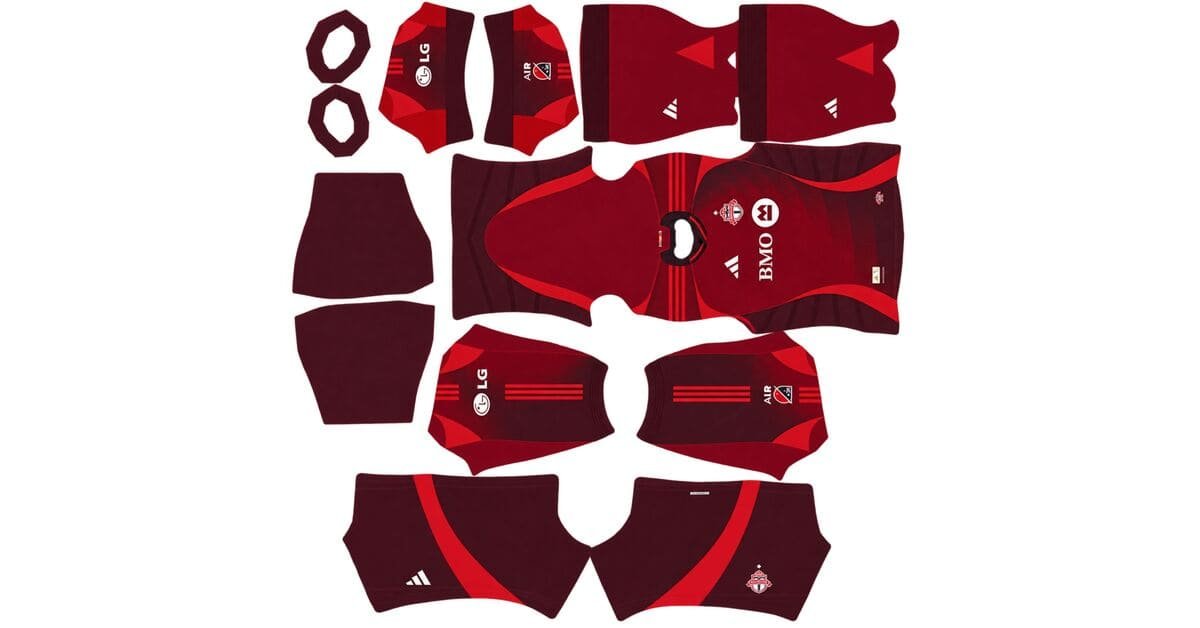
A Toronto FC DLS kits URL is a direct link to a 512×512 PNG TFC shirt that you can paste into Dream League Soccer. All four kit slots are listed below, and every file has been loaded into the game before being added to this page.
Toronto FC Logo
Official Logo 512×512 (2026/27)
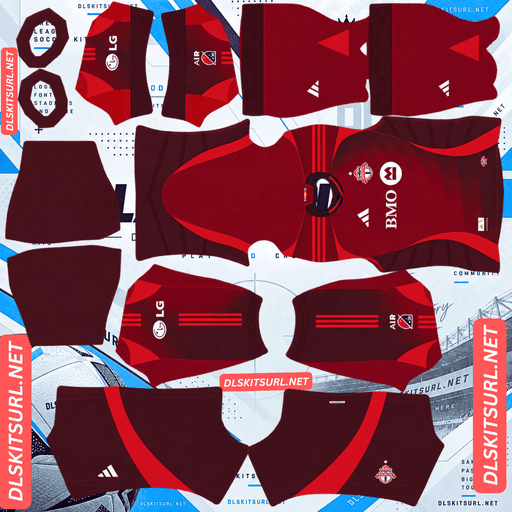
Toronto FC Home Kit
Home Kit 512×512 (2026/27)
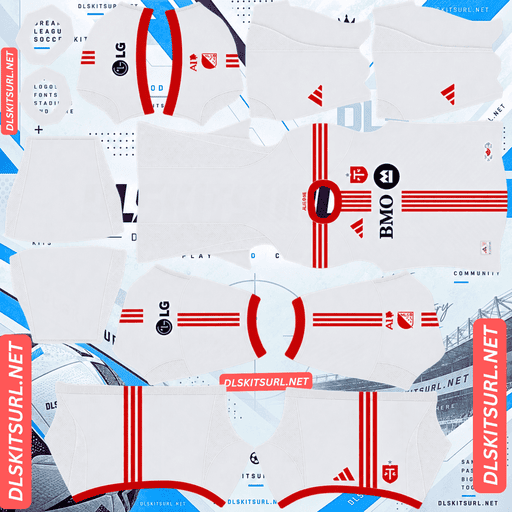
Toronto FC Away Kit
Away Kit 512×512 (2026/27)
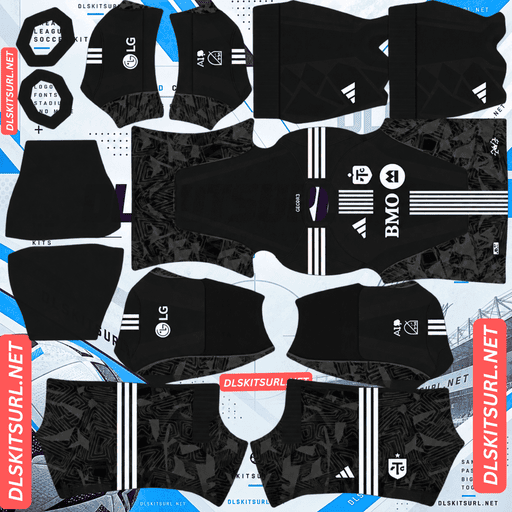
Toronto FC GK Home Kit
GK Home Kit 512×512 (2026/27)
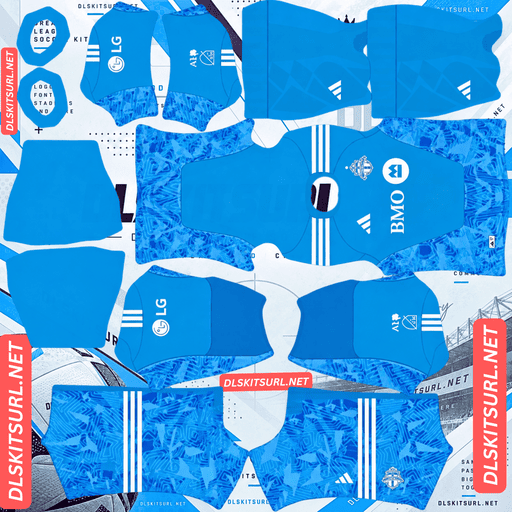
Toronto FC GK Away Kit
GK Away Kit 512×512 (2026/27)
Toronto is one of the clearest examples of why you should not judge a kit by the year in its filename. Both current shirts are designed to last two seasons, even though they were released in different years. That means a 2025 home file and a 2026 away file can both be correct.
Both Toronto FC kits cover two seasons
Adidas gives each MLS club one new kit per year rather than replacing both shirts every season. The other design carries over.
Toronto takes this a step further because both of its current kits have an official two-season lifespan.
Kit
Name
Seasons covered
Home
The Club Kit
2025 and 2026
Away
Winter Armour
2026 and 2027
So the home shirt is a 2025 release that remains current in 2026, while the Winter Armour away shirt is a 2026 release that stays current through 2027.
Why the year on the filename is misleading
For most clubs, checking the release year is a useful way to identify an outdated kit. Toronto is different because both of its overlapping two-season cycles are still active.
Instead of relying on the filename, look at the actual design:
Home: The Club Kit features a red gradient made from different shades of red, representing the club and Toronto’s diversity.
Away: Winter Armour features the phrase “All For One” embedded in the number 20 on the jocktag.
MLS also follows a calendar-year season, so its kits are labelled 2026 rather than 2026/27. That is another reason a filename alone can be misleading.
The Winter Armour away kit
Toronto unveiled the Winter Armour on 11 February 2026 as its Community Kit. The design marks the club’s twentieth MLS season and pays tribute to the soccer culture that continues through Canada’s winter.
Its jocktag includes the club motto “All For One” embedded in the number 20, while the shirt made its debut at BMO Field on 21 March.
Why the twentieth-season jocktag disappears in DLS
The jocktag sits at the bottom hem of the shirt, which is one of the least visible areas on the DLS player model.
There are two reasons the detail is difficult to preserve. First, the game renders the lower hem at a size where small text and numbers cannot remain clear. Second, the hem meets the shorts, so part of the design may be covered depending on the camera angle.
Do not expect the number 20 or the anniversary message to be visible. The detail sits in an area that DLS barely shows.
Other kits have similar problems this season. Corinthians’ collar inscription, Millonarios’ anniversary line, Santos’ hem tag and Atlanta United’s back-neck tag all use details placed in difficult-to-see areas.
The Club Kit home shirt uses a red gradient
Toronto’s home shirt is called The Club Kit. Its main design feature is a gradient that moves through different shades of red.
Gradients are among the most file-dependent details in DLS. They need enough pixels to preserve the small colour changes that create a smooth transition. If the image is too small or heavily compressed, the fade can break into visible bands.
Why a red-on-red gradient is especially difficult
Not all gradients behave the same way when converted into a small kit image.
A gradient that moves between two noticeably different colours has a wider range to work with. Australia’s coral-to-green design, Seattle’s paintbrush fade and CF Montréal’s blue-to-white gradient can still show a change in colour, even if the transition becomes uneven.
Toronto’s gradient is more delicate because it moves between different shades of the same colour. The red tones are much closer together, so compression can merge them before you notice obvious banding.
The result may simply look like a plain red shirt.
Open the home file at full size and inspect the body of the shirt. If you can see a gradual change between the red shades, the file is preserving the gradient. If the entire shirt looks like one flat red, the effect has probably been lost.
This is why a genuine, good-quality 512×512 file matters so much for Toronto’s home kit.
Which Toronto FC kit details survive best in DLS?
Kit
Design feature
DLS result
Home
Red-on-red gradient
Needs a genuine 512×512 file
Away
Winter Armour design
Shirt remains recognisable; jocktag is lost
The home gradient needs the most attention when choosing a file. The away shirt is less dependent on tiny details, since the jocktag is not expected to appear in the game anyway.
Watch for Toronto’s alternative crest
Toronto has used a secondary club mark on a recent away shirt, so this is worth checking if you are building an older kit collection.
The 2024 away kit, known as the GTA Kit and worn through 2025, featured TFC’s secondary mark instead of the standard club crest.
Dream League Soccer displays one imported crest regardless of which shirt your team wears. If you are recreating an older Toronto season, check which badge originally appeared on that particular shirt.
Santos, Corinthians, Strasbourg, Lyon, Internacional and CF Montréal also use alternative crests on certain kits this season.
Best number colours for Toronto FC kits
Dream League Soccer takes number colours from two small swatches in the kit template, not directly from your imported image. One controls the shirt numbers and the other controls the shorts.
Home kit: Choose white. It remains clear against the different shades of red used in the gradient. Avoid another shade of red because it can blend into parts of the shirt, especially across the back.
Away kit: Choose a colour that contrasts with whichever shade dominates the upper back, where DLS places the shirt numbers.
Set the shirt and shorts number colours separately.
How visible are Toronto FC kits on the pitch?
Red is one of the strongest colours for visibility in Dream League Soccer.
Players appear relatively small during matches, so the distance between the shirt colour and the pitch matters. Red sits close to the opposite side of the colour spectrum from green, giving Toronto’s home shirt a strong visual separation from the grass.
Even if the red gradient loses some of its detail, the shirt remains easy to follow during gameplay.
In fact, a flat, strong red may be slightly easier to track than a design that moves through several lighter shades. Losing the gradient affects the appearance more than the kit’s visibility.
How to identify a current Toronto FC kit file
Use these four checks before importing a Toronto shirt:
Adidas branding and BMO sponsorship: The shirt should feature Adidas branding and BMO on the chest.
Home design: Look for The Club Kit’s red gradient. A 2025-labelled home file is correct for 2026.
Away design: Look for the Winter Armour shirt, which remains current through 2027.
Crest: Check whether the shirt uses the standard Toronto crest or the secondary TFC mark.
The most important thing is to compare the design rather than relying only on the year in the filename.
How to use a Toronto FC DLS kits URL
Use the copy button on the kit card to get the direct image link. Copying the address from your browser’s address bar usually gives you the webpage instead of the actual PNG file.
Follow these steps to import your shirt:
Open Dream League Soccer.
Tap My Club.
Select Customise.
Open the Kit section, not Logo. They are separate options.
Choose the slot you want to replace.
Press and hold the URL field, then select Paste.
Tap Confirm to import the shirt. Older versions may show Download instead.
Adidas released Toronto’s home and away kits, so the third kit slot is available. Toronto’s 2025 third shirt is an interesting option: a School Bus Yellow design featuring a graphic of dripping maple syrup and Niagara Falls.
You can also use any other working 512×512 kit URL, regardless of its original release year.
The first custom kit requires a one-time gem unlock. After that, changing your imported kits does not cost additional gems.
Test the Toronto kit URL before importing
Open the copied URL in your browser before using it in DLS. The shirt should appear on its own, and the address should end in .png.
If the link opens a webpage with headings, buttons or other content surrounding the image, it is a viewer page rather than a direct image link. The game cannot import that type of webpage.
For Toronto’s home shirt, checking the actual image dimensions is especially important. The red-on-red gradient needs enough pixels to preserve the subtle differences between shades.
Why do Toronto FC kit URLs stop working?
There are three common reasons a kit URL can stop working, even if it was available when first published.
Free image hosts delete old uploads. Some services automatically remove files that have not been accessed for months or years. The URL may still look valid, but the image is no longer available.
Hotlink protection blocks requests from DLS. An image host may allow the picture to open in your browser but refuse requests from another application. This is why a link can work when you click it but fail when you paste it into the game.
The preview and the copied link point to different files. Some websites display a thumbnail stored on their own server while providing a separate URL for the actual image. The preview may continue working even after the linked file has disappeared.
For this collection, the shirt you see and the URL you copy point to the same file on the same server.
The Toronto FC badge
You can import the club crest during the same session. Follow the same process, but select Logo instead of Kit.
Toronto’s standard crest is built around a red and grey maple leaf. Its bold, self-contained design makes it easy to recognise at the small size used beside the score in DLS.
Remember that Dream League Soccer crops imported badges into a circle. Choose a file with enough clear space around the entire design rather than one trimmed tightly against the artwork.
Also consider which shirt you are recreating. Toronto has used a secondary TFC mark on a recent away kit, so decide whether the standard crest or alternative mark is the better match for your collection.
How to keep your Toronto FC kits safe
Custom kits are stored on your device rather than permanently attached to your account. A normal game update usually keeps them, but reinstalling DLS or changing phones can mean losing your imported shirts and badge.
Toronto has an advantage here: both current kits have two-season lifespans. A good home file covers 2025 and 2026, while the Winter Armour away remains current through 2027.
Before importing the collection, save all four kit URLs in a notes app. Keep the badge link there too, so you can restore everything if you reinstall the game or move to another device.
FAQ FOR RANK MATH
What is a Toronto FC DLS kits URL?
A Toronto FC DLS kits URL is a direct link to a 512×512 PNG TFC shirt that you can paste into Dream League Soccer’s Kit section. A working direct image link ends in .png.
Why can a 2025 Toronto FC kit file still be current?
Toronto’s home kit, The Club Kit, covers the 2025 and 2026 seasons. Its Winter Armour away kit covers 2026 and 2027. Since both designs have two-season lifespans, a 2025 home file and a 2026 away file can both be correct.
What is the Winter Armour kit?
Winter Armour is Toronto FC’s away kit for 2026 and 2027. It celebrates the club’s twentieth MLS season and pays tribute to the soccer culture that continues through Canada’s winter. Its jocktag features the phrase “All For One” embedded in the number 20.
Will the twentieth-season jocktag appear in DLS?
No. The jocktag sits at the lower hem, where small text and numbers are difficult to render. The shorts can also cover part of that area on the player model.
Why does my Toronto FC home kit look plain red?
The Club Kit uses a gradient that moves between different shades of red. Because those shades are close together, compression can merge them into one flat colour. A lower-quality image may therefore lose the gradient completely.
Does losing the red gradient affect visibility in DLS?
Not significantly. Toronto’s strong red base remains easy to see against the green pitch. A flat red shirt may even be slightly easier to track at match distance than one with several lighter shades.
What number colour should I use on the Toronto FC home kit?
White is the best choice. It provides clear contrast across the different shades of red in the home shirt. Avoid using another red shade because it may blend into the back of the kit.
Has Toronto FC used an alternative crest?
Yes. The 2024 away kit, known as the GTA Kit and worn through 2025, featured TFC’s secondary mark instead of the standard club crest.