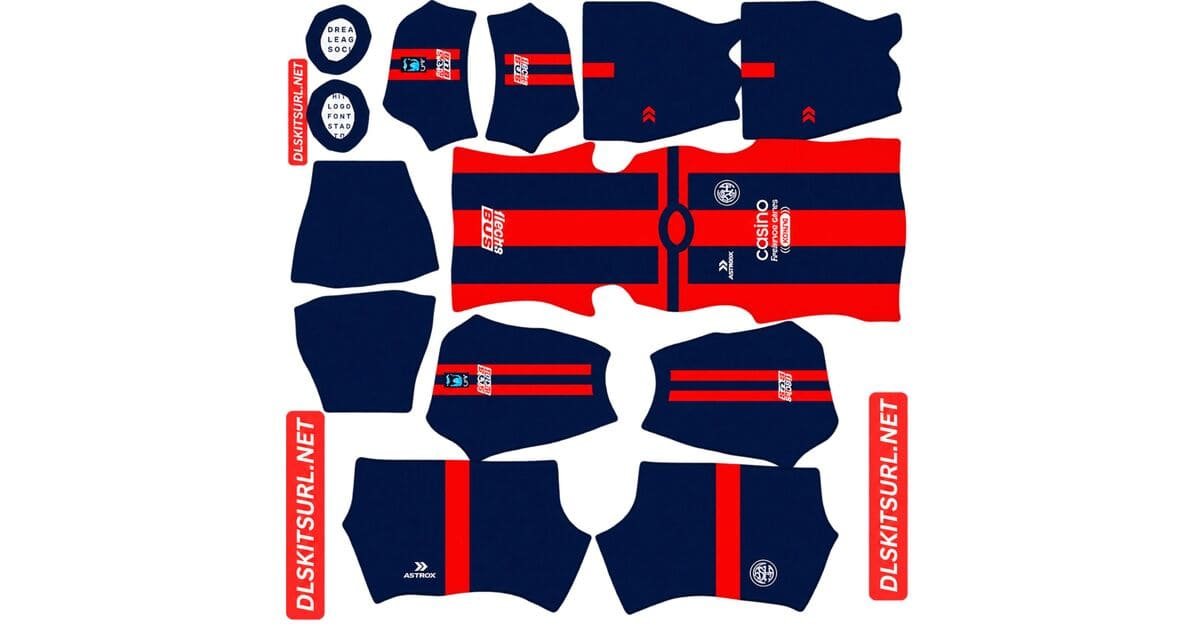
A San Lorenzo DLS kits URL is a direct link to a 512×512 PNG Ciclón shirt that you can import into Dream League Soccer. All four kit slots are listed below, and every file has been loaded into the game before being added to this page.
San Lorenzo Logo
Official Logo 512×512 (2026/27)
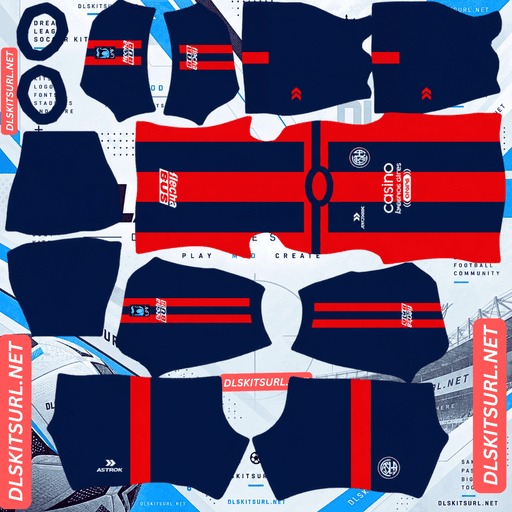
San Lorenzo Home Kit
Home Kit 512×512 (2026/27)
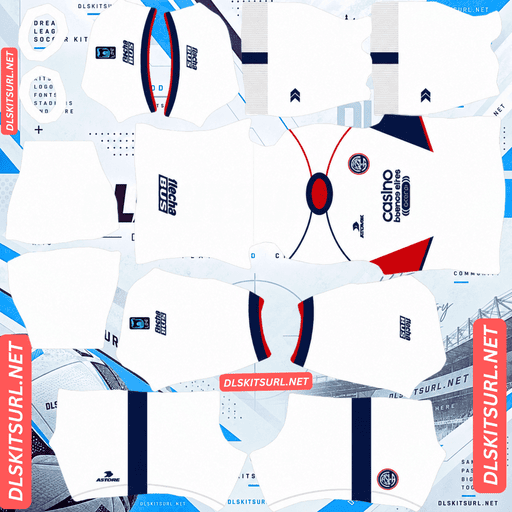
San Lorenzo Away Kit
Away Kit 512×512 (2026/27)
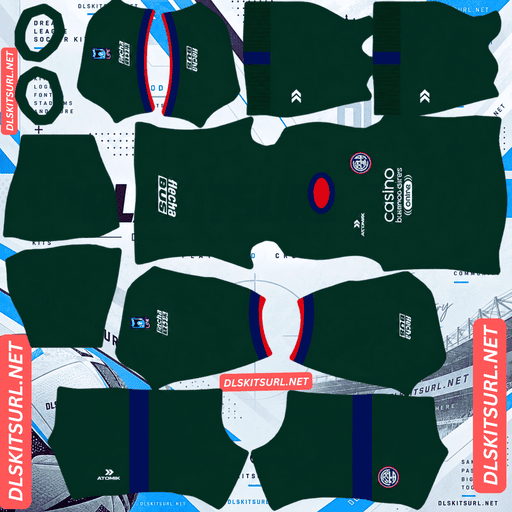
San Lorenzo GK Home Kit
GK Home Kit 512×512 (2026/27)
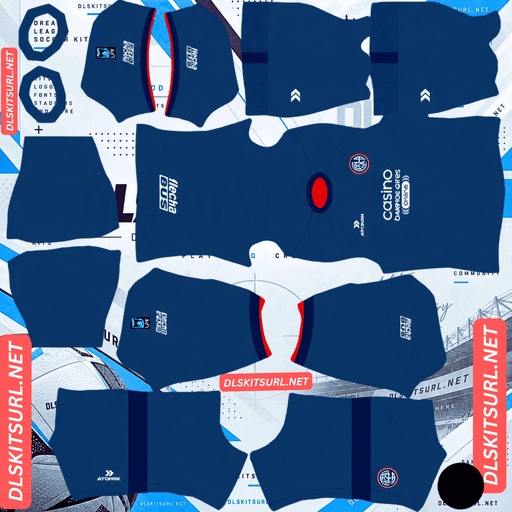
San Lorenzo GK Away Kit
GK Away Kit 512×512 (2026/27)
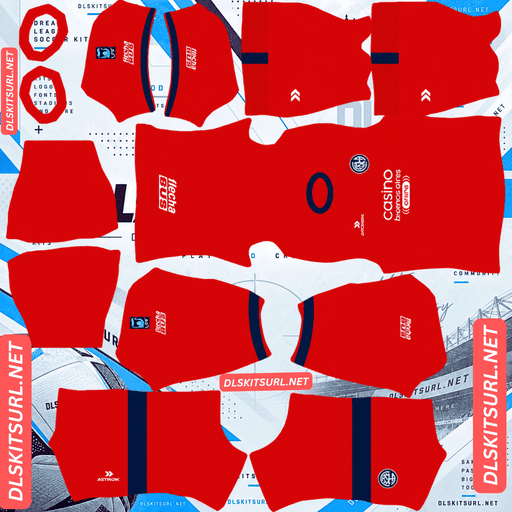
San Lorenzo GK Third Kit
GK Third Kit 512×512 (2026/27)
Two things changed at San Lorenzo in 2026: the kits and the club crest. The crest update is particularly important because it was introduced partway through the year, meaning older and newer badge files may look slightly different.
San Lorenzo changed its crest in April
During 2026, San Lorenzo introduced a modernised version of its club crest, making subtle refinements to the traditional shield.
Why the crest version matters in DLS
Dream League Soccer displays your imported badge on the chest, regardless of which kit your team is wearing. That means the crest you choose needs to match the version used on your shirt.
Badge files from before and after the update are not identical:
Files labelled 2025 or earlier: These should have the older crest.
Files labelled 2026: These could show either version, depending on when the image was created.
Open the badge at full size and inspect the shield before importing it. The changes are not dramatic, which makes it easy to mistake an older version for the updated one.
NYCFC has faced a similar situation this season: its crest was revealed in 2024 but did not reach the shirts until 2026.
The home kit pays tribute to Boedo
Launched in March 2026 at the corner of San Juan and Boedo, the club’s historic home, San Lorenzo’s new home shirt keeps its traditional azulgrana vertical stripes.
The design also introduces details inspired by fileteado porteño, the decorative painting style associated with southern Buenos Aires. Its ornamental lettering and flourishes are familiar sights on buses, signs and shopfronts across the city.
The stripes are safe; the ornamentation needs checking
Vertical stripes are among the easiest patterns to reproduce in a DLS kit. They need to line up in one main place along the centre of the body, whereas horizontal bands have several positions that must match across the template.
The red and blue also provide strong contrast, and the stripes are wide enough to remain visible at 512×512.
Even if some smaller details are lost, the shirt should still look unmistakably like San Lorenzo.
The more difficult part is the fileteado. Its decorative curls, flourishes and fine lines are much more vulnerable to image compression.
Open the home file at full size and inspect how the ornamentation has been reproduced:
Contrasting colours: The details should remain visible, at least in part.
Tonal decoration: Details that blend into the surrounding stripes will fade more easily.
Woven or embossed decoration: This type of surface texture will not appear in a flat kit image.
The most likely result is simplified ornamentation rather than a complete loss of the design. The traditional stripes still give the shirt its identity.
The third kit has a tonal jacquard design
San Lorenzo’s third kit pays tribute to Los Forzosos de Almagro, the club’s 1907 founding team, who played in burgundy before San Lorenzo adopted its familiar blue and red colours.
The shirt has a maroon base with a tonal checkered jacquard pattern, a dark blue polo collar, and contrasting panels. It also features a retro CASLA roundel carrying the inscription “Los Forzosos de Almagro 1907”, along with a special rubber commemorative emblem on the upper back.
The jacquard pattern will disappear
A jacquard pattern is woven into the fabric rather than printed as a separate colour. It is a surface texture, not a distinct graphic.
A flat 512×512 image cannot reproduce that physical texture. There is no surface depth for the game to display, and the pattern is tonal maroon on maroon, leaving very little colour contrast even in the original design.
The practical result is a mostly plain maroon shirt. No increase in image quality can restore a woven texture that is not represented in the image itself.
The same limitation affects Santa Fe’s lion’s-mane texture, Santos’ matte-and-gloss weave, Botafogo’s woven arabesque and Torino’s embossed third kit.
The upper-back emblem is unlikely to show
The special rubber commemorative emblem sits on the upper back, in the same general area where Dream League Soccer displays squad numbers.
At the game’s small rendering size, an applied detail like this is unlikely to remain visible. Expect that part of the shirt to be missing from your imported version.
The roundel and collar are the details to look for
The retro CASLA roundel is a defined graphic in a contrasting colour, while the dark blue polo collar and panels are structural parts of the design rather than fabric textures.
These are the details that should survive and make the shirt recognisable. They also provide useful quality checks: inspect the collar edges and placket to see whether they look sharp or blurred.
The roundel also creates a badge choice. If it replaces the standard crest on the real third kit, a matching roundel badge would be the more accurate option.
The fourth kit celebrates the supporters
San Lorenzo released another shirt in October 2026, built around the concept “la camiseta de la gente”, meaning the people’s shirt.
This retro-inspired design celebrates the club’s supporters and made its debut against Deportivo Riestra.
That gives San Lorenzo four outfield designs for Dream League Soccer’s three available outfield slots.
My recommendation is to keep the home and away shirts, then choose between the two historical designs: the 1907 tribute third and the supporters’ fourth. Compare the files and use whichever one has the better image quality.
You can always rotate the other shirt in later because kit changes are free after the first unlock.
One point worth considering is that the retro fourth kit may reproduce more accurately than the jacquard third. Older football designs were generally built around flat colours and clear shapes, rather than woven textures.
Which San Lorenzo kit reproduces best?
Home: The traditional azulgrana stripes should survive well, although the fine fileteado ornamentation may become simplified.
Away: Compare the available file against the kit card to judge its design and image quality.
Third: The maroon jacquard pattern will disappear, but the contrasting roundel, collar and panels should remain.
Fourth: The retro supporters’ design is a promising option, particularly if its main details use flat colours and bold shapes.
How visible are San Lorenzo’s kits on the pitch?
Dream League Soccer displays players at a small size during matches, so the distance between the shirt colours and the green pitch makes a difference.
Red contrasts strongly with green, while navy also stands out, even though it is much darker.
Together, the two colours give the home shirt strong internal contrast. Its alternating red and blue stripes make the players easy to distinguish at match distance, helping it stand out among Argentine Primera kits.
The maroon third is a less convincing case. It is a deep, muted colour that appears as a darker shape on the pitch. Once the tonal jacquard disappears, there is little left to break up the shirt’s surface. The dark blue collar and contrasting panels therefore become its most important visible details.
What number colours work on San Lorenzo’s kits?
Dream League Soccer uses two small colour swatches in the kit template to control numbers. It does not automatically take the number colour from your imported shirt image.
One swatch controls shirt numbers, while the other controls shorts numbers.
Striped home: Use white. Red and blue both blend into parts of the shirt, while white stands out against both colours. It also matches San Lorenzo’s traditional white shorts.
Third: White is the clearest option against the deep maroon base. Blue is another possibility if it provides enough contrast with the upper back.
Away and fourth: Choose a colour that contrasts with the dominant colour on the upper back.
Set the shirt and shorts swatches separately. San Lorenzo traditionally pairs its striped shirts with white shorts, so keeping that combination is a good starting point.
How to tell if a San Lorenzo kit file is current
Four details can help you identify the correct 2026 designs:
Atomik branding: Atomik is the current supplier. Nike supplied San Lorenzo through 2024, so a Nike swoosh points to a 2024 design or earlier.
The updated crest: Check whether the badge uses the modernised shield introduced during 2026.
Fileteado on the home shirt: The current home design combines traditional blue-and-red stripes with decorative ornamentation.
The two retro designs: Make sure you can tell the maroon 1907 tribute third apart from the supporters’ fourth kit.
The crest deserves particular attention because the update happened during the year. A file labelled 2026 does not automatically guarantee that it uses the newer version.
How to use a San Lorenzo DLS kits URL
Use the copy button on the kit card rather than copying the address from your browser bar. The browser address usually points to the webpage, not directly to the shirt image.
Open Dream League Soccer and follow these steps:
Go to My Club.
Select Customise.
Open Kit, not Logo. The badge is managed separately.
Choose the slot you want to replace.
Press and hold the URL field, then tap Paste.
Select Confirm. Some older versions of the game use the label Download.
Make sure you select the correct slot before pasting, because the currently selected kit is the one that gets replaced.
Three outfield designs can fill your home, away and third slots, with the goalkeeper kit handled separately. Since San Lorenzo has four outfield shirts, make a note of which retro design you leave out so you can bring it back later.
The first custom kit requires a one-time gem unlock. After that, changing kits costs nothing.
Test the kit link before importing it
Open the URL in your browser before using it in the game. A working direct image link should display the shirt by itself, with the address ending in .png.
If you see a webpage with headers, buttons or other content surrounding the picture, it is a viewer page rather than a direct image link. Dream League Soccer cannot import that type of URL.
The striped home shirt is not the best design for judging image quality. Wide stripes can still look convincing in a relatively poor image.
Instead, inspect the fileteado decoration and the collar. Also check the actual image dimensions reported by your browser to make sure you have the full-size file.
Why do San Lorenzo kit URLs stop working?
There are three common reasons a kit URL can fail, and only one is immediately obvious.
Free image hosts delete old uploads
Free image-hosting services sometimes remove files that have not been accessed for months or years. The original URL may still look valid, but the image itself is no longer available.
The fourth kit carries a higher risk because a late-season release usually attracts fewer uploads than a regular home or away shirt.
Hotlink protection blocks the game
Some image hosts enable hotlink protection, which prevents other websites and apps from loading images directly from their servers.
This can explain why a URL opens in your browser but fails when you paste it into Dream League Soccer. The browser request is allowed, while the game’s request is refused.
The preview and the copied URL are different files
Some websites display a thumbnail stored on their own server but provide a separate URL for the full image.
The preview can continue to work even after the actual image link has stopped functioning. That is why checking the copied URL itself is important.
For the files listed here, the image shown in the kit card and the link you copy point to the same file on the same server.
The San Lorenzo badge
You can import the crest during the same customisation session. Open the same menu, but select Logo instead of Kit.
First, check which version of the badge you have. San Lorenzo modernised its shield during 2026, so older and newer files may show slightly different designs.
The club’s crest is a shield carrying the CASLA monogram in blue and red.
Dream League Soccer crops imported badges into a circle. Since a shield narrows towards its base, choose an image with enough empty space around the complete design rather than one cropped tightly to the artwork.
The CASLA monogram is well suited to the game because it is a bold, recognisable design that remains clear at the small size used beside the score.
If you are using the 1907 tribute third kit, also check whether a matching CASLA roundel is available.
Keeping your San Lorenzo kits
Custom kits are saved on your device rather than attached to your account. Updating the game usually keeps them, but reinstalling Dream League Soccer or moving to a new phone can mean losing your imported shirts and badge.
San Lorenzo takes a little more preparation than most clubs because there are four outfield designs, two crest versions and two retro shirts to consider.
Before importing anything, save all four kit URLs in a notes app. Keep the badge link too, and make a note of whether you chose the older or modernised crest. That will make it much easier to restore your setup or switch between the retro designs later.
FAQ FOR RANK MATH
What is a San Lorenzo DLS kits URL?
A San Lorenzo DLS kits URL is a direct link to a 512×512 PNG Ciclón shirt that you can paste into Dream League Soccer’s kit screen. A working direct image link ends in .png.
Did San Lorenzo change its club crest in 2026?
Yes. San Lorenzo introduced a modernised version of its shield during 2026. The update is subtle, so badge files made before and after the change may look slightly different.
What is the fileteado design on San Lorenzo’s home kit?
Fileteado porteño is an ornamental painting style associated with southern Buenos Aires. It is commonly seen on buses, signs and shopfronts. San Lorenzo’s 2026 home shirt uses this decorative style over its traditional azulgrana stripes as a tribute to Boedo.
Will the fileteado survive in Dream League Soccer?
Some of it may survive, particularly if the decoration uses contrasting colours. Fine ornamental lines are vulnerable to compression, while tonal or woven details are much harder to reproduce. The traditional red-and-blue stripes should remain clear even if the decoration becomes simplified.
Why does my San Lorenzo third kit look plain maroon?
The third shirt uses a tonal checkered jacquard pattern woven into the fabric. Since the pattern is maroon on maroon and depends on surface texture rather than contrasting colours, it cannot be reproduced in a flat 512×512 kit image.
Which details survive on the San Lorenzo third kit?
The contrasting retro CASLA roundel, dark blue polo collar and panels should remain visible. These are defined shapes and colours rather than woven textures, making them more suitable for a DLS kit image.
How many kits does San Lorenzo have for 2026?
San Lorenzo has four outfield designs: the striped home, an away kit, the maroon 1907 tribute third and a retro-inspired supporters’ fourth kit released in October 2026. Dream League Soccer provides three outfield slots.
Who makes San Lorenzo’s kits?
Atomik is San Lorenzo’s current kit supplier. Nike supplied the club through 2024, so a shirt carrying a Nike swoosh belongs to that period or earlier.